
Introduction
Kadena is a blockchain that aims to be more scalable, more secure, and easier to use than the other Layer 1 blockchains. To program smart contracts a new language has been developed: Pact. This language is made to be human readable, easily formally verified, and, to improve security: Turing incomplete. Turing incompleteness here means roughly that the Pact language is not able to do everything a Turing complete programming language such as Solidity or Haskell can do. This could look like a downside, however when it comes to smart contract programming the need for Turing completeness is quite rare, even when developing complex DeFi protocols.
One of the most important points of Turing incompleteness is the absence of unbounded recursion. While it is true that this considerably reduces the attack surface, some “classic” attacks cannot be completely prevented, as we will soon see with the cross-function reentrancy.
Classic Reentrancy
Reentrancy attacks are very common security issues. They can be hard for developers to spot, and it can be laborious for an auditor to review all the potential consequences. Reentrancy attacks depend on the order of execution of specific tasks a function makes before and after making an external call.
If a contract calls an untrusted external contract, a malicious actor can make it repeat this function call again and again, creating a recursive call. If the reentered function performs important tasks (like updating the balance of an account) this could have disastrous consequences.
Here is a simplified example:
Let’s call the vulnerable contract, unsafe contract, and the malicious contract, Attack contract.
- An attacker makes a call on an
unsafecontract to transfer funds to theAttackcontract. - Receiving the call, the
unsafecontract first checks to see that the attacker has the funds, then it transfers the funds to theAttackcontract. - Upon receiving the funds, the
Attackcontract executes a fallback function which calls back into an unsafe contract before it is able to update its balance, thus restarting the process.
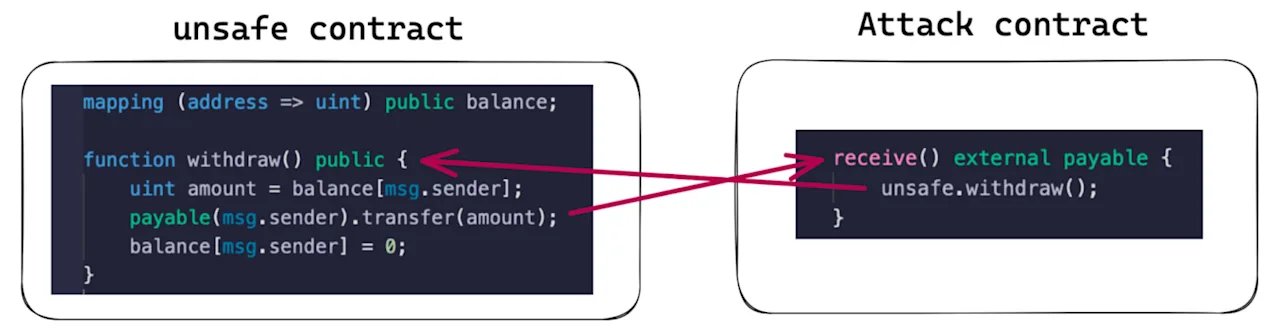
Because this kind of attack works through an unbounded recursive call, it is impossible to carry out if the language is not Turing complete.
Cross-Function Reentrancy
Cross-function reentrancy is similar to the classic reentrancy attack, except the function reentered is not the same as the one making the external call. This kind of reentrancy attack is usually harder to spot. In complex protocols, the number of possible combinations is huge and it may be impossible to manually test each potential outcome.
This leads us to our proof of concept: a simple cross-function reentrancy attack using the Pact language.
Simple Cross-Function Reentrancy in a Pact Module
As we will see in the following code snippets, the functions in the contract make an external call to another contract implementing a specific interface. This allows a designed attack contract to reenter. The capabilities in Pact are built-in functions that grant a user privilege to perform sensitive tasks. The following pieces of code are for illustrative purposes only, they are not taken from real case contracts.
The code example we will use has three parts:
- The interface:
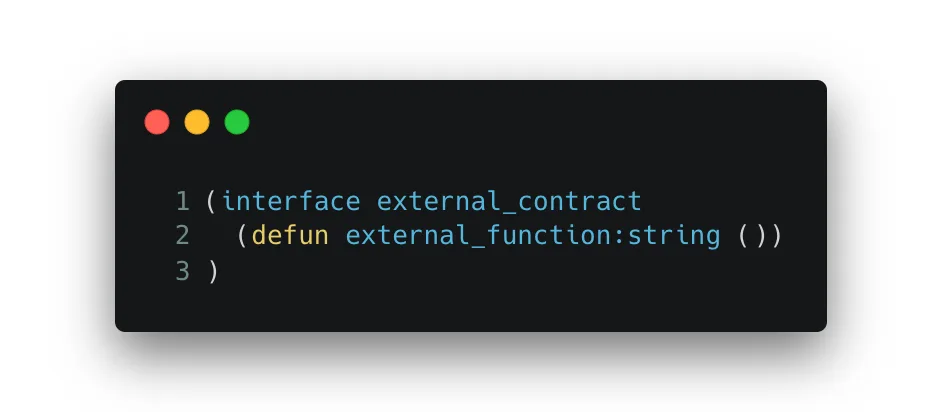
This will be used to make the main contract interact with a malicious external module.
- The main module:
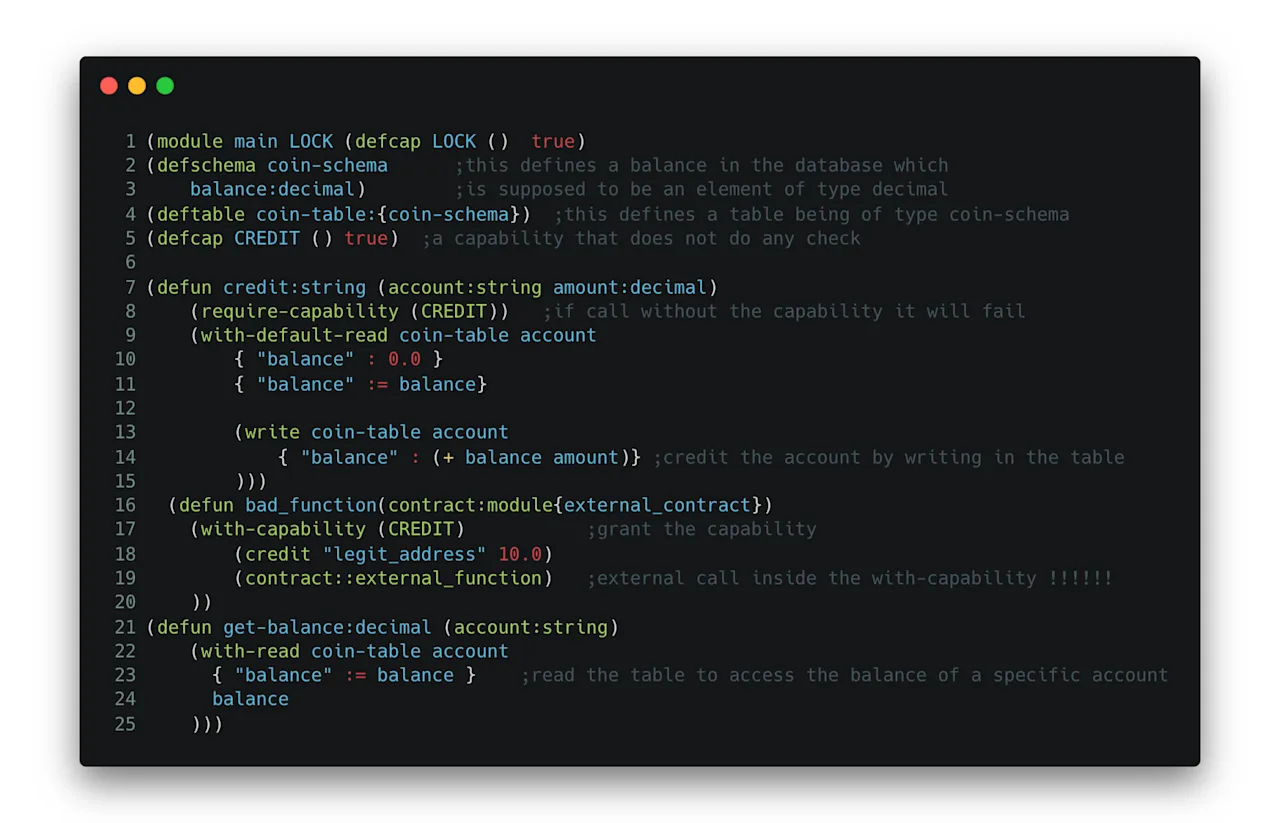
Here is the mock contract to be exploited.
First, a database is defined as a table where a string is stored in a row with an associated decimal number.
Then a capability is defined: CREDIT (which here is always true). This condition will be required by the credit function but is only granted by the bad_function inside the with_capability statement. This implies that calling credit directly would fail.
Now, the function credit is defined: it increases the balance (the decimal) of the string given as an input. It also creates the entry if the address is not already in the table.
Finally, the function bad_function increases legit_address balance but also performs a call to a contract compliant with the interface defined before, which can be provided as an input parameter.
The function get-balance allows us to read the table.
- The module used to exploit the reentrancy:
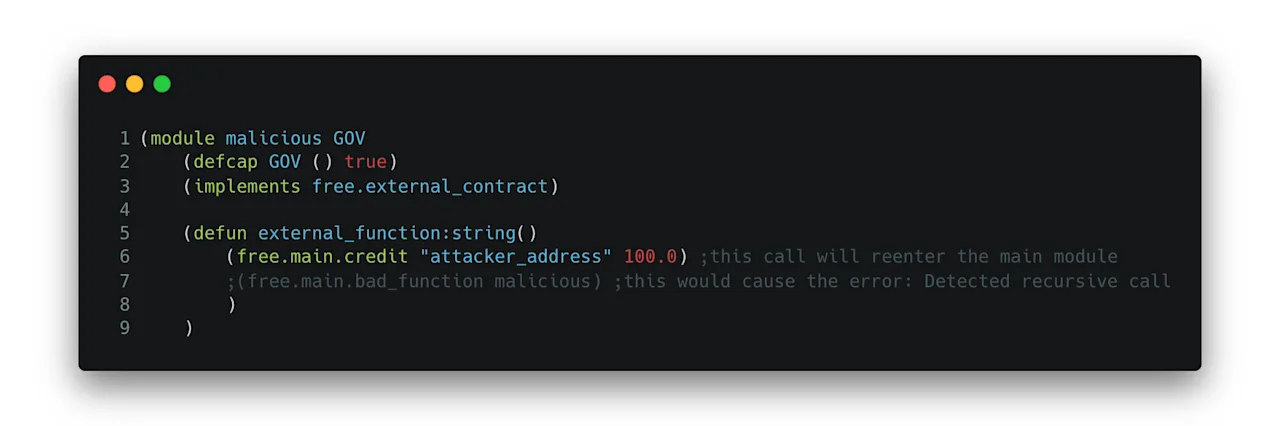
It reenters the main module to call the credit function.
The general flow is as follows:
a. bad_function is called with the attack contract as a parameter
b. The capability CREDIT is granted
c. The balance of “legit_address” is increased by 10
d. external_function from the malicious module is called: because this still has the capability CREDIT, it can reenter the contract and call directly the credit function to give “attacker_address” a balance of 100.
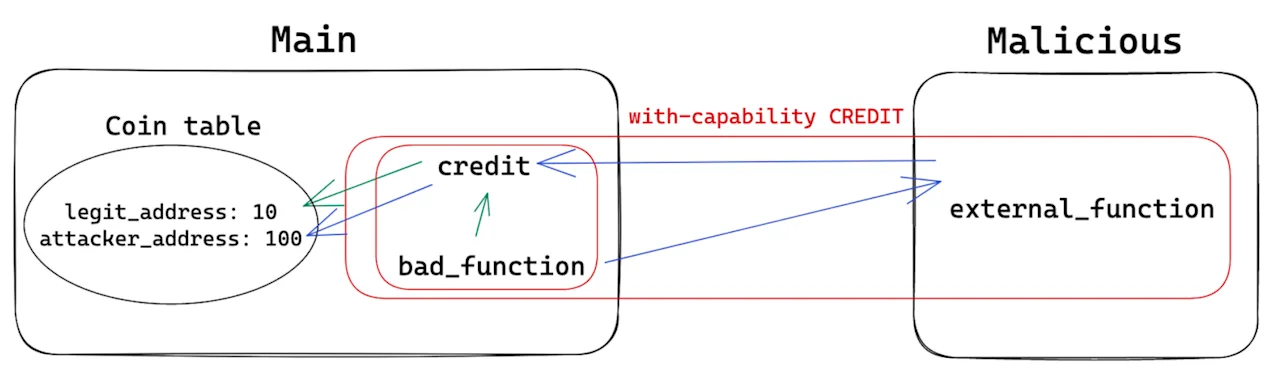
After that (get-balance “legit_address”) returns 10 and (get-balance “attacker_address”) returns 100.
The reentrancy was successful.
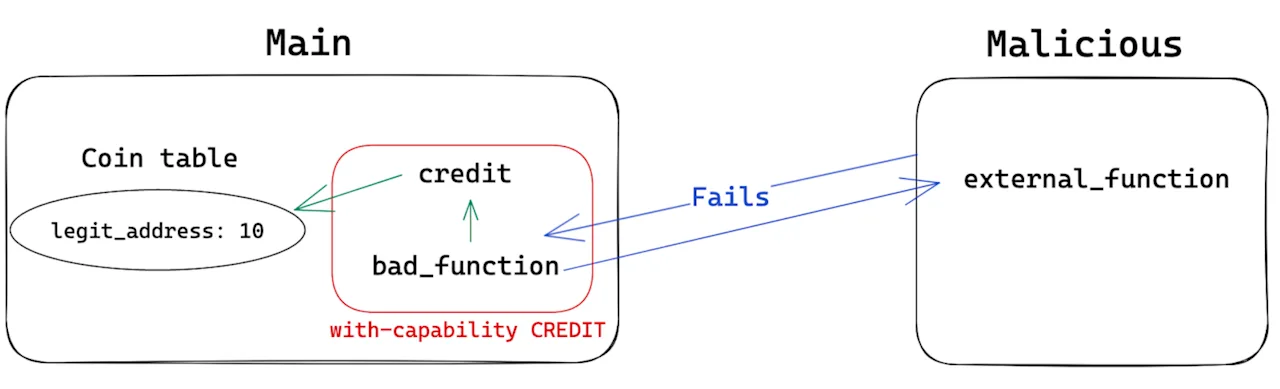
Now, what happens if instead of reentering to call credit we try to reenter to call bad_function again? Then, even if the first call to credit were successful, because the reentrancy would be in bad_function this would be a recursive call and the execution would not work.
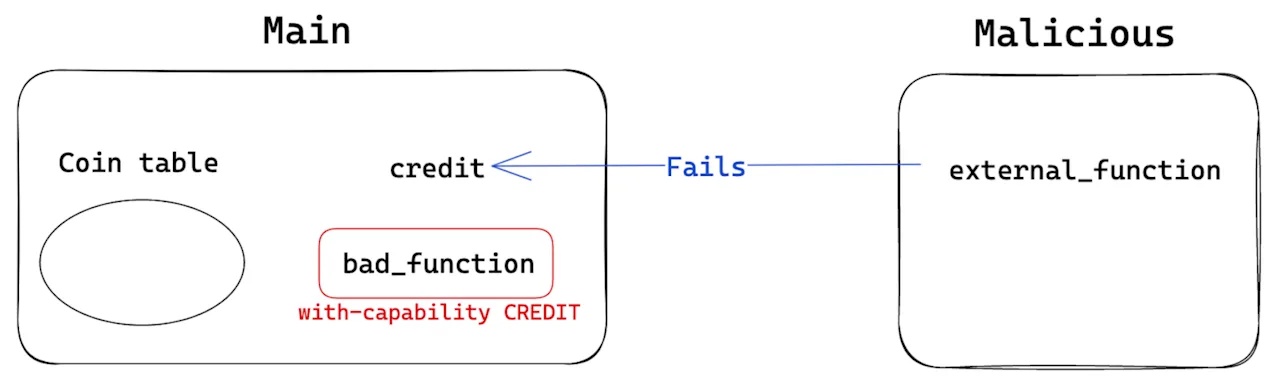
Now if instead, we try to call directly external_function, this would not work because the required capability CREDIT would not be granted.
Conclusion
By removing unbounded recursivity, Turing incompleteness can prevent some reentrancy attack vectors. However, since cross-function reentrancy can be done without a recursive call, Turing incompleteness does not prevent all such attack vectors and users should not assume that reentrancy is not a problem when interacting with this kind of language.
Reentrancy and cross-function reentrancy are very common security issues that have led to some of the most costly attacks in Web3.
Pact is a promising smart contract programming language that takes a somewhat different approach to other languages like Solidity or Haskell. Pact does not rely solely on Turing incompleteness to improve security; the language is designed to be easier to read, understand, and formally verify. However, no programming language is immune to all attack vectors. It is important for developers to be aware of the unique features of the languages they work with, and for all projects to be thoroughly audited before deployment.