Executive Summary
Stablecoin supply on TRON grew 9.2% to USD 89.2 billion, more than six times the total market’s 1.5% growth. Transfer volume rose 4.1% quarter-on-quarter as the broader market fell 28.3%, while decentralized finance (DeFi) total value locked (TVL) held flat through a market that lost more than a third of its value. This was not a broad ecosystem expansion but a settlement-share gain: TRON’s core rails held up while adjacent crypto activity weakened.
Settlement was the engine behind that divergence. USDT made up 98.5% of stablecoin supply on TRON, and the network cleared USD 4.01 trillion in H1 transfer volume, ranking third among major chains. Its stablecoin holder base grew from 87.8 million to 96.4 million addresses, the largest among major stablecoin networks, indicating that demand for high-frequency, low-cost stablecoin settlement did not cool in H1.
The second theme grew out of the first: artificial intelligence (AI). Agents need a wallet, an identity, a payment rail, and a way to execute. TRON already operates the payment rail at scale, so its H1 AI push extended the settlement business rather than departing from it, with B.AI, also known as Bank of AI, providing the clearest proof point.
Stablecoin Supply Grew While the Market Stalled
TRON DAO’s stablecoin supply reached USD 89.2 billion by June 30, representing 28.7% of the entire stablecoin market and ranking second only to Ethereum. Its 9.2% H1 growth was more than six times the broader market’s 1.5%, while Ethereum’s stablecoin supply fell 5.8%.
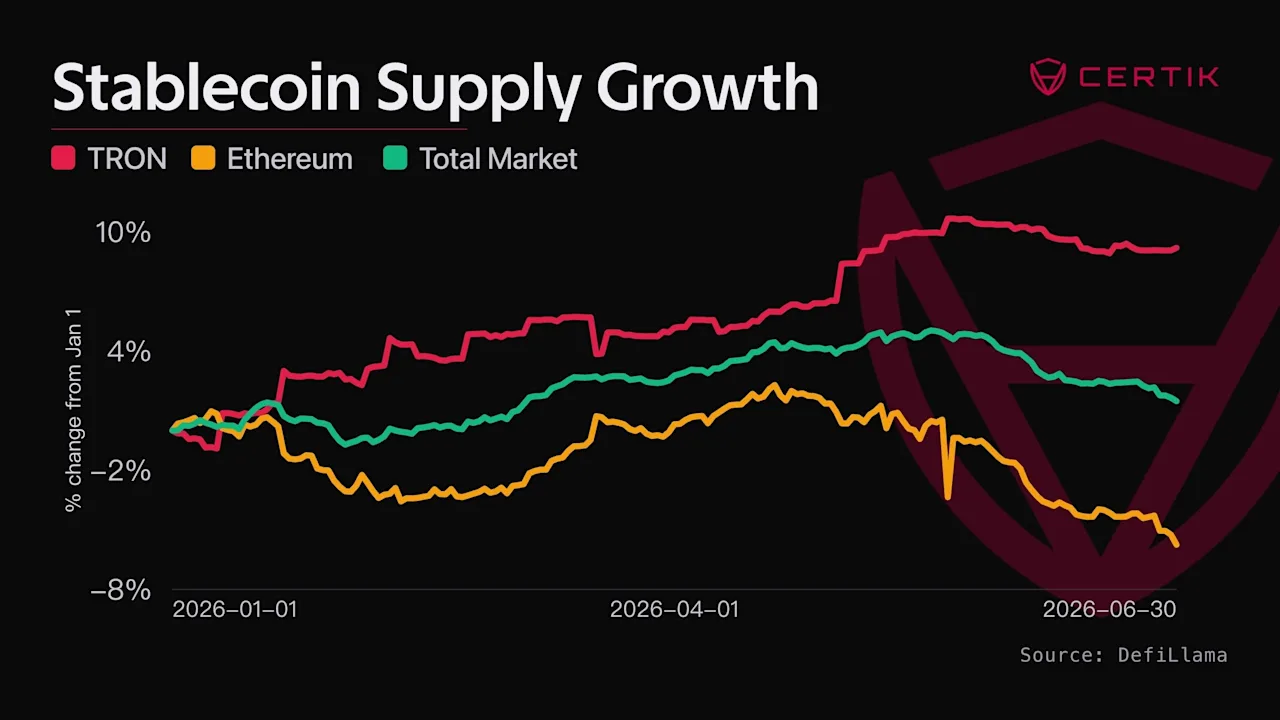
TRON added supply during a half when its largest peer lost it. That growth sits almost entirely on USDT, which rose to USD 87.9 billion and accounted for nearly all stablecoin liquidity on the network. The concentration limits asset diversity, but it also makes TRON one of the primary settlement venues for the largest stablecoin in crypto.
The holder base tells the same story. Addresses holding stablecoins on TRON grew from 87.8 million to 96.4 million, representing more than 35% of holders across major networks and the largest distribution among them.
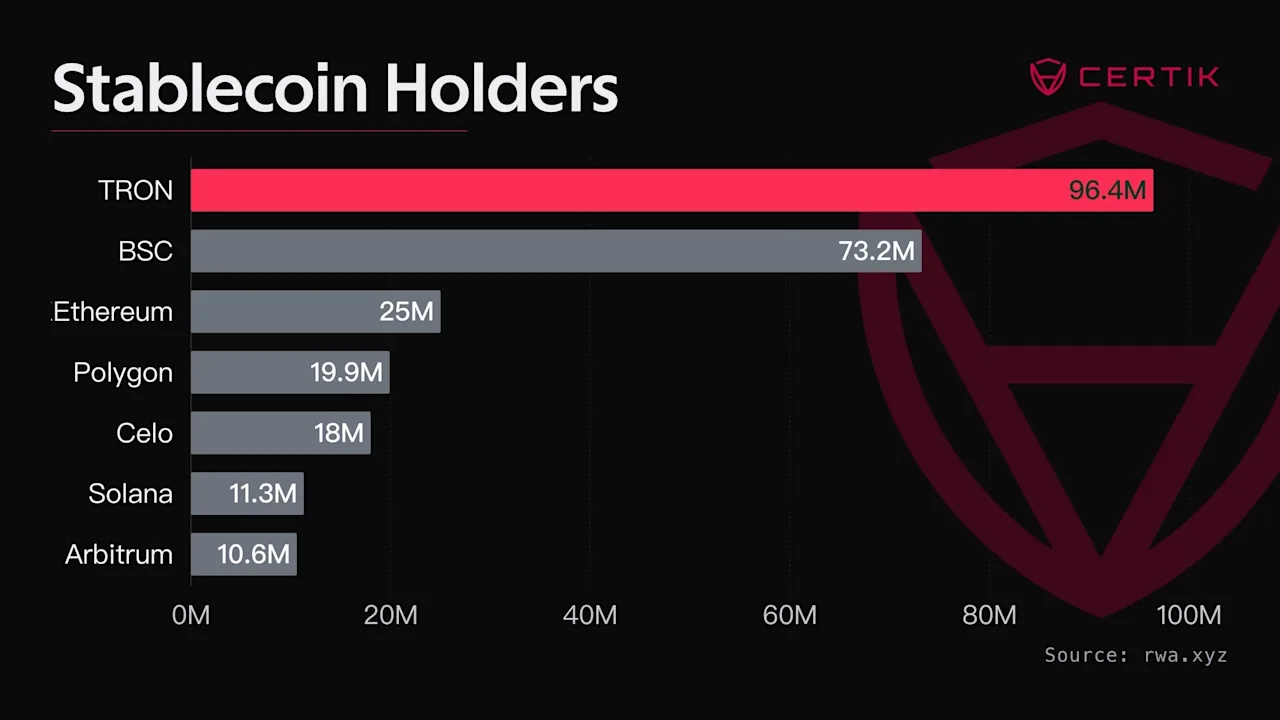
For a payments chain, that distribution base matters. Liquidity can move quickly, but a holder network of 96.4 million addresses is harder to replicate.
TRON Was the Only Top-Five Transfer Network to Rise
TRON ranked third by H1 transfer volume, clearing USD 4.01 trillion by June 30, behind Base and Ethereum and ahead of Solana and BNB Chain. The ranking is less important than the direction: among the five largest transfer networks, TRON was the only one whose Q2 transfer volume rose. It gained 4.1% over Q1 while the broader market fell 28.3%. The other four networks all dropped by at least 26%, with Ethereum and Solana both falling 26.6%, BNB Chain falling 33.8%, and Base falling 35.8%.
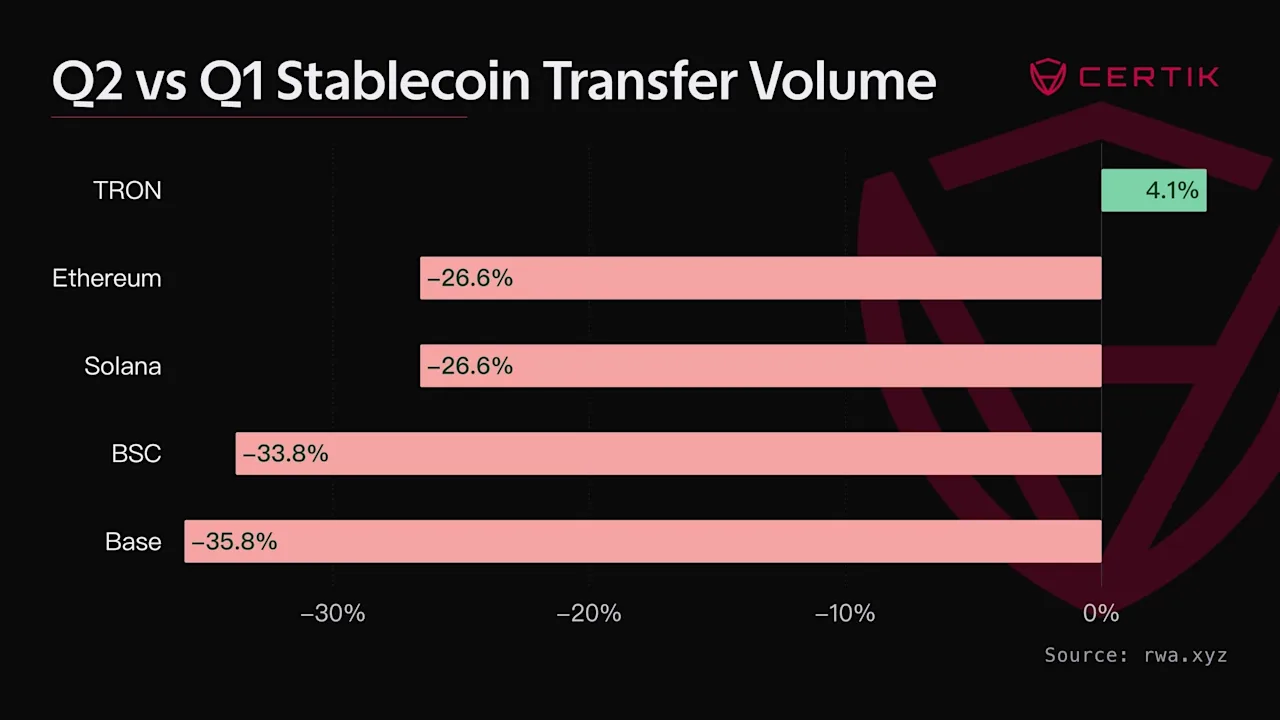
TRON gained share by holding its ground while the field retreated. Usage data points to the same payment-heavy pattern: by June 30, the network had reached 14.59 billion cumulative transactions and 390.7 million total accounts, with 4.96 million active accounts over the preceding 24 hours. TRON processed 2.04 billion transactions in H1, equivalent to approximately 11.3 million per day. Frequent stablecoin movement, rather than episodic speculation, remained the core activity base. For transfer activity, the H1 story was durability rather than acceleration, and its source was a single use case: high-frequency, low-cost stablecoin settlement.
DeFi Held Flat While the Market Lost a Third
DeFi was not TRON’s growth engine in H1, but its TVL outperformed the market by standing still. Total DeFi TVL across chains fell from USD 114.5 billion to USD 70.3 billion, a 38.6% decline in H1. TRON’s TVL moved from USD 4.40 billion to USD 4.43 billion, increasing 0.8% in a market that lost more than a third of its value.
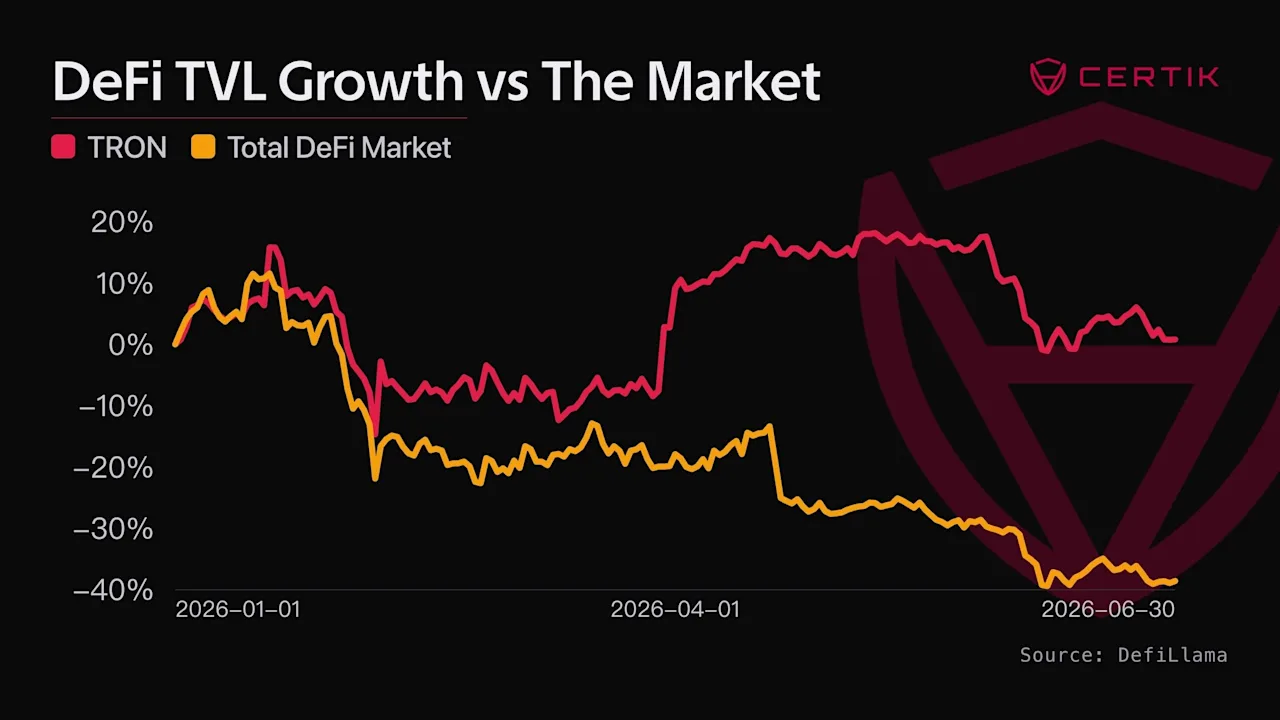
The steady headline hid an internal rotation. JustLend V1 fell from USD 3.70 billion to USD 2.94 billion, while USDD TVL expanded from USD 486 million to USD 1.30 billion and USDD supply on TRON grew from USD 536 million to USD 1.08 billion. TRON’s DeFi liquidity therefore rotated toward USDD-linked yield products.
Trading activity also softened, although less than the broader market. Total decentralized exchange (DEX) volume across chains fell from USD 916.8 billion in Q1 to USD 628.8 billion in Q2, a 31.4% decline, while TRON DEX volume decreased from USD 5.67 billion to USD 4.49 billion, down 20.8%. The weakness was in activity rather than retention: trading cooled and JustLend contracted, while USDD absorbed more liquidity.
Resource Income Showed Settlement Demand More Clearly Than DeFi Trading
TRONSCAN network resource income reached USD 1.31 billion in H1, averaging USD 7.25 million per day. Energy-related income accounted for USD 1.13 billion of that total, tracking demand for high-frequency transfers and contract execution.
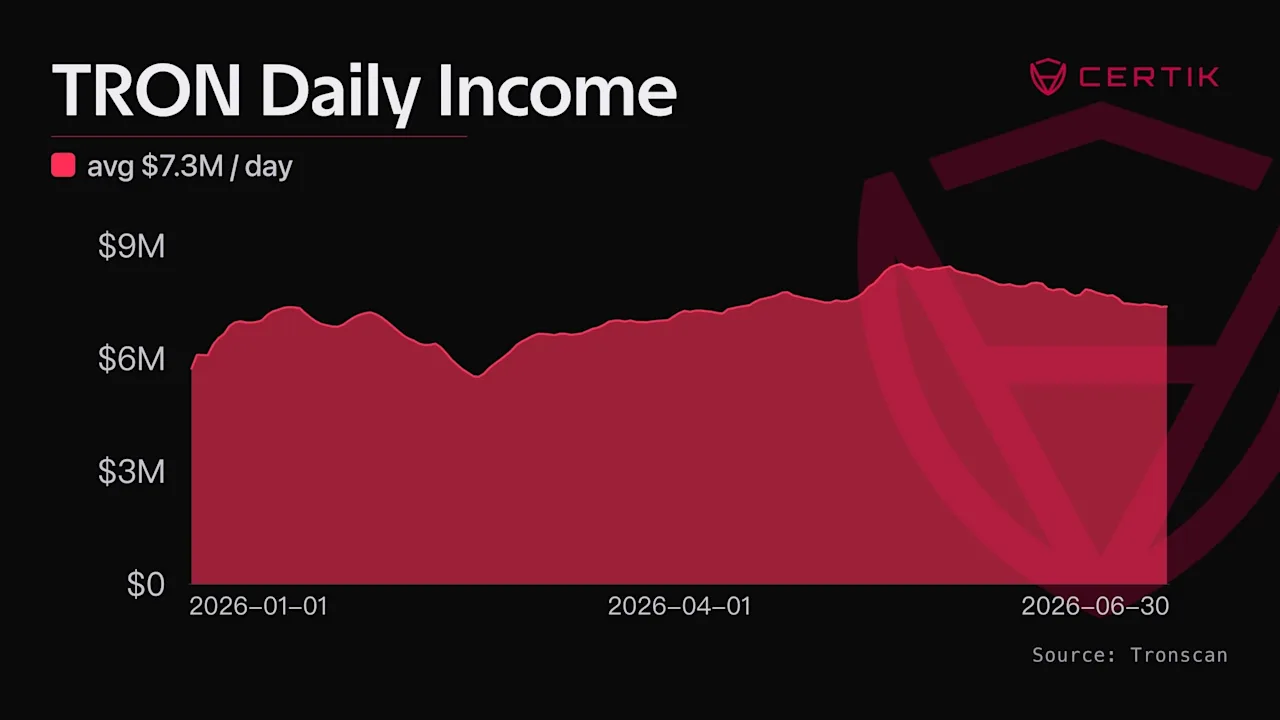
The income profile matched the rest of TRON’s H1 performance: settlement was the economic engine, even as DeFi trading cooled. Token economics reflected the trade-off behind inexpensive execution, with H1 daily burn averaging 3.05 million TRX against issuance of 3.92 million TRX per day and leaving the network in mild net issuance. Lower execution costs supported payment density while also limiting burn pressure.
AI Extended the Payment Rail Rather Than Replacing It
AI agents need four things to transact: a wallet, an identity, a payment rail, and a way to execute. TRON already operates the payment rail at scale, so its H1 AI work extended infrastructure the chain already had. The commitments scaled across the stack through a USD 1 billion AI fund, an Agentic AI Foundation board seat, OpenWallet, and a wave of Model Context Protocol (MCP) integrations exposing TRON’s data and liquidity to agents. Those announcements broadened the network’s surface area.
B.AI supplied the traction data. As of late June, B.AI’s daily token throughput had reached 15.37 billion, with a peak of 18.69 billion. Application programming interface (API) traffic made up 99.6% of usage, registered users approached 2 million, and TRON accounted for more than 70% of onchain payment and deposit activity. AI compute, API workflows, and crypto-native payments are starting to meet on TRON’s settlement layer. If the early B.AI activity persists, TRON’s AI angle will be less about building a new narrative and more about adding a new source of demand for the same settlement layer: API users, agent wallets, and stablecoin deposits.
H2 Will Test Whether Settlement Becomes Agent Infrastructure
TRON enters H2 with a large stablecoin base, the largest holder distribution among major stablecoin networks, transfer activity that held up through a market-wide decline, DeFi TVL that stayed flat while the broader market contracted, and early traction in AI-agent infrastructure. The metrics to watch are stablecoin supply growth, transfer-volume durability, resource income, recurring activity from B.AI, and whether MCP integrations convert from infrastructure announcements into measurable agent-driven transaction flow.
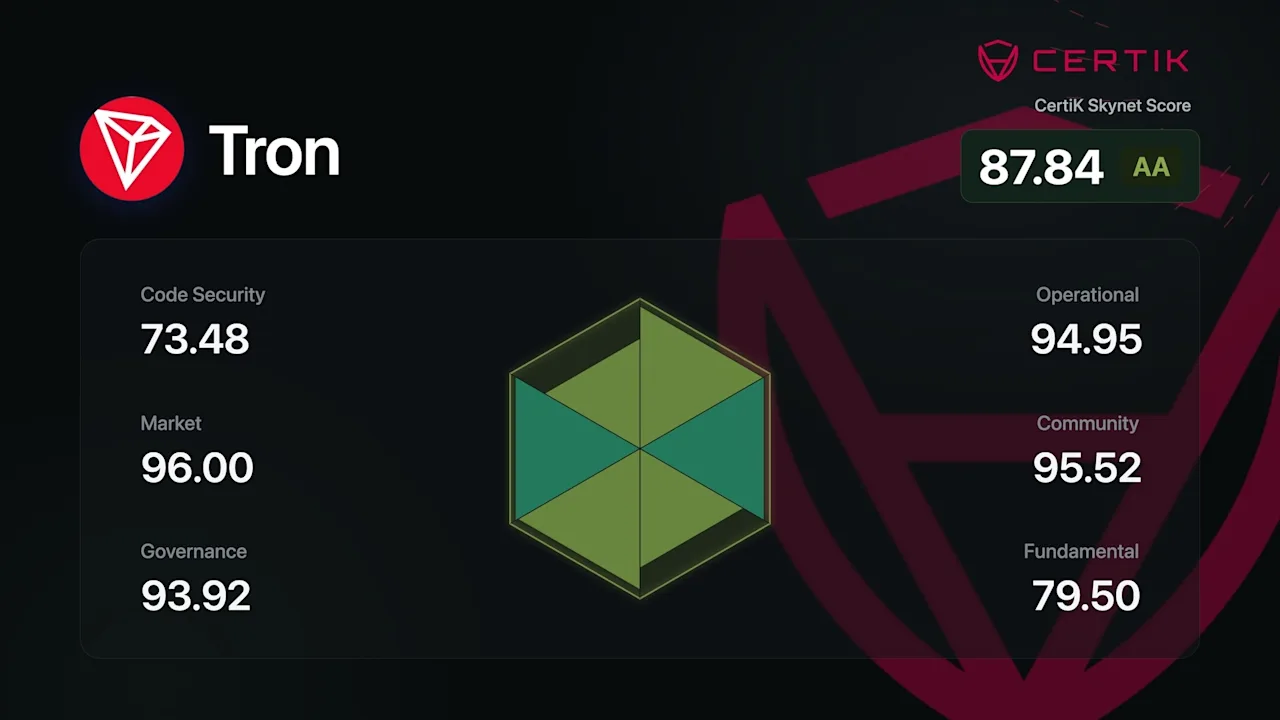
H1 confirmed TRON’s role as a settlement network. The open question for H2 is whether that settlement layer can turn early AI-agent application traction into recurring transactions, deposits, and resource demand. Track TRON’s security posture on CertiK Skynet.
References
- DefiLlama: Stablecoins, TRON Chain, and DEX Volumes
- RWA.xyz: Networks and TRON
- TRONSCAN