A lending protocol’s credit boundary is defined by which assets can create borrowing capacity and be liquidated efficiently during market volatility.
Venus is expanding that boundary on BNB Chain by bringing institutional custody access, tokenized equities, and tokenized gold into its lending markets.
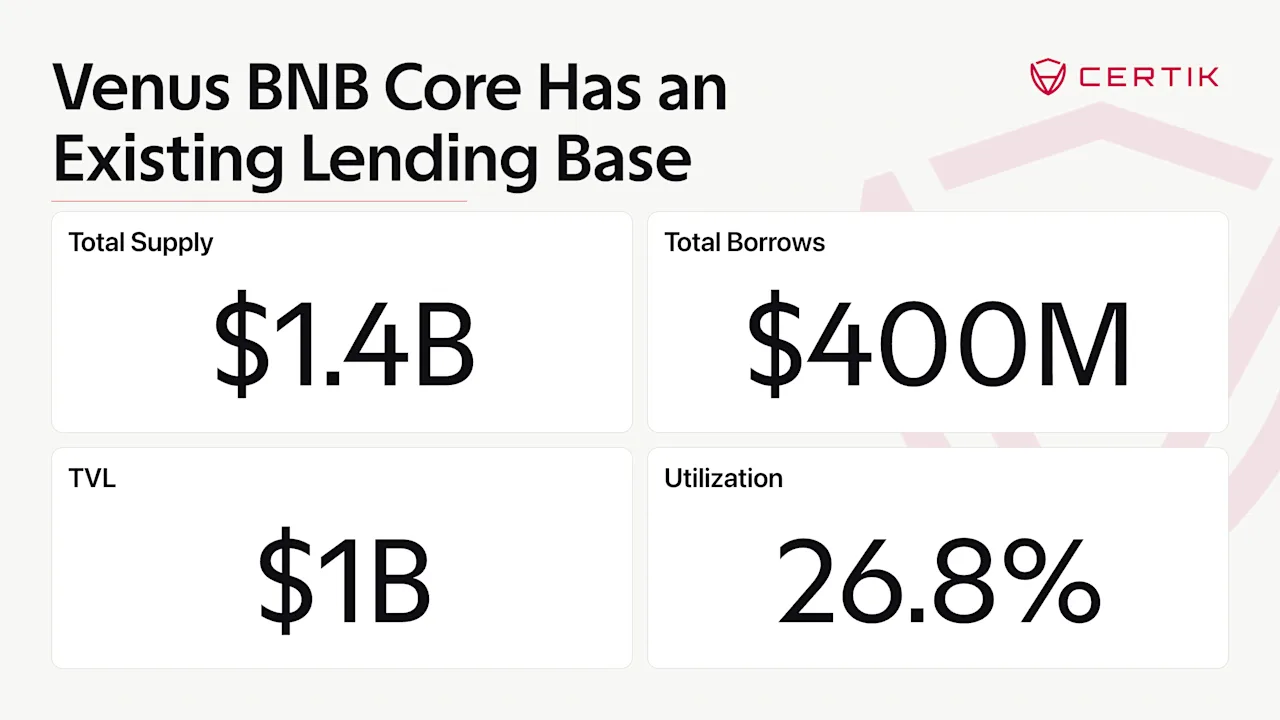
As of July 25, Venus’ official BNB Core dashboard showed:
- USD 1.40 billion in total supply
- USD 400 million in total borrows
- USD 1.024 billion in total value locked (TVL)
- 26.8% protocol utilization
Venus is now connecting institutional custody access, tokenized stocks, and tokenized gold to that balance sheet.
The infrastructure is already in place. The next measure of progress is how much recurring borrowing demand these assets generate.
How the Venus Lending Model Works
Venus Core consists of multiple asset markets. Users can supply an asset to earn interest, or enable it as collateral and borrow another asset such as USDT or BNB.
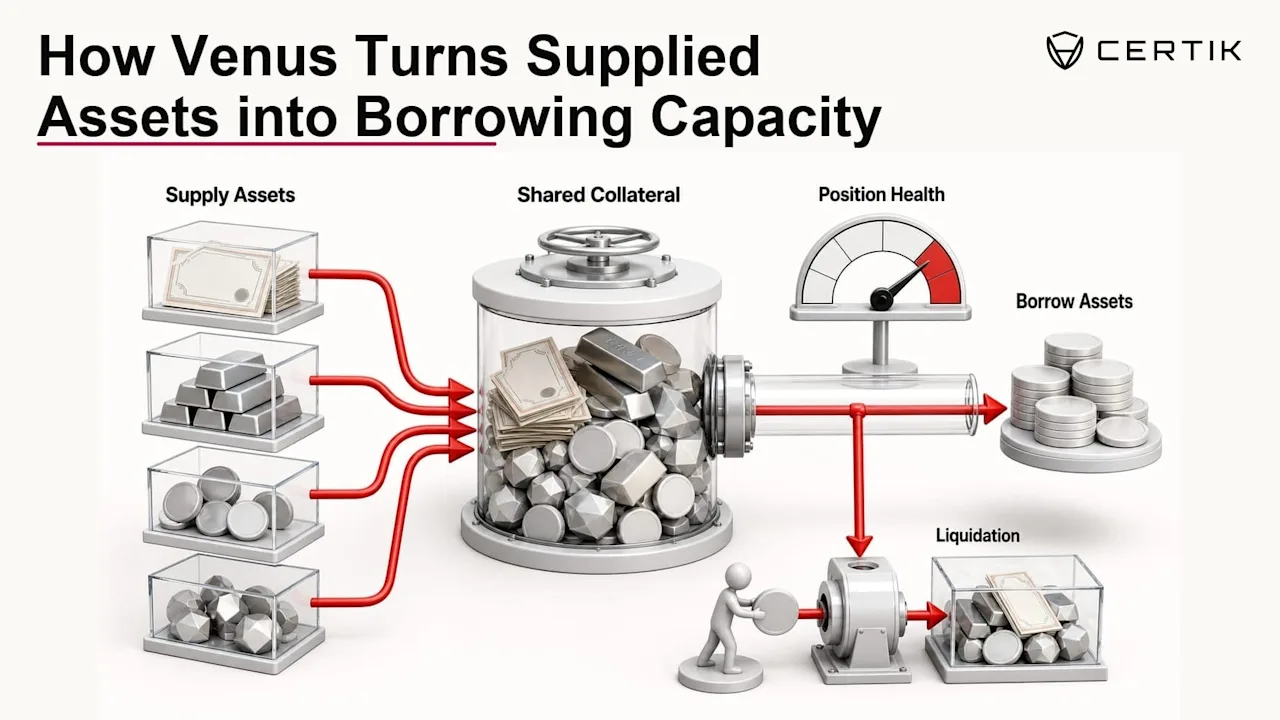
The basic flow is straightforward:
Supply an asset → enable it as collateral → borrow another asset → monitor position health → liquidate if the position falls below its threshold
If an asset has a 60% collateral factor, supplying USD 10,000 of it can theoretically contribute around USD 6,000 of borrowing capacity. As the position approaches its liquidation threshold, a liquidator can repay part of the debt and receive collateral in return.
Venus Core uses a pooled collateral model. A user’s collateral assets collectively support the account’s total debt. The protocol does not record that one specific USDT loan is supported only by NVDAB, BNB, or another individual asset.
That is why Venus’ Collateral Attribution dashboard uses a proportional attribution model. It estimates each collateral asset’s contribution to existing debt based on its value and collateral parameters.
Debt Supported is useful for measuring whether an asset is beginning to function as a credit instrument. It should not be interpreted as a one-to-one on-chain mapping between a collateral token and an individual loan.
Cactus Link Addresses the Institutional Access Problem
The Venus integration with Cactus Custody focuses on how institutions enter this lending structure.
Cactus Link is a DeFi Connector provided by Cactus Custody. It allows institutional clients to access Venus through their existing custody, approval, and risk-control workflows instead of creating a separate DeFi wallet process.
The division of roles is clear:
- Venus provides the lending markets and liquidity.
- Cactus Custody provides the infrastructure institutions already use, including HSM-backed cold storage, institutional MPC, approval procedures, and transaction controls.

Through Cactus Link, eligible clients can supply assets supported by Venus Core or use collateral such as BTC, BNB, and XAUm to borrow other assets.
For an institution holding XAUm, the most direct use case is converting tokenized-gold exposure into stablecoin liquidity without first leaving its existing custody environment.
The integration reduces an operational barrier, but adoption still has to be measured through usage.
The relevant indicators are supply entering through Cactus Link, the resulting borrow volume, the collateral mix, and whether institutions continue using the route after the initial integration period.
bStocks Have Supply. Credit Conversion Is Still Early.
Binance’s bStocks have surpassed USD 400 million in assets under management (AUM) and USD 2.5 billion in cumulative trading volume.
Tokenized equities are no longer only an issuance experiment. They already have meaningful distribution and secondary-market activity.
Venus has added the next layer: holders can now use these assets as collateral.
The four live bStock markets showed:
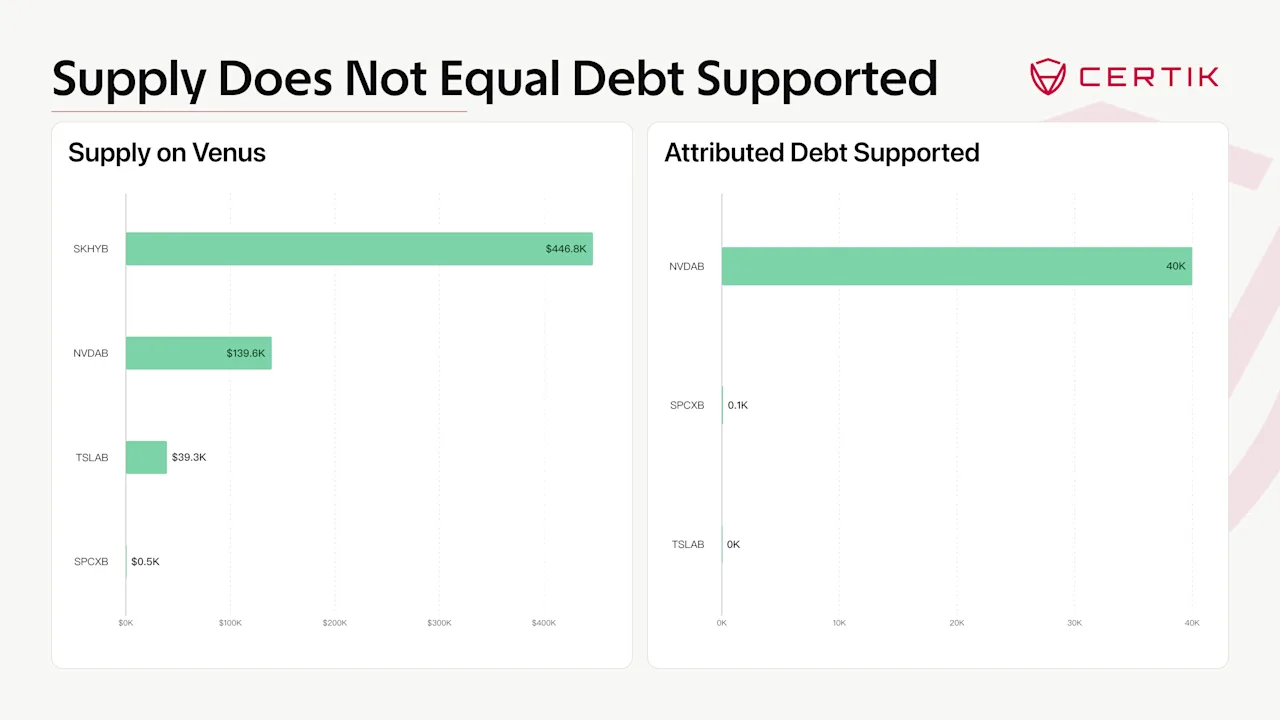
- SKHYB supply: USD 446,840
- NVDAB supply: USD 139,630
- TSLAB supply: USD 39,330
- SPCXB supply: USD 529
Combined supply was approximately USD 626,330, equivalent to around 0.045% of Venus BNB Core supply.
Supply alone does not show how these assets are being used.
Venus’ official Collateral Attribution dashboard showed that NVDAB supported approximately USD 40,000 of attributed debt.
The distinction matters.
Supplying an asset proves that holders are willing to place it inside the protocol. Supporting debt shows that the asset is being used to obtain liquidity.
NVDAB has started to support measurable borrowing activity. The other markets remain closer to the supply-acquisition stage.
New Collateral Extends the Security Perimeter
Once tokenized equities begin supporting debt, three conditions must hold at the same time:
- The underlying asset and the holder’s rights must remain verifiable.
- The oracle must continue producing defensible prices when the traditional market is closed.
- Liquidators must have enough executable liquidity to exit the collateral under stress.
Venus introduced the first bStock markets with relatively conservative parameters.
The stock tokens themselves cannot be borrowed. Their collateral factors range from 50% to 60%, while liquidation thresholds range from 65% to 70%. The markets also use limited supply caps and a 16.67% oracle protection trigger.
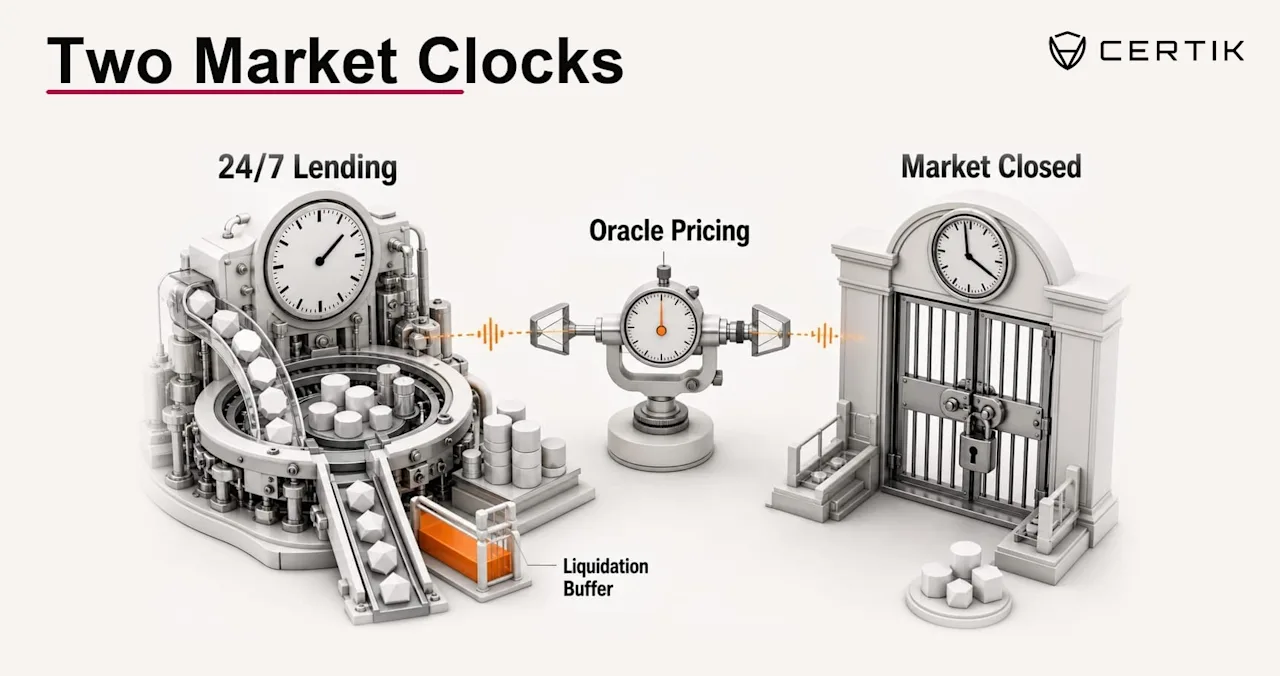
The protocol established a USD 200,000 bStock liquidation buffer for weekends and periods of limited liquidity.
If necessary, liquidators can resolve an unhealthy position on-chain and then transfer the acquired stock tokens to another market for sale.
These controls reduce the protocol’s initial exposure, but they do not remove the mismatch between two market clocks.
Venus operates continuously. U.S. equity markets close overnight, on weekends, and during holidays, and can reopen with price gaps.
Risk controls must keep oracle behavior, supply caps, collateral parameters, and practical exit liquidity aligned during these periods.
On CertiK Skynet, Venus had a Skynet Score of 92.75 and an AA tier at the July 25 snapshot. Its Code Security score was 96, while its Community score was 98.
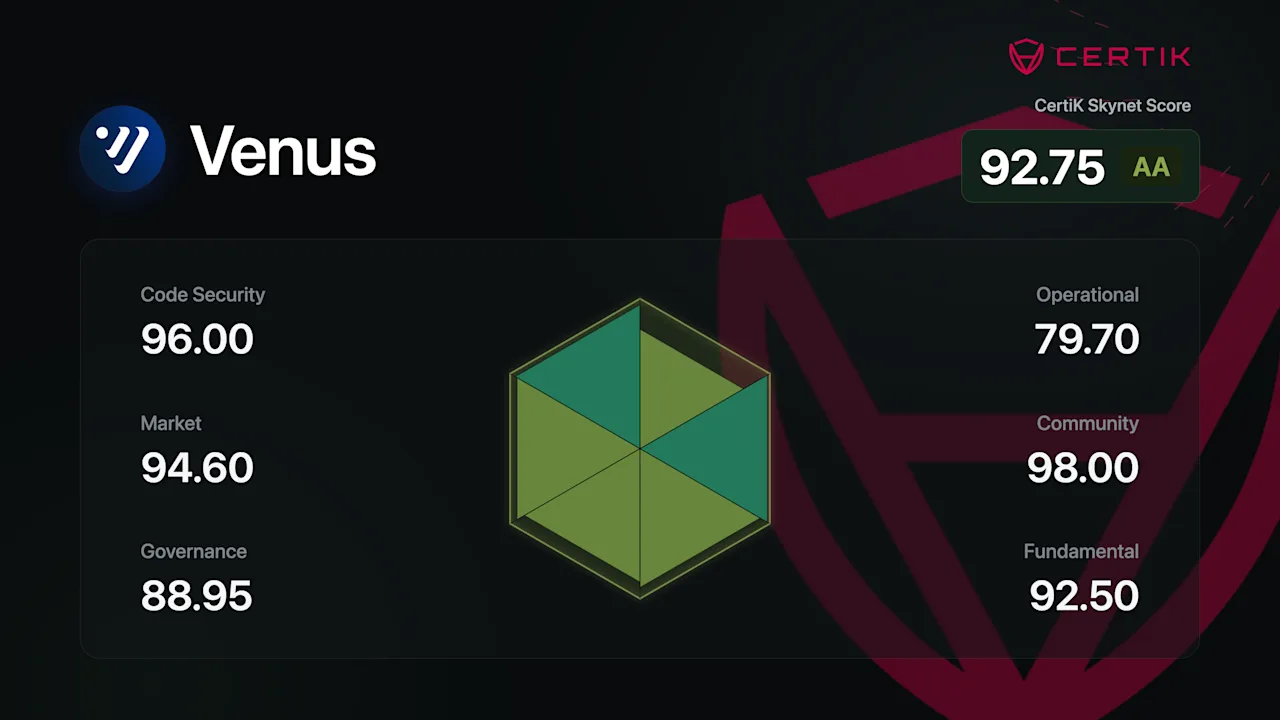
Scores and audits provide evidence within a defined scope and point in time. They are not guarantees.
Tokenized collateral also depends on oracle behavior, issuance and redemption controls, holder concentration, and liquidation execution. These risks require continuous monitoring after deployment.
Venus deploys backup oracles, 24/7 monitoring, and a risk fund funded by protocol revenue as safeguards intended to help protect user funds.
XAUm Shows the Difference Between Backing and Lending Demand
Tokenized gold presents a different comparison.
Matrixdock’s latest verification data reported 508 physically inspected gold bars, representing 16,331.184 troy ounces of gold against 16,331.179 XAUm in circulation. The indicated reserve value was approximately USD 66.09 million.
This evidence addresses whether the gold backing exists. It does not show whether holders want to use that exposure inside a lending market.
As of July 25, the official Venus XAUm market showed approximately USD 5,810 in supply. The Collateral Attribution dashboard showed that around USD 5,721 had been enabled as collateral and supported USD 2,463 of attributed debt.
That demand now exists, but it remains small.
What to Watch Next
Venus has connected three components:
- A scaled lending balance sheet on BNB Chain
- An institutional access route through Cactus Link
- Tokenized stocks and gold that can enter the collateral layer
The pathway is already operating. The next metrics are the pace and durability of credit conversion.
Four indicators matter most:
- Debt supported by each tokenized collateral asset
- Deposit retention after incentives decline
- Collateral concentration and liquidation liquidity under stress
- Institutional supply and borrow volume entering through Cactus Link
Tokenization brings assets on-chain, but lending turns them into credit only when they can be continuously priced, used as collateral, and liquidated when necessary.