

The regulatory landscape for Web3 in the U.S. is undergoing a significant transformation, even in the absence of the long awaited CLARITY Act. On August 18, 2026, the U.S. Securities and Exchange Commission (SEC) issued a notice of proposed rulemaking titled Regulation Crypto Assets (Release No. 33-11434; File No. S7-2026-27).
Acknowledging a shift in the Commission’s approach to digital assets that began in early 2025, this landmark proposal outlines a tailored framework specifically engineered for "covered investment contracts." Rather than forcing crypto projects into traditional registration frameworks built for standard corporate equities, the proposal introduces two conditional offering exemptions, custom disclosure standards, and a conditional safe harbor from the term "investment contract."
Whether you are building an early-stage protocol, planning a token raise, or transitioning toward a decentralized architecture, understanding the exact mechanics—and technical demands—of this proposed framework is essential.
The Core Framework: Two Exemptions and a Safe Harbor
Regulation Crypto Assets replaces regulatory uncertainty with a structured, multi-tiered pathway for token offerings. Here is a breakdown of how the proposed rules function.
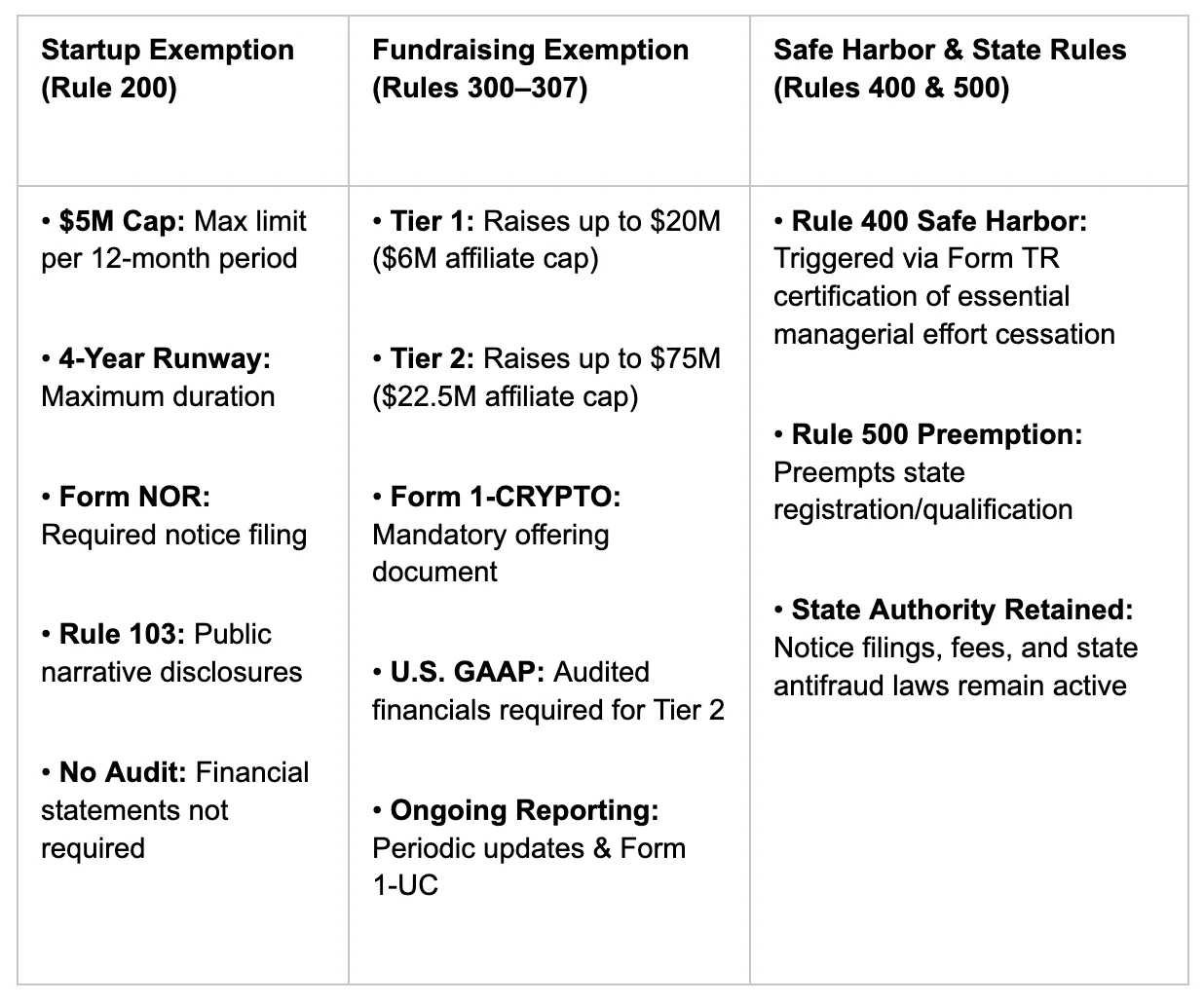
1. Startup Exemption (Rule 200)
Designed for early-stage development teams, Rule 200 provides a 4-year temporary regulatory runway to launch and iterate on a network.
- Capital Cap: Permits offerings of covered investment contracts up to $5 million within any 12-month period.
- Minimal Friction: Issuers relying on Rule 200 are not required to provide audited financial statements, significantly lowering the administrative barrier for early startups.
- Filing Requirements: Teams must file a Form NOR notice prior to commencing the offering and maintain free, publicly accessible narrative disclosures under Rule 103 on a dedicated website.
2. Fundraising Exemption (Rules 300–307)
Modeled in part on Regulation A, this two-tiered exemption facilitates larger public token raises while operating alongside existing capital-raising pathways.
- Tier 1: Facilitates public raises up to 6 million sublimit for affiliate selling securityholders). It does not mandate audited financial statements.
- Tier 2: Facilitates public raises up to 22.5 million sublimit for affiliates). Tier 2 requires audited U.S. GAAP financial statements audited under U.S. GAAS or PCAOB standards by an independent accountant.
- Disclosure & Reporting: Issuers must submit a Form 1-CRYPTO offering statement and adhere to ongoing reporting requirements, including periodic reports (Form 1-KC, Form 1-SC) and event-driven updates (Form 1-UC).
3. Investment Contract Safe Harbor (Rule 400)
Rule 400 creates a conditional off-ramp from securities regulation. An issuer can rely on the safe harbor by certifying on Form TR that it has completed or permanently ceased all promised "essential managerial efforts" and makes no new representations or promises regarding such efforts.
When these conditions are met, the covered investment contract is deemed to have ceased for specified Securities Act and Exchange Act definitions. Note that this safe harbor applies strictly to the covered investment contract itself—it is not a blanket determination that the underlying crypto asset cannot constitute a security on any other legal basis.
4. State Law Preemption (Rule 500)
Rule 500 preempts state "Blue Sky" securities registration and qualification requirements for offerings conducted under Regulation Crypto Assets and certain qualifying secondary transactions. However, this preemption is targeted: state securities regulators retain full authority regarding notice filings, filing fees, and enforcement under state antifraud statutes.
Technical Verification Meets Legal Compliance
Under Regulation Crypto Assets, legal compliance and technical architecture are deeply intertwined. Satisfying SEC disclosure requirements is not simply a matter of submitting legal paperwork—it requires proving that your narrative disclosures accurately reflect your onchain code, smart contract permissions, and operational security.
Here is how rigorous technical security practices support each key element of the proposed rules:
| Regulatory Rule | SEC Disclosure Requirement | Technical Verification Role |
|---|---|---|
| Security Disclosures (Rule 103(b)(6)) | Narrative description of material network security aspects; link to source code URL if code is public. | Independent Smart Contract Audits and Formal Verification reports provide objective, supporting technical documentation for narrative security disclosures. |
| Risk Factors & Reporting (Rule 103(b)(10) & Form 1-UC) | Disclosure of issuer-specific material risk factors; reporting on specified corporate events. | Continuous security intelligence and threat monitoring allow teams to dynamically track operational risks, smart contract vulnerabilities, and key security metrics to keep risk disclosures accurate. |
| Insider Accountability (Rules 103(b)(4) & 104) | Mandatory disclosures regarding management, conflicts of interest, lockups, and bad-actor disqualifications. | Transparent operational security, multi-sig key governance, and verified team access controls help satisfy due diligence inquiries regarding management authority and control risks. |
| Tokenomics & Governance (Rules 103(b)(7)–(8)) | Narrative breakdowns of token supply caps, mint/burn parameters, distribution mechanics, and governance permissions. | Scoped code reviews ensure that onchain smart contract logic and permission parameters strictly match the tokenomics and governance narratives submitted in regulatory filings. |
| Safe Harbor Analysis (Rule 400 / Form TR) | Form TR Item 3 requirement to provide an analysis supporting the certification that managerial efforts have ceased. | Technical assessments evaluating code immutability, decentralized governance execution, and administrative privilege deprecation produce bounded inputs supporting the issuer's analysis. |
Key Regulatory Clarifications for Builders
Navigating this proposed rule requires precision. As teams evaluate Regulation Crypto Assets, several critical nuances should be kept in mind:
- Conditional Exemptions, Not Automatic Exemption: The proposal does not automatically make all token fundraising legal, nor does it grant unconditional non-security status. Compliance depends entirely on satisfying specific offering conditions, filing notices, and hosting compliant disclosures.
- Source Code Requirements: Proposed Rule 103(b)(6) requires disclosing material security aspects of the network, but it does not force teams to open-source their private code. A URL link to code repositories is required only if the issuer has already made the source code publicly available.
Practical Takeaways for Web3 Teams
Regulation Crypto Assets signals a clear evolution in Web3 compliance: legal disclosures must be backed by verifiable technical reality.
As the SEC solicits public feedback on File No. S7-2026-27 (with comments officially due 60 days after publication in the Federal Register), projects planning to raise capital or transition toward a decentralized operational model should take proactive steps today:
- Audit Your Disclosures Against Your Code: Ensure your tokenomics narratives, mint/burn parameters, and admin permissions exactly mirror what is deployed in your smart contracts.
- Establish Baseline Security Evidence: Utilize independent smart contract audits and formal verification to substantiate your Rule 103(b)(6) material security statements.
- Implement Real-Time Risk Intelligence: Maintain continuous threat monitoring to track protocol security and maintain dynamic risk factor reporting over time.
By aligning robust smart contract security with legal disclosure requirements early, Web3 teams can confidently navigate this new regulatory framework.