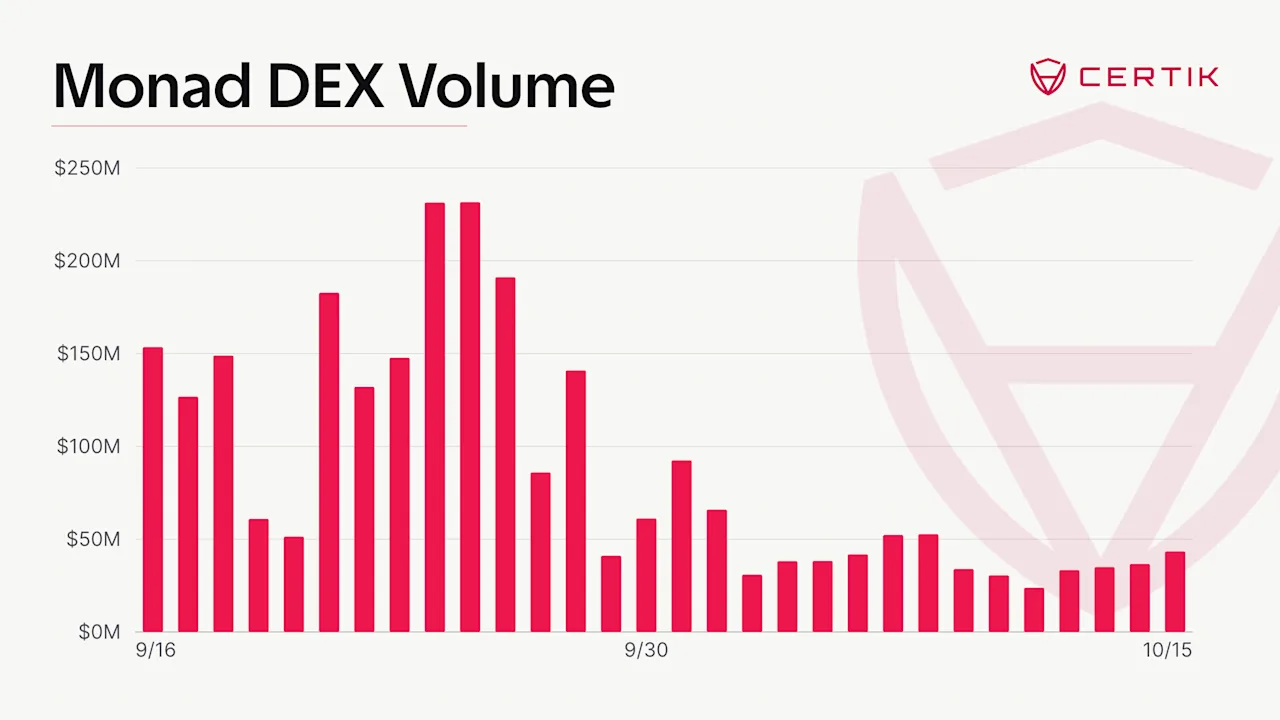
As of October 16, 2026, Monad held approximately USD 1 billion in total value locked (TVL). Over the 30 complete UTC days from September 16 to October 15, its decentralized exchanges (DEXs) processed USD 2.64 billion in spot volume, while independently measurable perpetual venues processed USD 2.5 billion in the trailing 30-day window measured in the September 28 snapshot. Tracked lending markets held USD 1.11 billion in gross supply and USD 613.1 million in borrows.
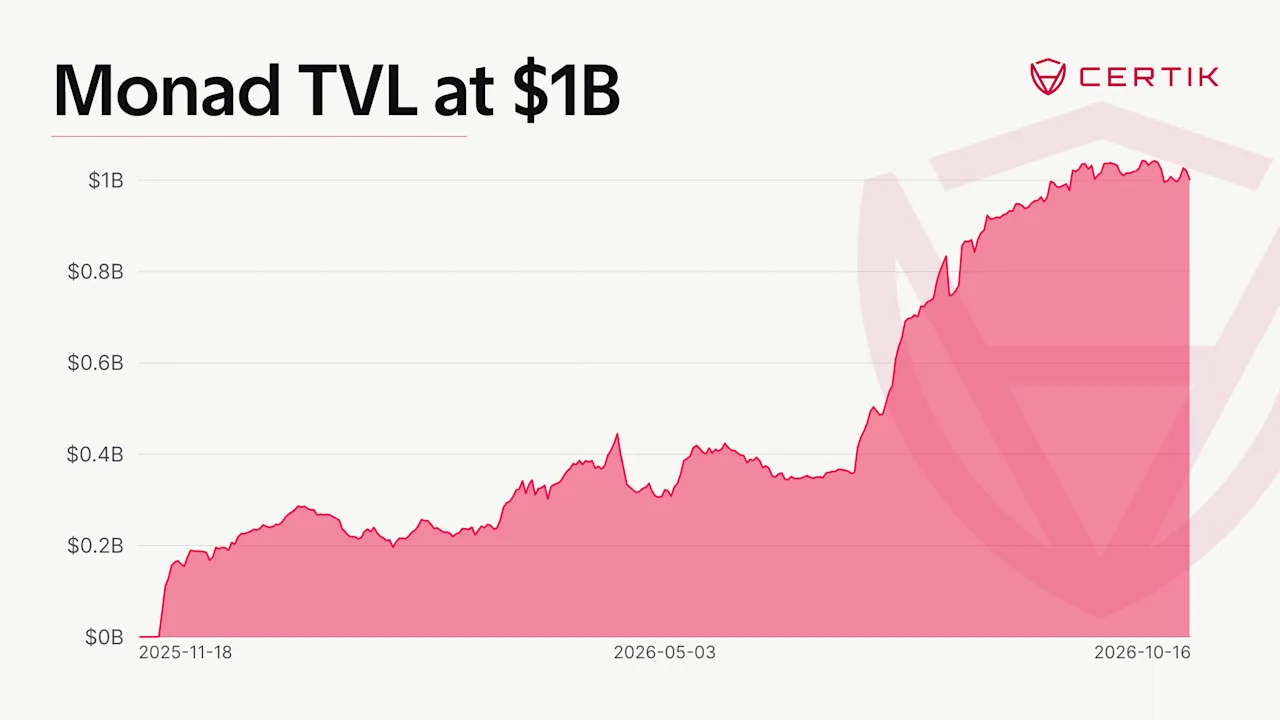
These figures describe more than a growing application catalog. Monad now has the execution layer, credit markets, settlement assets, and tokenized real-world assets (RWAs) needed to operate as a multi-layer financial ecosystem. At the same time, liquidity and activity are beginning to aggregate around a small number of high-throughput venues.
Monad’s defining development is not simply that it has built many financial applications. It is that those applications are beginning to produce market leaders, capital turnover, and network effects.
Monad’s Hybrid Formation Model Is Now Visible
Monad’s financial ecosystem is forming through several layers at once. Mature Ethereum Virtual Machine (EVM) primitives such as Aave, Uniswap, Morpho, Euler, and Curve provide familiar financial functions and liquidity structures.
Monad-native venues such as Kuru, Perpl, and Metric create chain-specific execution and market surfaces. Stablecoins and real-world assets provide the asset base, while network operations and security tooling extend the stack beyond application deployment.
This is a hybrid formation model: established primitives supply financial completeness, native venues provide differentiation, and asset and operational layers allow the different functions to operate in parallel.
Monad is not being defined by one flagship application. Its market structure is emerging from several financial functions developing together, followed by liquidity concentrating around the venues that users are choosing most often.
Application Breadth Is Converting Into Market Leadership
Monad currently has 18 DEXs with at least USD 1 million in volume over the 30 complete days ending October 15. That breadth matters because it gives users and aggregators multiple execution routes. The distribution of volume shows that the network is also developing clear liquidity centers.
Kuru processed approximately USD 1.25 billion of Monad’s USD 2.64 billion in 30-day DEX volume, giving it a 47.2% share. Uniswap V4, Curve, Hanji Protocol, and Pendle V2 brought the top-five share to 88.9%.
The perpetual market has formed an even clearer leader. In the September 28 snapshot, Perpl processed approximately USD 2.19 billion, followed by LeverUp at USD 275.9 million and Drake Exchange at USD 39.4 million. Perpl alone represented 87.4% of measurable Monad-only perpetual volume; Perpl and LeverUp together represented 98.4%.
Fee generation shows the same pattern at the economic layer. Twenty-nine tracked fee sources generated at least USD 10,000 in fees over the 30 complete days ending October 15. Aggregate protocol fees were approximately USD 6.38 million, with protocol revenue at USD 739,900; the five largest fee sources contributed 71.9% of measured fees.
The structure is important because protocol count and market leadership answer different questions. Protocol count measures the range of available functions. Volume and fee share show where order flow, liquidity, and economic activity are actually settling. Monad is developing both: a broad execution layer and a smaller set of markets that can aggregate depth and usage.
Lending Is Turning Deployed Capital Into Credit Activity
Lending provides the clearest evidence that Monad’s financial stack is doing more than hosting contracts. Across the tracked lending markets, gross supply reached approximately USD 1.11 billion, borrows reached USD 613.1 million, and aggregate utilization was 55.2%.
Aave is Monad’s largest lending market. The latest tracked Aave V3 Monad market data shows approximately USD 708.1 million in supplied assets, USD 312.0 million in outstanding borrows, and USD 396.1 million in supply net of borrows, implying 44.06% utilization. The largest supplied assets were USDC at USD 210.0 million, syrupUSDC at USD 156.5 million, USDe at USD 132.9 million, USDT0 at USD 77.3 million, and PT-AUSD maturing December 17, 2026, at USD 54.6 million. USDC was the largest borrowed asset at USD 189.9 million.
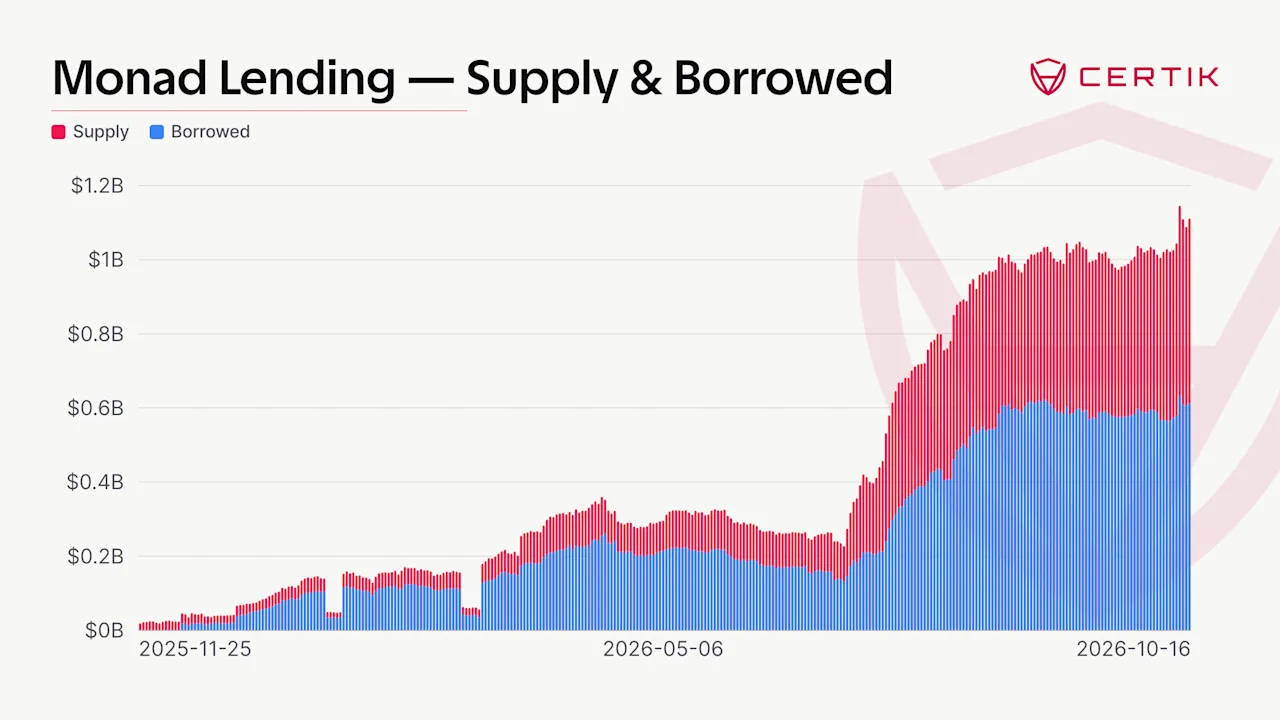
These figures place Aave at the center of Monad’s credit layer while leaving room for differentiated lending markets. Euler, Morpho, Curvance, and other markets serve different collateral configurations and borrowing demand. Capital intermediation therefore extends beyond the largest deposit venue: several markets are converting supplied assets into active credit positions.
The same pattern is visible in Monad’s expanding distribution layer. More than one million gasless Monad transactions have been sent through MetaMask, while Meru is live on Monad for users in more than 150 countries. These routes connect lending and trading liquidity to wallets, payments, and cross-border account funding, extending Monad from a DeFi execution environment into a broader financial distribution network.
The important mechanism is capital reuse. Assets can enter through a wallet or stablecoin route, move into a lending market, support borrowing or liquidity, and return to trading or payment flows. Monad’s lending layer is therefore becoming a balance-sheet layer for the rest of the ecosystem.
Stablecoins Provide Settlement While Credit-Heavy RWAs Expand the Asset Base
Monad’s stablecoin layer currently represents USD 672.8 million in market capitalization, 97,153 holder addresses, and USD 15.53 billion in trailing 30-day transfers.
Stablecoins connect the rest of the stack. They can fund DEX trades, collateralize loans, settle payments, and provide the unit of account for tokenized credit products. This gives Monad an asset layer that is both liquid and composable across multiple financial functions.
The non-stablecoin RWA layer adds a different form of capital. Distributed RWA value reached USD 472.9 million through October 15, with 1,802 holder addresses and USD 502.0 million in trailing 30-day transfer volume reported in the October 16 dashboard update. Asset-backed credit, active strategies, and diversified credit represented 87.1% of distributed RWA value. Commodities and asset-backed credit generated 88.3% of measured RWA transfer volume.
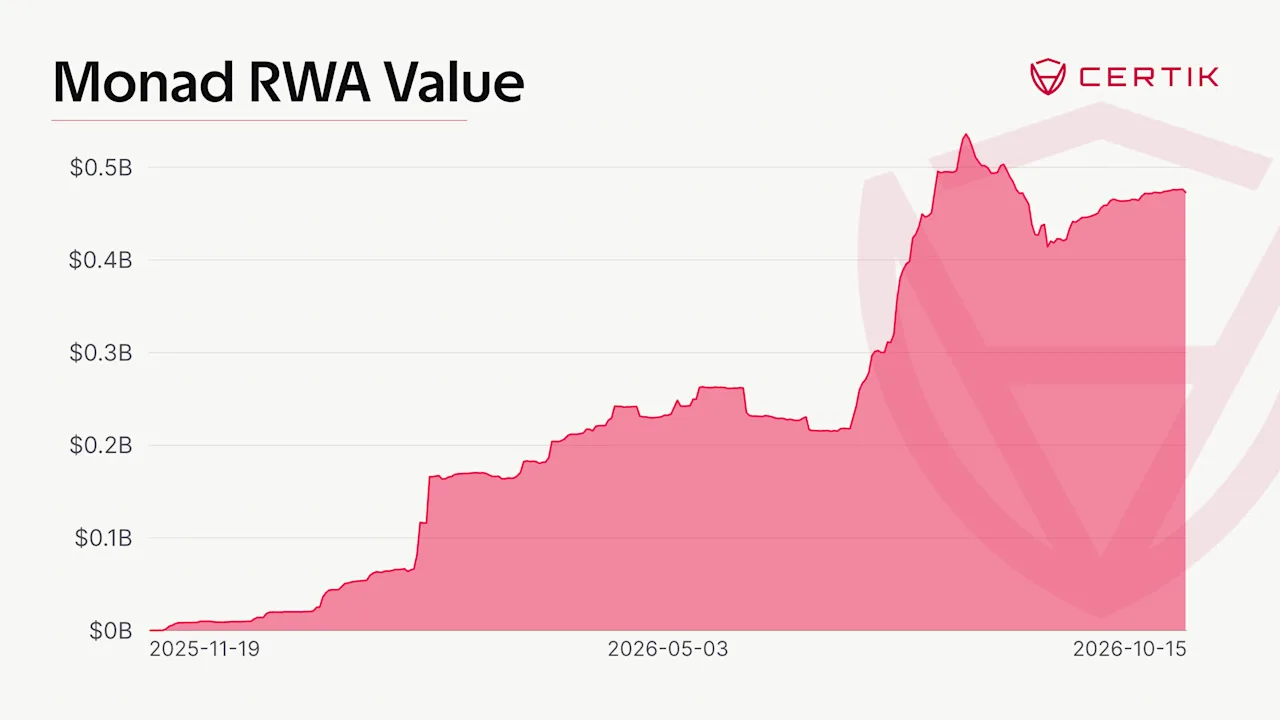
This composition gives Monad a distinct RWA profile: credit and managed strategies are doing more of the work than a generic tokenized-asset catalog. The result is an asset base that fits naturally beside lending, stablecoin settlement, and specialized trading venues.
Recent product announcements are extending that base. Midas and Wellington Management are bringing mWIN, a tokenized institutional credit strategy, to Monad. HelloTrade has announced plans to bring 10,000 assets to the network. Together, these developments point toward a broader market for institutional credit and tradable assets, giving Monad more ways to connect tokenized value with trading, collateral, and settlement.
Infrastructure and Security Development Are Scaling With the Financial Stack
Financial applications can only compound their usage when the underlying network remains predictable. Monad’s public mainnet operating record shows 100% uptime since public launch, more than 60 million uninterrupted blocks, a 99.903% successful proposal rate, and a 99.999% finalization rate through August 30, 2026. Approximately 200 validators participated in consensus during that measurement window.
That operational record matters to the ecosystem formation model because it gives trading, lending, payments, and RWA applications a common execution environment on which to accumulate activity. As market leaders carry more volume, predictable block production and finality become part of the financial stack itself.
Monad also open-sourced Ultrafuzz, an agent-coordinated smart-contract fuzzing and threat-hunting system. The initiative extends security work beyond base-layer consensus into developer tooling, contract testing, and external research collaboration. In combination with validator operations and network-level reliability, it shows Monad building the operational layer required for a financial ecosystem rather than stopping at application deployment.
Monad Is Moving From an Application Set to a Financial Network
Monad now has a multi-layer financial ecosystem: spot and perpetual venues generate trading activity; lending turns assets into reusable credit; stablecoins provide high-frequency settlement; and RWAs bring credit-oriented real-world value onchain.
The defining structure is that activity is beginning to aggregate around leaders. Kuru, Perpl, Aave, the largest fee sources, and a small number of RWA categories are each becoming important entry points for spot trading, derivatives, credit, protocol economics, and asset distribution.
Monad’s breadth and concentration are not opposing stories. Breadth supplies the financial functions; market leaders aggregate liquidity, users, and capital efficiency. Together, they give the network the architecture of a financial network rather than a list of deployed applications.
The next stage should be measured by whether spot and perpetual markets continue to deepen, whether fees and protocol revenue scale with activity, whether lending can absorb more capital across multiple markets, and whether RWA use expands beyond the categories that currently dominate transfers.
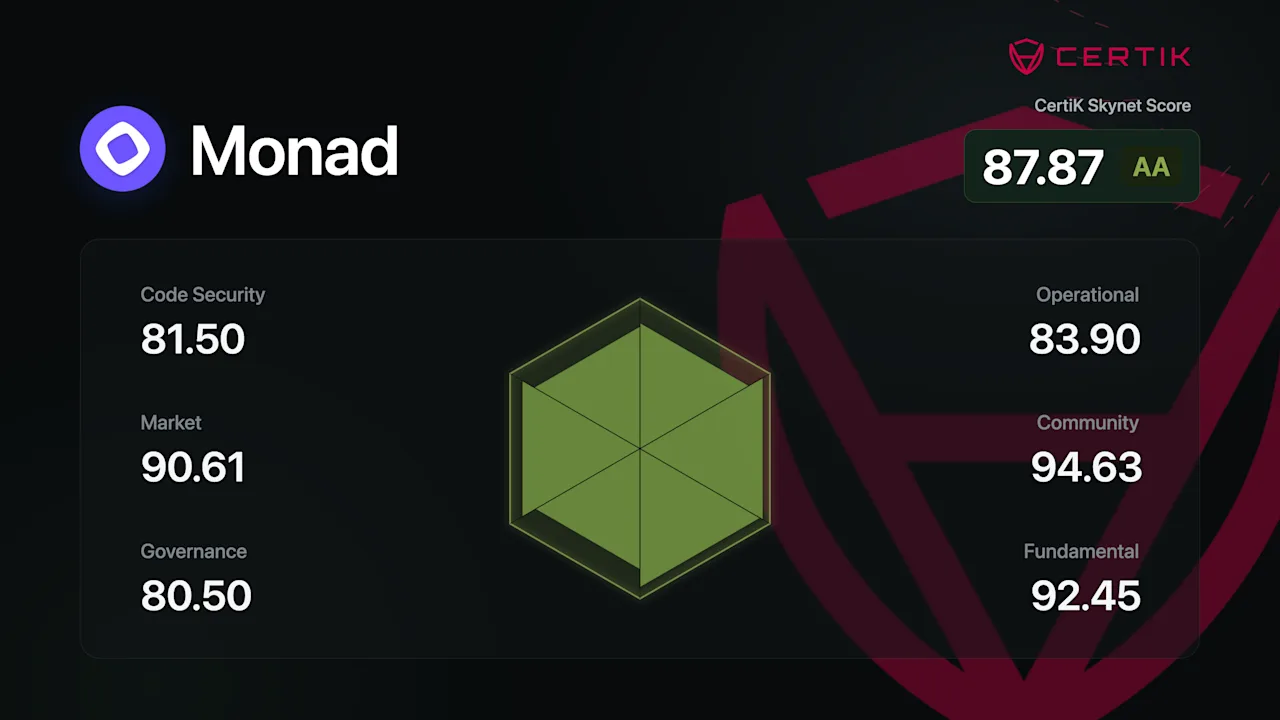
Monad’s growth is also accompanied by a strong current security profile. CertiK Skynet lists the network at an overall score of 87.87 (AA) as of October 16, 2026. As more trading, lending, payments, and RWA activity settles on Monad, this ongoing security visibility adds another layer to the network’s foundation.