When you buy Bitcoin, the asset exists natively on-chain. Its supply is verifiable, its custody is provable, and its full history is publicly auditable.
When you buy a real world asset like tokenized gold, the token lives on-chain, but the gold does not. It sits in a vault, managed by a custodian, documented through paper records and serial numbers. The chain confirms you own the token, but it cannot confirm that the gold exists.
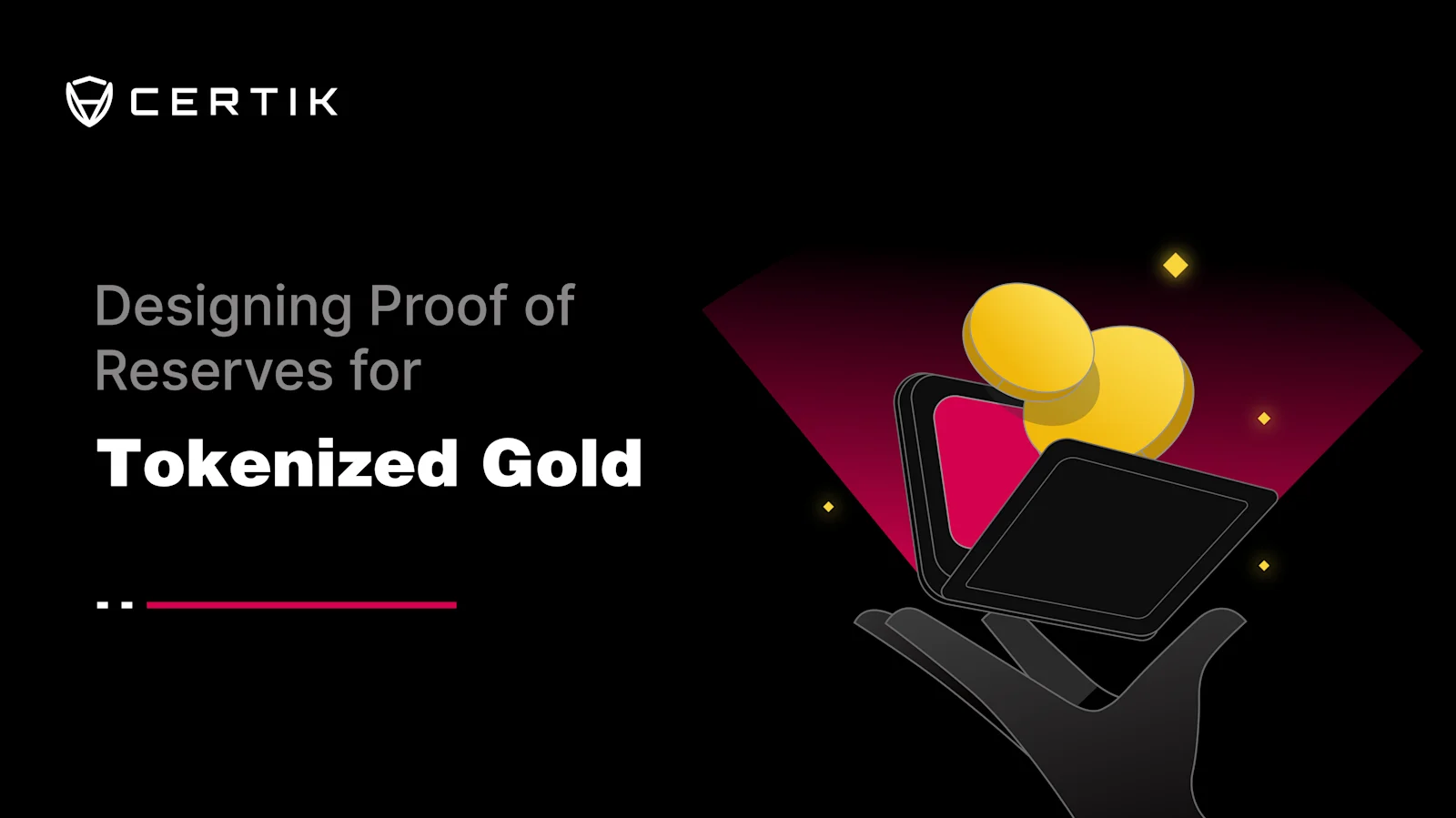
Proof of Reserves (PoR) is the mechanism designed to close that gap. And as tokenized gold scales into a multi-billion dollar market, getting PoR right is no longer optional. It is a security and compliance requirement.
The Trust Problem with Tokenized Gold
Tokenized gold surpassed $4.5 billion in market cap in late 2025 as spot prices climbed past $4,500 per ounce. Central bank demand, de-dollarization trends, and growing institutional appetite for on-chain commodity exposure are all accelerating adoption. But every buyer of tokenized gold is making a bet that goes beyond the price of gold. They are betting that the issuer actually purchased the gold, that a custodian is holding it securely, that no one has pledged it as collateral or encumbered it with third-party claims, and that the redemption mechanism linking the token back to the physical metal works as described.
None of these things are visible on a chain explorer.
Warehouse receipt fraud, rehypothecation of stored metals, and custodial failures have plagued traditional gold markets for decades. Tokenization does not eliminate these risks. It just moves them off-screen. And from a security standpoint, that creates a new attack surface: one where the vulnerability is not in the smart contract code, but in the gap between what the token represents and what actually exists in the physical world.
What PoR Actually Needs to Verify for Gold
Most people think of Proof of Reserves as a simple balance check. For native crypto assets, that is roughly accurate. For tokenized gold, the verification scope has to be much wider.
Physical existence. Does the gold actually exist? This is the most fundamental question, and the one that on-chain data simply cannot answer. Verification means reviewing custodial records, bar lists with serial numbers, and assay certificates that confirm weight and purity. More advanced implementations use IoT-enabled tracking or physical spot-checks of individual bars. Without this layer, buyers are placing trust in a document rather than in verified fact.
Supply reconciliation. Token supply is transparent on-chain. Gold reserves are tracked off-chain. PoR bridges the two by confirming that the number of tokens in circulation matches the quantity of gold the custodian holds. Any mismatch, even a small one, is a red flag that warrants immediate investigation.
Legal review. Gold sitting in a vault can be pledged as loan collateral, subjected to liens, or claimed by creditors in insolvency proceedings. A PoR that counts bars without checking their legal status provides incomplete assurance. Proper verification includes a review of custody agreements to confirm the gold is held solely for the benefit of token holders and is not exposed to the issuer's own liabilities.
Redemption integrity. The connection between a gold token and physical gold is only as credible as the ability to actually redeem one for the other. PoR should verify that, when tokens are burned, a corresponding quantity of gold leaves the vault, and that the issuer's redemption process works as documented. If the redemption pathway breaks down, the token's peg to gold becomes a claim with no enforcement mechanism.
Emerging Regulatory Requirements for PoR
Regulators are paying close attention to tokenized real world assets. The EU's MiCA framework is imposing reserve, transparency, and licensing requirements on asset-backed tokens. Dubai's VARA framework requires similar rigor. Hong Kong's SFC has introduced its own set of compliance expectations for digital asset custody and issuance. In each of these jurisdictions, the ability to prove that reserves are real, sufficient, and properly segregated is moving from best practice to legal obligation.
From a security perspective, PoR for gold-backed tokens also needs to account for risks that do not exist in purely digital asset verification. Custodial key management is one example. If the issuer's operational security is compromised, tokens could be minted without a corresponding gold purchase, inflating supply and diluting every existing holder. Smart contract audits catch logic errors in minting and burning functions, but they cannot detect whether the off-chain process that triggers those functions is itself secure. PoR fills that gap by independently confirming the outcome: that what is on-chain matches what is in the vault.
There is also the question of counterparty risk across the custodial chain. A typical gold-backed token involves a token issuer, a vault operator, an insurance provider, and sometimes a logistics firm handling physical transfers. Each handoff introduces a point of failure. A thorough PoR engagement examines the full chain of custody, not just the final tally of bars in a vault.
Why Gold PoR Is Structurally Harder Than Crypto PoR
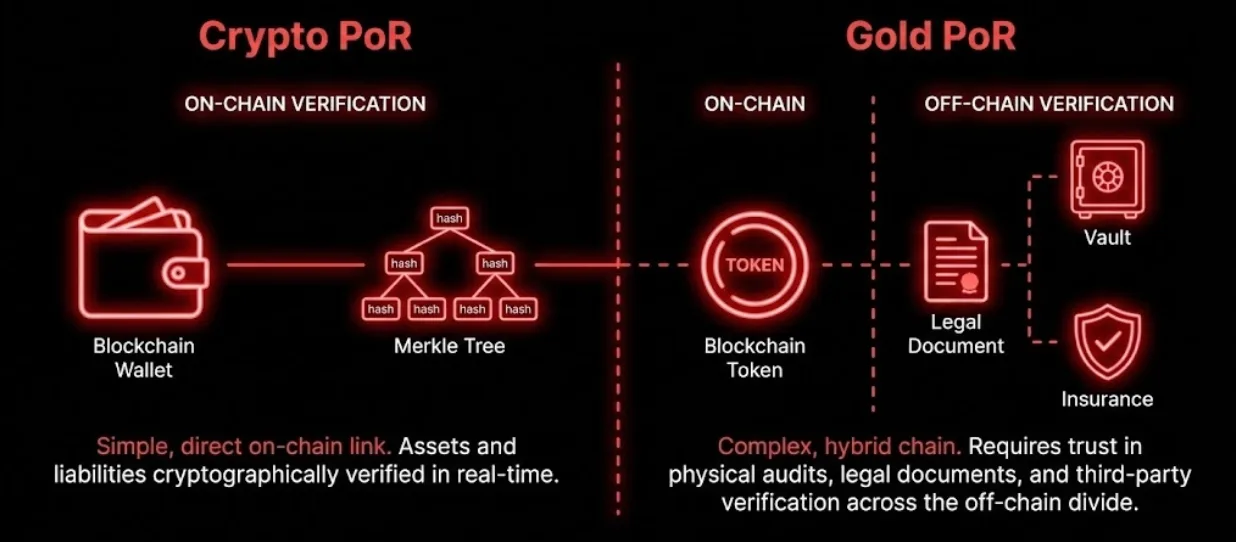
For a crypto exchange, Proof of Reserves verifies that digital assets on a set of blockchain addresses match digital liabilities in a Merkle tree. Both sides of the equation are natively digital and cryptographically provable.
Gold is different. The liability side (tokens) is on-chain and transparent. The asset side (physical gold) is off-chain and opaque. This asymmetry means gold PoR requires verification that extends beyond cryptographic proofs into physical auditing, legal review, and custodial due diligence.
The consequences of weak PoR are also more severe for gold. If a crypto exchange runs a fractional reserve, on-chain analytics and unusual withdrawal patterns can surface warning signs quickly. If a gold token issuer is running a fractional reserve, there is no blockchain-native signal. The gold either exists in the vault or it does not. Without an independent PoR, there is no way for buyers to know.
What Users Should Look For
For anyone holding or evaluating tokenized gold, PoR quality should be a primary decision factor.
Look for independent third-party verification, not self-reported reserves. Expect a regular cadence, quarterly at minimum, not annual or event-driven. Evaluate the scope. A PoR that only checks token supply without verifying physical custody, legal encumbrances, and redemption pathways is not complete. And make sure the results are publicly accessible. Verification that cannot be reviewed by the broader market loses most of its value.
As tokenized gold evolves from an early-stage crypto product into a serious vehicle for commodity exposure, the infrastructure supporting it must evolve too. Proof of Reserves sits at the center of that infrastructure. It is what connects the transparency of blockchain with the reality of a gold bar in a vault, and it is what gives buyers, regulators, and institutions the confidence that the asset behind the token is actually there.
Learn more about CertiK provides Proof of Reserves audits at certik.com.