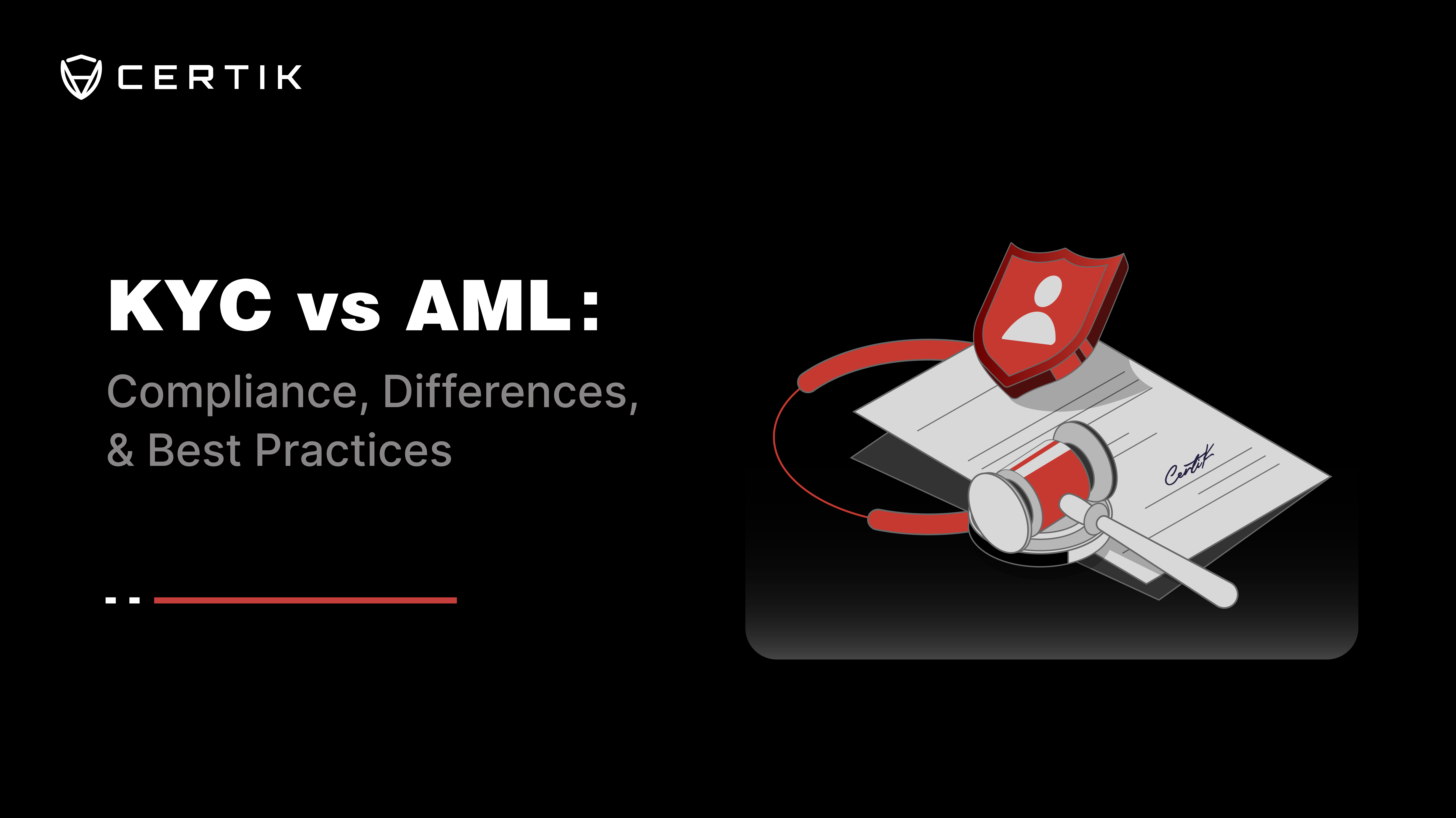
Security requires continuous attention to detail and innovation in order to maintain robust systems. This applies just as much to financial crime compliance as it does to cybersecurity. Too often, Know Your Customer (KYC) and Anti-Money Laundering (AML) are treated as interchangeable checklists rather than interconnected systems. In reality, however, KYC is only one component of a broader AML framework. It must operate continuously, adapt to risk, and withstand regulatory scrutiny.
Our guide clarifies the differences between KYC and AML, maps how they work together across the customer lifecycle, and outlines a practical approach for designing and operating an effective compliance program. This information is particularly relevant for financial institutions, fintechs, and blockchain service providers.
What do KYC and AML Mean?
Know Your Customer (KYC)
The purpose of KYC is to verify a customer’s identity, understand the nature of their activities, and assess their risk profile before and during the business relationship.
Here are some core components:
- Customer Identification Program (CIP): Collection and verification of identity and attributes, such as name, date of birth, address, and government-issued ID.
- Customer Due Diligence (CDD): Risk assessment based on geography, products, delivery channels, and expected transaction behavior.
- Enhanced Due Diligence (EDD): Deeper scrutiny for higher-risk customers, including beneficial ownership analysis and source-of-funds verification.
- Ongoing Monitoring: Periodic refreshes and event-driven reviews throughout the relationship.
In other words, KYC establishes who the customer is and the risk of the relationship.
Anti-Money Laundering (AML)
The purpose of AML is to prevent, detect, and report money laundering, terrorist financing, and related financial crimes. An effective AML framework would include the following:
- Governance, policies, and internal controls
- KYC and customer risk management
- Transaction monitoring and investigations
- Sanctions, PEP, and adverse media screening
- Independent testing and assurance
- Suspicious Activity Report (SAR) filing
AML must operate continuously in order to be effective.
Key Differences between KYC and AML
| Dimension | KYC | AML |
|---|---|---|
| Scope | Identity verification and onboarding | End-to-end lifecycle controls |
| Objective | Confirm identity and assign risk | Detect and report suspicious behavior |
| Timing | Onboarding and periodic refresh | Real-time and retrospective |
| Controls | CIP, CDD, EDD | Monitoring, screening, investigations, SARs |
KYC Workflows Across the Customer Lifecycle
1. Pre-Onboarding Risk Assessment
- Map regulatory obligations by product, market, and customer type
- Define risk tiers (retail, high-risk industries)
- Establish verification and ownership thresholds
2. Onboarding & Identity Verification
- Collect identity data and supporting documentation
- Apply biometric or liveness checks where appropriate
- Validate data against reliable, near-real-time sources
3. CDD, EDD, and Risk Profiling
- Score risk using geography, products, ownership structure, and watchlist exposure
- Trigger EDD for PEPs, complex entities, or high-risk jurisdictions
- Record rationale, approvals, and evidence for auditability
4. Ongoing Monitoring & Refresh
- Apply risk-based refresh cycles
- Initiate reviews based on events (ownership changes, sanctions updates, adverse media)
- Use workflow automation to reduce manual burden
Transaction Monitoring, Screening, and SARs
Once customers are onboarded, AML controls will operate continuously.
- Transaction Monitoring: Thresholds, velocity, structuring, peer-group analysis.
- Screening: Sanctions, PEPs, and adverse media during onboarding and on an ongoing basis.
- Investigations: Alert triage, documentation, escalation.
- SARs: Timely filing and feedback loops to improve detection.
Overall, the goal is consistency between expected behavior and observed activity.
Technology, Automation, and False Positives
Modern AML programs rely on technology to scale without sacrificing control. Elements include automated onboarding and reviews, risk-based scoring with continuous feedback, data normalization and deduplication, tuned matching logic to reduce false positives, and end-to-end audit trails. As is the case with all forms of technology, it should reduce noise, not obscure accountability.
AML and KYC for Crypto, Digital Assets, and Web3
Web3 introduces distinct compliance considerations because identity, custody, and transaction visibility differ from traditional financial (TradFi) systems. KYC remains anchored to real individuals and legal entities, but must be reliably linked to wallet control, permissions, and beneficial ownership. Effective programs focus on establishing and maintaining these links, rather than treating wallet addresses as identities in themselves.
AML monitoring in digital asset environments emphasizes behavior and exposure, rather than transaction value alone. While blockchain activity is transparent, it lacks contextual information, requiring programs to combine on-chain analytics with off-chain customer risk profiles. Monitoring concentrates on transaction patterns, indirect exposure, and interactions with higher-risk infrastructure, including bridges, mixers, and certain decentralized protocols.
Crypto-specific AML design can also be influenced by sanctions, cross-border obligations, and governance. Screening extends beyond names to wallet addresses and smart contracts and must operate continuously, as risk can propagate rapidly through interconnected systems. Compliance programs are most effective when identity verification, on-chain intelligence, and auditability function as a unified framework aligned with evolving regulatory expectations.
How CertiK Helps
CertiK supports compliance teams with a variety of products and services, including identity and beneficial ownership verification, AML risk assessments and program design, sanctions and watchlist screening optimization, transaction risk strategies aligned with regulatory expectations, and security audits that protect compliance infrastructure.
Ready to streamline KYC and strengthen AML?
Connect with us to develop a compliance roadmap aligned with your risk profile.