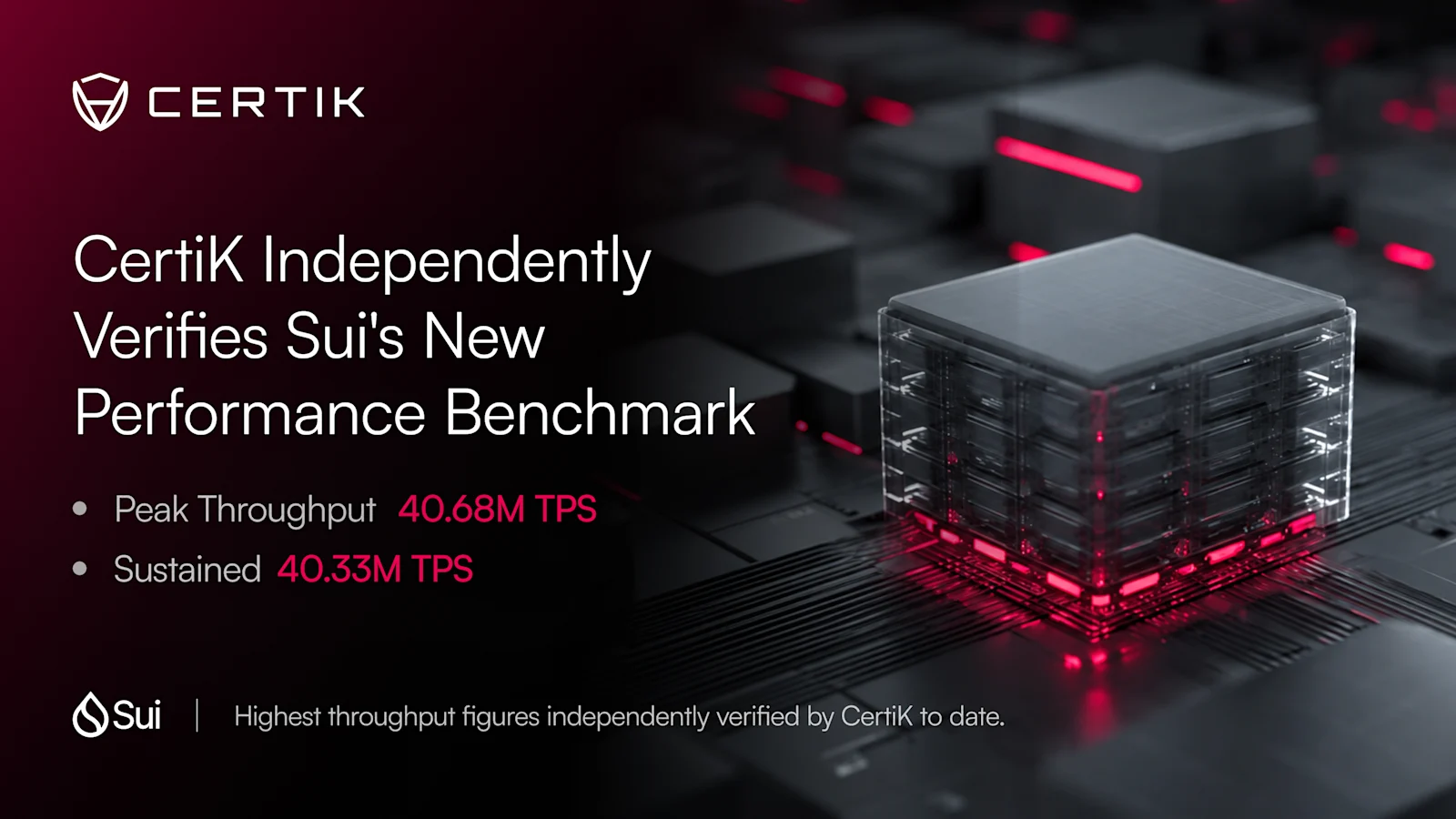
On October 7, 2026, during Sui Basecamp Day, Sui ran a live Mainnet performance campaign to show what its Tunnel architecture can handle at scale. The campaign recorded 15,241,348,297 tunnel transactions across 7,680 tunnels, and every tunnel was opened and settled on chain. At its highest point, the campaign reached 40,682,328 transactions per second (TPS).
CertiK was engaged to independently verify these results. The Sui team supplied the campaign data and executed all test scenarios. CertiK then examined the retained evidence, recalculated the transaction counts and throughput, and checked that each part of the campaign reconciled. The verified results confirm a Peak Tunnel TPS of 40,682,328 and a Sustained Tunnel TPS of 40,339,143.65.
What Are Sui Tunnels?
A Sui Tunnel lets a small group of participants carry out many application actions without sending each action to the blockchain. When a tunnel opens, Sui records the participants, their authorization keys, the protocol rules, the initial state, and the custody terms. Inside the tunnel, participants exchange signed transition receipts that represent payments, game moves, or agent actions. When the tunnel closes, Sui records the agreed final state, the outcome, and the settlement.
The intermediate actions happen off-chain, but they remain verifiable. An auditor can replay the signed receipts through the application’s protocol rules, rebuild the final state, and compare it with the on-chain settlement record. This reduces the data and gas required on the base layer while keeping entry, custody, and final settlement anchored to Sui.
Tunnels belong to the same state channel family as Bitcoin’s Lightning Network, but they support a broader range of applications. Lightning is optimized for payments and payment routing. Programmable tunnels can carry application-specific state transitions, which makes them suitable for gaming, agent coordination, and other interactive use cases.
The Benchmark Results
The campaign ran 10 runs across five workload types: simple payments, flash, blackjack, tic-tac-toe, and battleship. The runs were spread across 960 slots, with eight tunnels in each slot, for a total of 7,680 tunnels.
The peak result came from the busiest complete second of the campaign, between 08:46:17 and 08:46:18 UTC, when 40,682,328 qualifying tunnel transactions were committed. Throughput held close to that level for a full minute. The highest 60-second rolling average, from 08:46:07 to 08:47:07 UTC, came to 40,339,143.65 TPS. That one-minute window alone contained 2,420,348,619 qualifying transactions.
Simple payments made up the largest share of the campaign. Its 6,144 tunnels committed more than 12 billion transactions, which is 78.98% of the campaign total. The other workloads ranged from roughly 433 million transactions for blackjack to more than 1.6 billion for flash.
The workloads were staggered rather than launched all at once. All five workload types ran at the same time for 288.179 seconds. Within that period, all 7,680 tunnel windows were open together for 148.545 seconds, and this period of full concurrency is where the peak and sustained results were recorded.
How Throughput Was Measured
CertiK’s report sets out a strict definition of what counts as a transaction. In this campaign, a transaction is a tunnel transition receipt that meets three conditions: it is valid under the protocol, it carries all required authorization proofs, and it appears exactly once as committed in the canonical journal. Only transactions committed strictly inside the measured play window are included in the count.
The methodology also avoids a common way of inflating throughput figures across many parallel channels. For concurrent tunnels sharing the same time window, CertiK adds their qualifying transaction counts once and divides by a single shared duration. The report does not add individual per-tunnel rates together, and it does not multiply a single tunnel’s rate by the number of tunnels.
For the peak and sustained metrics, only complete one-second intervals aligned to UTC are counted. Partial seconds at the edges of the measurement window are excluded. The final values were taken from the campaign summary and cross-checked by recomputing them from the retained arrival-second counts.
The Verification Process
CertiK verified the campaign on dedicated AWS infrastructure with 128 vCPUs and 247 GiB of RAM. A Python controller scheduled the work in waves, and within each wave a native Rust audit adapter verified each tunnel independently. The adapter used Sui-supplied libraries for receipt admission, workload protocols, and archive verification.
All 7,680 executions and all 960 slots reached VERIFIED status. The 15,241,348,297 committed in-window transactions matched the full-history admitted receipts exactly, and every tunnel’s admitted count matched the count declared on chain. Opening and closing checkpoint numbers and timestamps also agreed across every execution. Authorization, deadline, state-continuity, and resulting-state checks passed for all 7,680 executions.
Billions of Transactions, Anchored on Sui
Although tunnels move most activity off-chain, Sui’s base layer still has to open, fund, and settle large numbers of tunnels quickly. If the base layer is slow, entry and exit become the bottleneck, even when activity inside the tunnel is fast.
The campaign shows how efficiently this anchoring can work. All 7,680 tunnels were opened through 960 shared opening transactions and settled through 960 shared closing transactions, with each transaction serving eight tunnels. As a result, more than 15.2 billion off-chain transactions were anchored to Sui through just 1,920 distinct on-chain lifecycle transactions.
Understanding the Scope of the Results
The report is clear about what these figures represent. Tunnel TPS measures qualifying off-chain tunnel transactions per second. It is not a measurement of Sui’s on-chain transaction capacity, and dividing off-chain transactions by on-chain lifecycle time should not be presented as on-chain TPS.
The report is equally transparent about the limits of its evidence. CertiK reconciled the arithmetic, receipt counts, and timestamps, but it did not re-execute individual signatures or carry out a fresh cryptographic replay of every receipt. The available records do not establish physical clock accuracy, failure rates, latency percentiles, or results across repeated runs. The sustained figure is the highest observed 60-second average, not a minimum throughput guarantee.
These boundaries matter. Large throughput claims are only as meaningful as the method behind them, and stating clearly what was and was not verified makes the result easier for developers, institutions, and the wider ecosystem to evaluate.
Looking Ahead
The results show that Sui Tunnels can support very high off-chain throughput on Mainnet, across multiple application types, while keeping custody and settlement anchored on chain. In this model, Sui acts less like a processor for every individual interaction and more like a shared registry, escrow, and final court of settlement. Participants agree on the rules when they enter a tunnel, interact directly under those rules, and return to Sui with the final result.
Tunnels can also be combined with other technologies, such as trusted execution environments, zero-knowledge proofs, multi-party computation, and verifiable randomness, to strengthen privacy and execution assurance. These extensions were outside the scope of this verification, but they point to a growing range of applications for the tunnel design.
For more information, download the full report here.
FAQs
What did CertiK verify in the Sui Tunnel performance report?
CertiK independently verified and recalculated data from Sui’s October 7, 2026 Mainnet Tunnel campaign. It confirmed that all 7,680 executions across 960 slots were VERIFIED. It also recomputed the campaign’s transaction counts and throughput from the retained evidence.
What was the peak TPS recorded for Sui Tunnels?
The peak Tunnel TPS was 40,682,328 transactions in a single complete second. The sustained Tunnel TPS, measured as the highest 60-second rolling average, was 40,339,143.65.
Does this mean Sui processes 40 million transactions per second on chain?
No. Tunnel TPS measures qualifying off-chain tunnel transactions. Tunnels open and settle on Sui, but intermediate actions are processed off-chain, so the figure is not a measurement of Sui’s on-chain transaction capacity.
How many transactions were recorded during the campaign?
The campaign recorded 15,241,348,297 committed tunnel transactions across 7,680 tunnels. These were anchored by 1,920 distinct on-chain lifecycle transactions: 960 openings and 960 settlements.
What is a Sui Tunnel?
A Sui Tunnel lets a group of participants execute many application actions off-chain without submitting each one to the blockchain. Sui records the participants, keys, protocol, and custody terms when the tunnel opens. It then records the agreed final state and settlement when the tunnel closes.