Summary
- Banking KYC combines identity verification, document verification, and AML screening to reduce financial crime while accelerating customer onboarding.
- Use a risk-based approach (CDD vs. EDD), automate where possible, and keep humans in the loop for edge cases.
- Track outcomes with clear metrics like time-to-approve, false positives, and risk profiles, and maintain ongoing monitoring across the customer lifecycle.
What are KYC Services for Banking?
Know Your Customer (KYC) services help banks and financial institutions verify customer identities, assess risk, and meet regulatory requirements for anti-money laundering (AML) and countering terrorist financing (CTF). In practice, KYC is not a single step. It begins before account opening and continues throughout the customer lifecycle.
Core components of KYC include the following elements:
- Identity Verification: digital identity, biometric, liveness, and authentication.
- Document Verification: government IDs, proof of address, and business documents.
- Sanctions Lists & Watchlists Screening: PEP exposure and law enforcement notices.
- Risk Assessment: jurisdiction, beneficial ownership, and activity pattern.
- Customer due diligence (CDD) and enhanced due diligence (EDD) for high-risk profiles
- Continuous monitoring and alerts for changes in customer information and behavior
KYC vs. AML: How They Fit Together
KYC and AML are closely linked, but serve different functions.
KYC focuses on verifying and validating customer identity and information, particularly during onboarding and periodic reviews. AML builds on this foundation by monitoring activity, detecting suspicious behavior, investigating alerts, and filing required reports. In Web3 environments, AML uniquely extends to on-chain wallet activity, where transaction patterns, counterparties, and fund flows can be analyzed directly on the blockchain to identify risks.
Together, KYC and AML form a control system that balances regulatory compliance with a smooth customer experience. Strong KYC reduces noise downstream, making AML programs more effective and less reactive.
A Risk-Based KYC Workflow (End-to-End)
A modern KYC program adapts its depth based on risk. The goal is speed for low-risk customers and rigor where exposure is higher.
Pre-Onboarding: Information Gathering
Customer data is collected with consent and verified against eligibility criteria, including jurisdiction and product access. Early signals help segment customers into standard or higher-risk paths before deeper checks begin.
Identity and Document Verification
Where possible, verification should happen in real time. This typically includes an ID scan, paired with a selfie or liveness check, to verify identity and reduce impersonation. Document verification looks for tampering, expiration, and mismatches. Device and biometric signals add another layer of confidence.
Sanctions, PEP, and Adverse Media Screening
Customers are screened against sanctions lists, watchlists, and PEP databases using fuzzy matching to catch variants without overwhelming teams with false positives. Effective triage is critical here to keep queues moving.
Risk Assessment and Due Diligence Depth
Customer Due Diligence (CDD): Standard customers with clean signals can be approved automatically.
Enhanced Due Diligence (EDD): Higher-risk profiles trigger deeper checks, including source of funds, source of wealth, extended documentation, and manual analyst review.
Here is a more in-depth comparison of the two:
| Area | Customer Due Diligence (CDD) | Enhanced Due Diligence (EDD) |
|---|---|---|
| Use case | Standard risk | High-risk (jurisdiction, PEP, unusual activity) |
| Data depth | Basic identity, standard screening | Additional documents, beneficial ownership, source of funds |
| Turnaround | Often real-time | Hours to business days |
| Review | Mostly automated | Human analyst + senior approval |
| Monitoring | Standard cadence | Tighter thresholds, more frequent re-screens |
Decisioning and Onboarding
Approval or rejection decisions are recorded in the case file with a clear rationale. Controls are documented, and product-level rules such as transaction limits or stepped-up authentication are applied as needed.
Ongoing Monitoring
KYC does not stop at onboarding. Periodic re-screening, transaction-based alerts, and lifecycle reviews ensure risk profiles stay current as customer behavior and external data change.
Provider Landscape: What to Look For
Choosing the right KYC provider directly affects both compliance outcomes and customer conversion. Here are some key criteria to look for:
- Coverage: Global data sources, multilingual document support, and cross-border ID coverage.
- Accuracy and Speed: Real-time verification for low-risk and predictable SLAs for manual reviews in business days.
- Functionality: APIs, SDKs, webhook events, case management, audit trails, and fraud prevention signals.
- Risk-Based Controls: Configurable rules for kyc verification and risk assessment.
- Regulatory Compliance: Clear mappings to KYC regulations and compliance requirements in target markets.
- Security and Privacy: Encryption, role-based access, and data minimization for personal data.
Automation That Actually Helps (Without Breaking UX)
Automation works best when it reduces friction rather than creating it.
Effective approaches include adaptive forms that change based on customer type and jurisdiction, real-time checks to prevent abandonment, and automated triage that suppresses obvious false positives. Risk-based step-ups allow passive checks first, with biometrics or additional documents used only when signals warrant. Automated re-screening and event-driven monitoring keep profiles up to date without manual effort.
Banking, FinTech, and Web3: Same Goals, Different Details
Banks operate under heavier regulatory scrutiny and typically rely on deeper data sources and more extensive due diligence. FinTech companies tend to prioritize conversion and user experience, often using modular KYC solutions with strong APIs. Crypto and Web3 organizations place added emphasis on beneficial ownership, transparent controls, and risk-based monitoring for both users and internal teams.
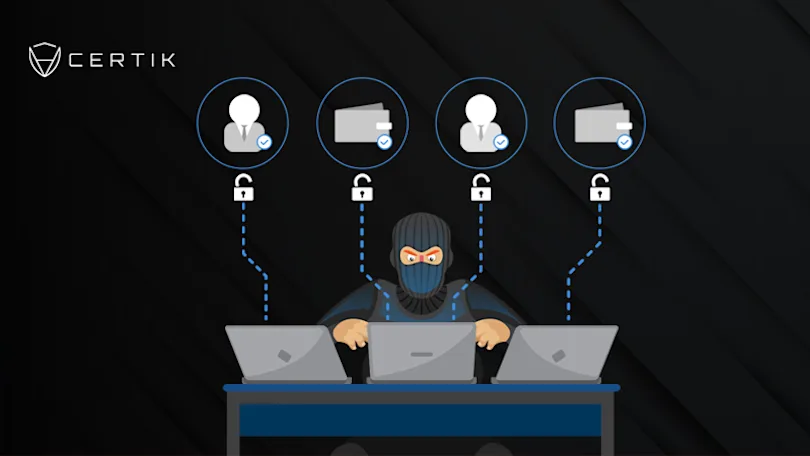
Web3 introduces unique risks that go beyond standard identity checks. Unlike traditional banking, you often deal with global, anonymous teams and unknown wallet controls, where the true owner is hidden. This requires specialized industry knowledge to analyze on-chain activities, ensuring that, even if a user's ID is valid, their wallet hasn't interacted with sanctioned mixers, hacks, or darknet markets. Without this specific fluency, you risk onboarding clean identities linked to dirty funds.
How CertiK Can Help
CertiK offers KYC services tailored to banking and fintech needs: identity verification, business verification (including beneficial ownership), AML/sanctions screening, and ongoing monitoring.
We deliver end-to-end workflows, risk-based decisioning, and an auditable trail so you can meet KYC compliance while protecting growth and the customer experience. Pair KYC with our broader security offerings to manage risk across your full lifecycle.