Executive Summary
Trading activity across centralized exchanges cooled in H1 2026, with volume easing from last year's highs as the broader market softened. That made the half less a contest of raw trading volume and more a test of whether centralized exchange leadership rests on turnover alone or on balance-sheet depth. As activity normalized, the gap between venues widened once volume was read alongside reserves, stablecoins, Bitcoin custody, and open interest.
Balance-sheet depth is where the separation showed. Binance led both spot and futures volume while also holding the largest clean-asset and stablecoin base in the market, and Coinbase Pro held the most Bitcoin of any venue. No single metric defined the H1 leaderboard; the overlap across several did.
The other shift was scope. Tokenized stocks, exchange-traded funds (ETFs), pre-initial public offering (pre-IPO) exposure, and broader traditional finance instruments moved deeper into centralized exchange product lines, pushing competition from which token an exchange lists toward which venue can connect crypto liquidity to broader markets.
Spot and Futures Volume Measured Different Businesses
Binance cleared approximately USD 1.76 trillion in spot volume and USD 9.24 trillion in futures volume from January through June month to date. OKX ranked second in futures volume at USD 4.15 trillion, followed by Gate at USD 2.53 trillion, Bybit at USD 2.27 trillion, and Bitget at USD 1.61 trillion.
In spot markets, Binance led at USD 1.76 trillion, followed by Bybit at USD 397.8 billion, Gate at USD 368.5 billion, Coinbase at USD 329.5 billion, and OKX at USD 314.6 billion. Futures was the more concentrated book: Binance's USD 9.24 trillion ran more than twice OKX's USD 4.15 trillion, with Gate, Bybit, and Bitget forming the next tier.
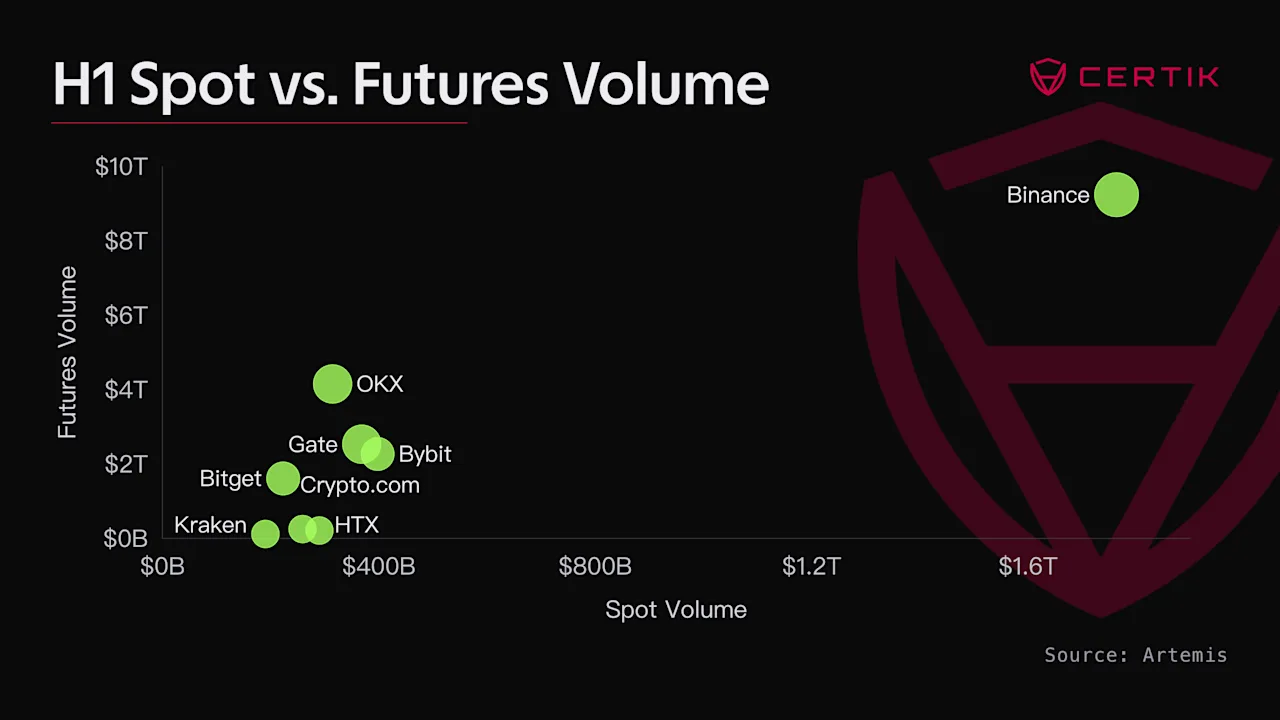
The split means market share has no single answer. Binance ranked first in both spot and futures, while OKX ranked second in futures but outside the spot top tier. Bybit held meaningful scale in each. Coinbase ranked high in spot volume and Bitcoin custody but is not represented in the futures series used here.
Read through a spot lens, a derivatives lens, or a custody lens, the H1 ranking reshuffles each time.
Open Interest Fell From January Highs and Stayed Concentrated
Average open interest concentrated at the top. From January 1 to June 30, H1-to-date average open interest was roughly USD 23.3 billion at Binance, USD 10.6 billion at Bybit, USD 6.5 billion at Bitget, and USD 6.4 billion at OKX. The ranking did not mirror futures volume one-for-one, but it showed the same broad concentration: Binance led by a wide margin, while Bybit, Bitget, and OKX formed the next liquid derivatives tier.
The direction of travel was the same across venues. By the June 30 end-period snapshot, Binance open interest was about USD 19.7 billion, Bybit USD 8.6 billion, Bitget USD 5.2 billion, and OKX USD 5.1 billion. The major derivatives venues fell from the start of the year within a relatively tight band: Binance declined 28.0%, Bybit 32.7%, Bitget 30.7%, and OKX 29.4%. A contraction that uniform reads as market-wide, rather than specific to any one exchange.
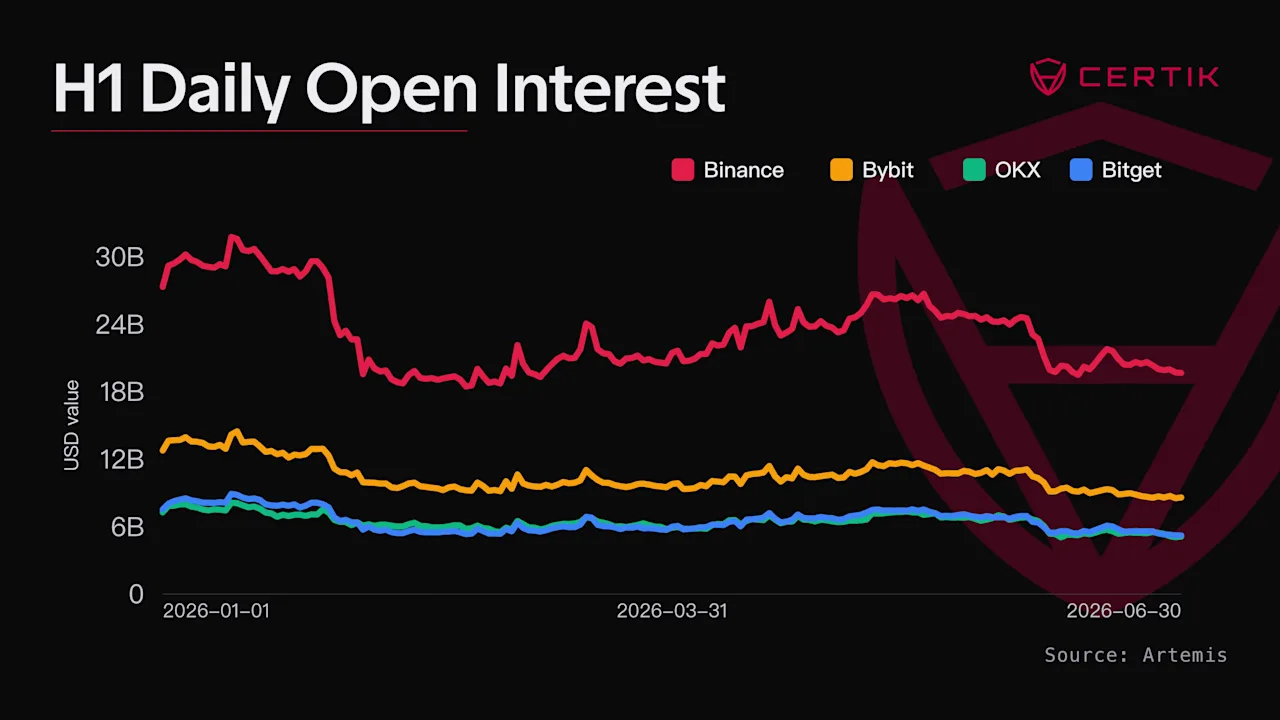
The peaks clustered in mid-January. Binance topped out near USD 31.8 billion on January 13, Bybit at USD 14.5 billion on January 14, Bitget at USD 8.9 billion on January 13, and OKX at USD 8.1 billion on January 13. Derivatives risk inventory did not build through the half; it peaked early, fell, and settled into a lower second-quarter range.
Reserve Base Separated the Field More Than Volume Did
Reserve base provides a second layer for reading exchange structure. Assets measure total tracked exchange-wallet holdings, while clean assets strip out exchange-native and related tokens to make venues more comparable. Stablecoins, Bitcoin, and Ether provide a narrower view of liquid core reserves.
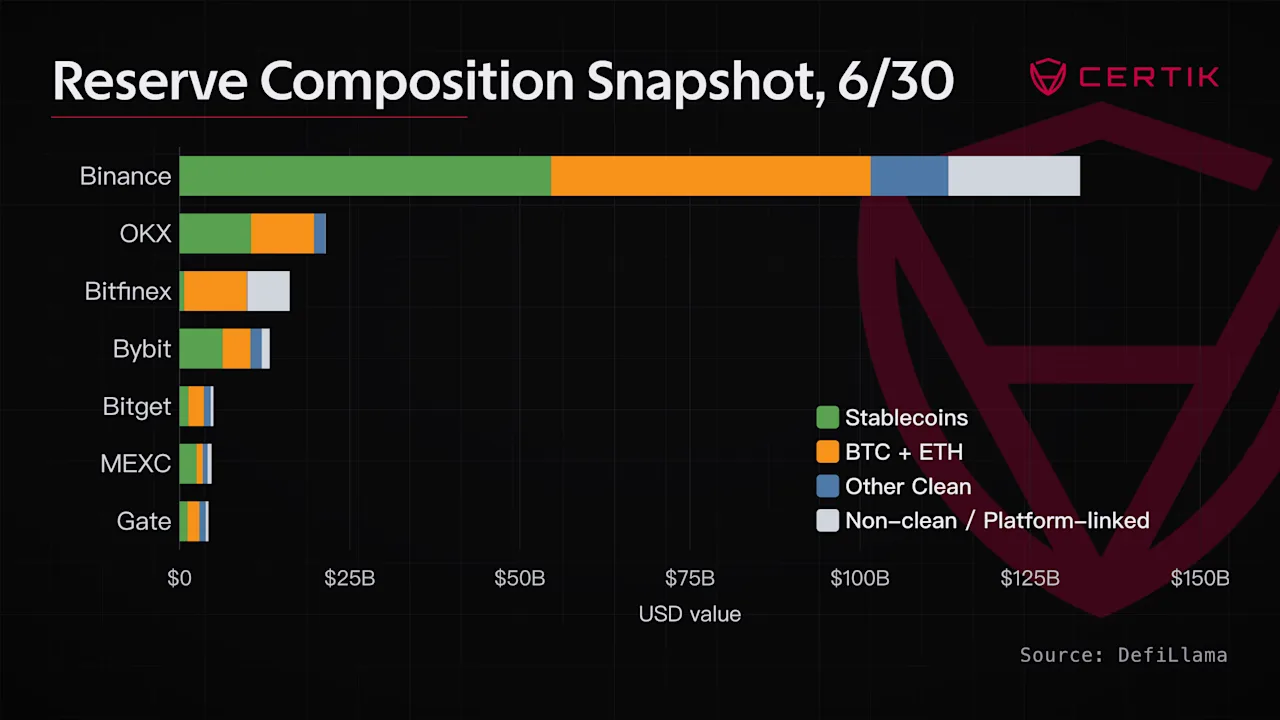
As of June 30, the gaps were an order of magnitude, not a few percentage points. Binance held about USD 131.9 billion in assets and USD 112.5 billion in clean assets. OKX followed at USD 21.4 billion in assets and clean assets, Bitfinex at USD 16.1 billion and USD 9.9 billion, Bybit at USD 13.2 billion and USD 12.1 billion, Robinhood at USD 10.5 billion and USD 10.5 billion, Bitget at USD 4.9 billion and USD 4.6 billion, MEXC at USD 4.7 billion and USD 4.1 billion, and Gate at USD 4.2 billion and USD 3.8 billion.
Stablecoin reserves concentrated the same way. Binance held about USD 54.3 billion, OKX USD 10.5 billion, Bybit USD 6.2 billion, MEXC USD 2.5 billion, Bitget USD 1.3 billion, KuCoin USD 1.2 billion, and Gate USD 1.1 billion. The largest venue by total assets was also the largest stablecoin settlement pool.
Bitcoin custody told a different story at the top. Coinbase Pro held about 851,807 BTC, ahead of Binance at 645,893 BTC, Bitfinex at 417,740 BTC, Kraken at 145,818 BTC, OKX at 91,414 BTC, Bybit at 49,327 BTC, Bitget at 36,681 BTC, and Gate at 23,123 BTC.
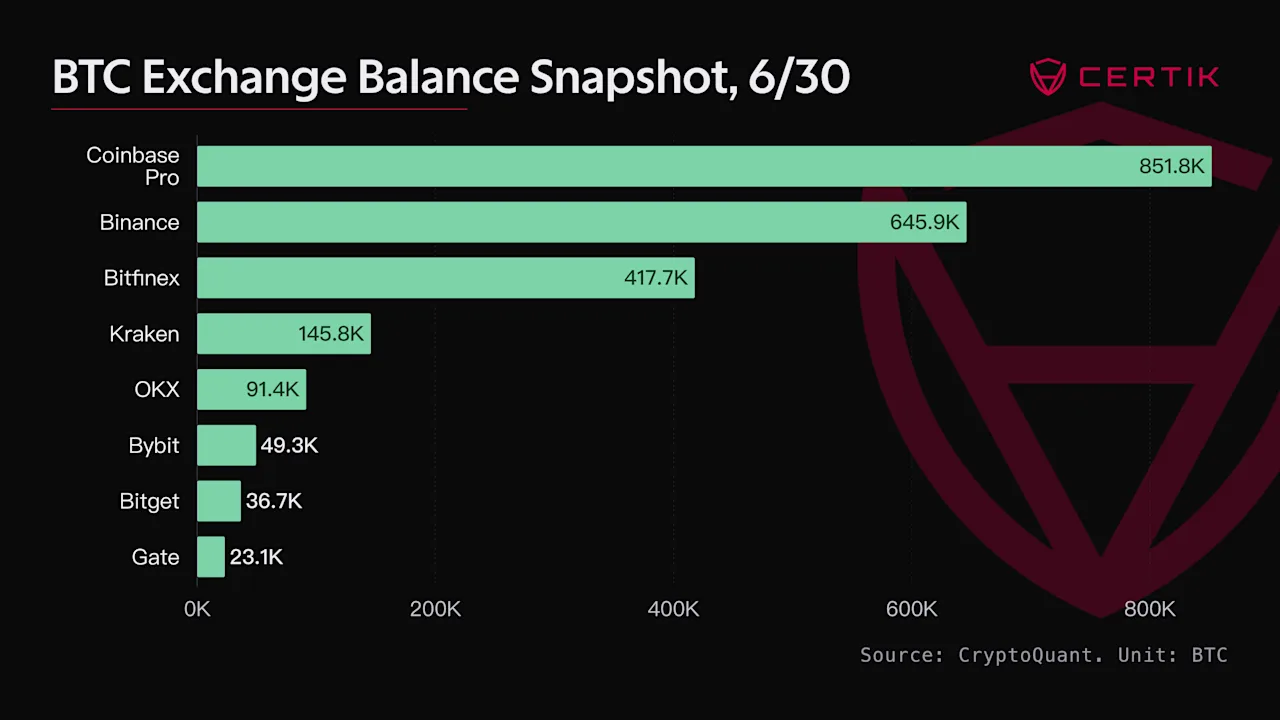
Each measure captures a different strength, and the leader changes with the lens. Clean assets show asset depth, stablecoin reserves show settlement capacity, and Bitcoin custody shows long-term asset retention. Coinbase Pro led on Bitcoin custody, while Binance ranked at or near the top on assets, clean assets, stablecoins, spot volume, and futures volume. The reserve gap was wider than the volume gap: Binance's total assets were roughly 6.2 times OKX's and more than 31 times Gate's.
Adjusted for Core Reserves, the Open Interest Ranking Reorders
Raw open interest shows where derivatives positions concentrate. It does not show the liquid reserve base behind that exposure. The open interest-to-core-reserve ratio adds that lens by measuring how much open interest sits against each dollar of stablecoin, Bitcoin, and Ether reserves.
This is not a direct solvency ratio. Open interest is not the same as an exchange liability, and derivatives risk also depends on margining, insurance funds, liquidation engines, market-making depth, and user positioning. It is still useful for one comparison: how concentrated derivatives exposure is relative to an exchange's liquid reserve base.
As of June 30, Binance carried about USD 22.3 billion in open interest against USD 101.8 billion in core reserves, an open interest-to-core-reserve ratio of 21.95%. Among the other venues, Bitfinex recorded 9.73%, OKX 31.38%, Crypto.com 57.26%, Bybit 87.34%, Bitget 174.46%, MEXC 250.91%, and Gate 268.45%.
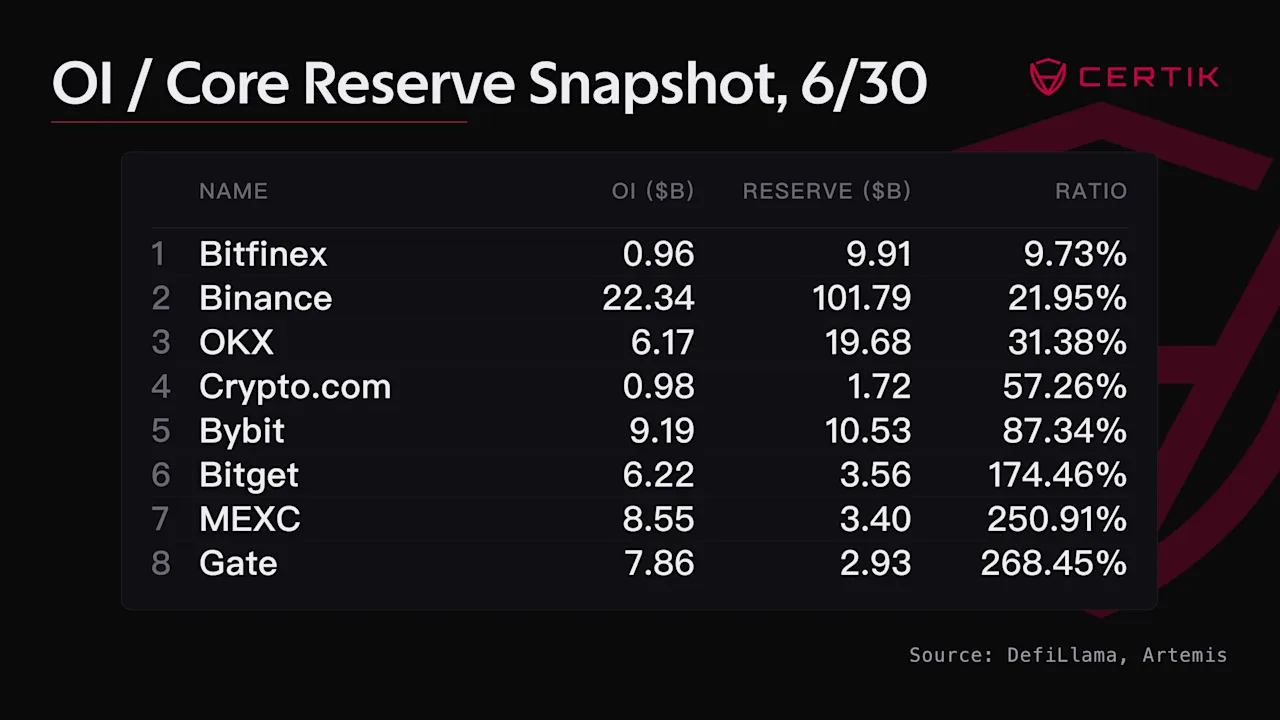
This is where the ranking changes. Binance carried the largest open interest in absolute terms, yet its ratio stayed below 22%, lower than every derivatives-heavy peer. OKX remained near 31% and Crypto.com near 57%, while Bybit ran close to parity. Bitget, MEXC, and Gate carried open interest well above their core reserves.
The read is straightforward. Binance runs the most derivatives activity in the market, yet that activity sits on a far larger reserve base than any peer. Depth on both sides—the open positions and the reserves behind them—is a large part of why users keep defaulting to Binance and why liquidity keeps concentrating there.
The ratio does not rank exchange safety on its own. It shows whether derivatives activity is supported by a broad liquid reserve base or by a thinner reserve stack relative to open interest.
Product Lines Expanded Beyond Crypto
H1 product competition was not only about new listings. Exchanges began extending trading accounts, stablecoins, and global distribution into markets outside crypto.
Binance launched two stock-related product lines. Direct Stocks sits closer to traditional brokerage access, covering more than 7,000 U.S. stocks and ETFs with stablecoins as the settlement layer. bStocks are 1:1-backed tokenized securities that can move onto BNB Chain and into self-custody and decentralized finance. The two lines cover both models at once: brokerage-style access and on-chain tokenized equity.
Peers moved along the same axis from different starting points. Robinhood launched more than 200 U.S. stock and ETF tokens in Europe and announced Robinhood Chain. Kraken's xStocks offers tokenized stocks and ETFs, with coverage listed at more than 100 companies. Bybit launched IPO Express, starting with tokenized pre-IPO exposure to SpaceX. Bitget spanned tokenized stocks, pre-market exposure, and traditional finance instruments through Reality and rTokens, Stocks 2.0, and IPO Prime.
The models differ. Some provide brokerage access, some offer 1:1-backed tokenized equities, some offer pre-IPO exposure, and others provide synthetic traditional finance instruments. The common thread is direction, not design: each represents an attempt to convert crypto-native liquidity into cross-asset distribution.
That direction loops back to stablecoin reserves. Tokenized stocks and pre-IPO products look like equity products on the surface, but underneath they still run on stablecoin settlement, trading-account capital efficiency, and global user distribution. The H1 product race was therefore not only about which exchange listed stocks; it was about which venue could wire crypto liquidity into larger financial markets.
Closing
H1 2026 made one thing clear: volume still matters, but it no longer explains centralized exchange competition on its own. A fuller assessment needs spot volume, futures volume, average open interest, clean assets, stablecoin reserves, Bitcoin custody, the open interest-to-core-reserve ratio, and product scope in the same frame.
As trading normalized, the differences at the top became easier to see. Binance's position rested on no single number; it ranked at or near the top across spot volume, futures volume, average open interest, assets, stablecoin reserves, and cross-asset products.
Coinbase Pro led on Bitcoin custody. OKX, Bybit, Bitget, Gate, and MEXC each showed distinct strengths, whether in futures activity, spot trading, reserve composition, derivatives intensity, or product expansion. The field no longer sorts cleanly by one ranking.
The open question for H2 is whether tokenized stocks and pre-IPO access can move from launch to recurring volume. If stocks, ETFs, pre-IPO exposure, and real-world asset products start generating sustained activity, centralized exchange competition will depend less on crypto market beta and more on which venue can connect stablecoin settlement, trading liquidity, and global access to broader cross-asset markets.
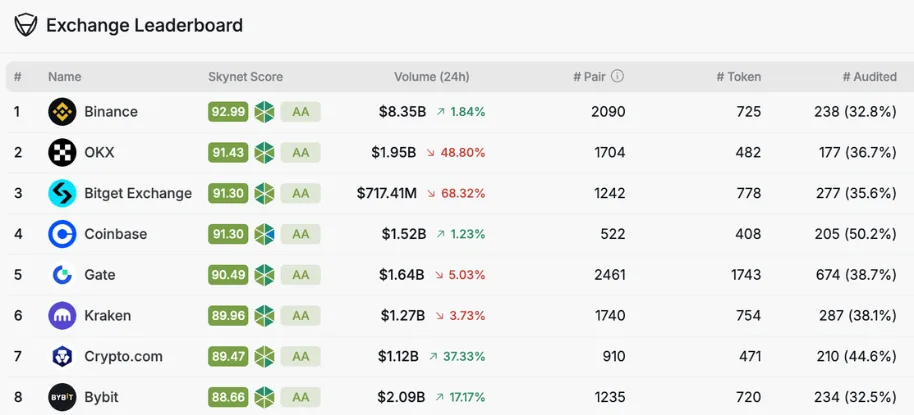
Track the latest CertiK Skynet exchange transparency rankings.