
Services
Formal verification for Web3 security
Prove that specified security and correctness properties hold for the reviewed code. CertiK defines the properties with your team and verifies them against an explicit model and set of assumptions.
From startup launch to global enterprise
Security spotlights
CertiK received recognition from over 25 leading global companies for its significant contributions to security.

Delphinus Lab zkWasm
CertiK formally proved circuit soundness for the covered zkWasm circuits against a model of WebAssembly semantics. See the proof repository for scope and assumptions.

TON
The Open Network (TON) has its Masterchain contract, the top layer of its chain consensus, formally verified by CertiK. Two subtle bugs were discovered during the work.

Ant Group HyperEnclave
HyperEnclave by Ant Group is a cross-platform trusted execution environment. Its core components have been formally verified by CertiK. The work has been accepted by ASPLOS'24 conference.

Cosmos SDK
Cosmos SDK is the world's most popular framework for building application-specific blockchains. CertiK formally verified its standard Bank module, a first for L1 modular frameworks.
Ethereum Foundation grant, Rocq tactics
Under an Ethereum Foundation grant, CertiK delivers "Better Rocq tactics" that streamline modular arithmetic and packed integer handling for zkVMs.
Scope
Prove the properties your system depends on.
Define critical security and correctness properties with your team, verify them under explicit assumptions, and document the results for the reviewed code.
Scale
Common Security Properties for popular smart contracts such as ERC-20 and ERC-721 have been automatically verified for hundreds of projects during their auditing.Precision
Advanced custom security and correctness properties, such as the increase-K property of AMM, have been specified and proved precisely for complex smart contracts in addition to their regular auditing.Coverage
In addition, CertiK also formally verifies other blockchain building blocks such as consensus protocol, etc. Basic systems infrastructure, such as Enclave Hypervisor, can also been formally verified.
Method
All audit processes are not created equal
Combine manual review, automated checks, and formal proofs according to the engagement scope. Each method contributes evidence about the code and properties reviewed.
- Most vendors and CertiK
Manual code review
Examine in-scope code and business logic.
- Few vendors and CertiK
Automated checks
Apply supported checks to the code.
- CertiK
Custom formal verification
Prove agreed properties under stated assumptions.
Why CertiK
Why CertiK?
CertiK researchers work with your engineers to define the properties that matter, model the relevant code, and prove agreed guarantees. Our work spans smart contracts, protocol components, and infrastructure such as zkWasm and Ant Group’s HyperEnclave.
Benefits
Benefits of CertiK Custom Formal Verification
Tailored to the native languages running in your project
Highly customized for the features of your project, protocol, or virtual machine
Developed by a world-class team of academics, researchers, and engineers
FAQ
Questions, answered
Formal verification uses mathematical reasoning to prove that specified properties hold within a defined model. The guarantee applies to the reviewed components and depends on the specification, model, and stated assumptions.
An audit examines code and design to identify vulnerabilities and recommend fixes. Formal verification proves agreed properties under explicit assumptions. The two approaches can be combined within the same engagement.
A flaw in a deployed smart contract can be costly to fix. The ability to change the contract depends on its upgrade design. Formal verification helps teams establish that selected properties hold before deployment or an upgrade.
Formal verification can identify complex logical errors, subtle consensus flaws, incorrect arithmetic handling, reentrancy risks, token standard inconsistencies, and protocol-level edge cases that may not be detectable through manual inspection alone.
CertiK works with your team to specify security and correctness properties for the selected code. Researchers construct and check proofs, then document the results, scope, and assumptions using the verification approach suited to the system.
CertiK automatically verifies common properties for widely used smart contract standards such as ERC-20 and ERC-721. This includes checks for token behavior consistency, access control constraints, and common exploit patterns.
Yes. CertiK formally verifies blockchain building blocks, including consensus protocols, masterchain contracts, modular frameworks, zkVM components, and even foundational infrastructure such as enclave hypervisors.
For a specified property, a proof covers all behaviors represented by the model under its assumptions. Auditing and testing can address additional risks in the implementation, integrations, and operating environment.
CertiK combines formal methods research with work on production software, including zkWasm circuit soundness and Ant Group’s HyperEnclave components. Published research and project materials explain the properties proved and the assumptions used.
Resources
Learn more from our resources
 Policy pulseProving zkWasm Sound: Inside CertiK and Delphinus Lab’s Formal Verification ResearchCertiK and Delphinus Lab formally verified the circuit soundness of zkWasm. The researchers explain what was proven, the bugs it uncovered and what comes next.
 Technical insightsTensorLean: CertiK and Columbia University Researchers Formally Verified Production AI Kernels from DeepSeek and FlashAttention Explore how CertiK and Columbia University researchers use TensorLean for formal verification of production GPU kernels from DeepSeek and FlashAttention.
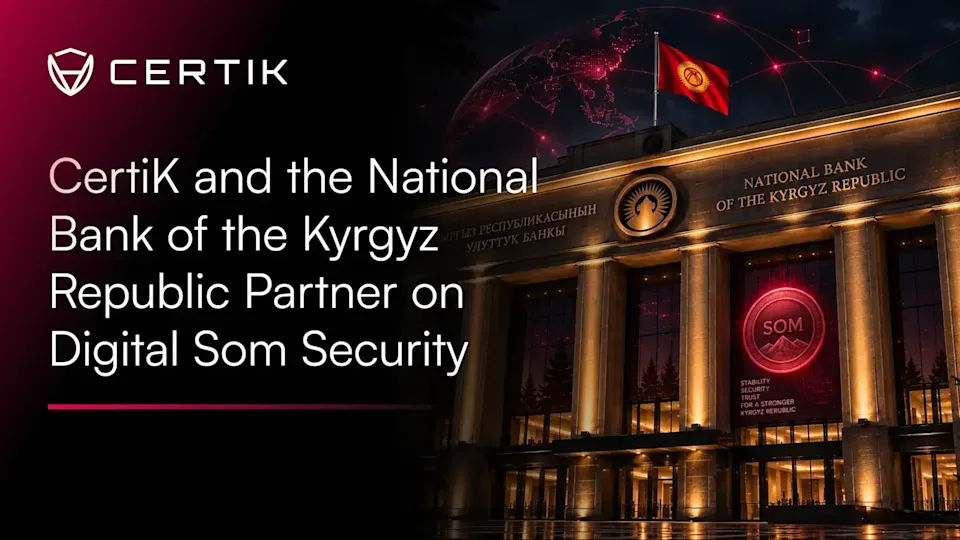 Policy pulseHow Central Banks Secure Digital Currency before Launch: Inside the CertiK and NBKR DealKyrgyzstan’s central bank is developing a digital version of its national currency, the Digital Som. On 9 September 2026, it signed a Memorandum of Understanding with CertiK, the largest Web3 security services provider, on Digital Som security and broader digital asset oversight. The partnership spans security assessment, formal verification, operational resilience, and ongoing risk monitoring, connecting technical security with longer-term risk management and regulatory oversight.
 Company updatesCertiK Formally Verifies zkWasm, Proving Mathematical Soundness of a Leading zkVMCertiK’s formal verification of zkWasm provides mathematical proof that a leading zero-knowledge virtual machine executes programs correctly — a rigor level beyond traditional audits, now validated for ACM CCS 2026.
 Company updatesCertiK Joins LF Decentralized Trust to Advance Security Standards for Enterprise BlockchainCertiK joins LF Decentralized Trust to bring formal verification and security expertise into the open-source infrastructure enterprises are building on amid intensifying global regulation.
 Company updatesCertiK Sponsors the First Theorem Proving Competition, Supported by OpenMathThe first Theorem Proving Competition, hosted by the China Computer Federation (CCF) officially launched. The competition is supported by OpenMath, the world’s first decentralized mathematical platform, with backing from Shentu Chain and CertiK.