
Choosing an AI model appears simple from the user's side: select a model name, send a prompt, and receive an answer. Behind the interface, the request may pass through a gateway, a reseller, or one of several provider endpoints. Each route can differ in price, latency, availability, rate limits, and service quality. As access to models becomes increasingly aggregated, routing becomes part of the product even though most users never see it.
DGrid is a useful case study of this emerging layer. It is a Web3-native AI model gateway that connects users and Agents with more than 200 models. It also combines a paid membership system, onchain Agent identities, x402-compatible payments, an Arena for comparing model outputs, and Proof of Quality (PoQ) for evaluating model and provider performance.
The important question is not whether DGrid can offer a long model list. It is whether the network can use provider choice and evaluation data to improve how requests are executed. That requires separating three things that are often grouped together: access to models, evidence about service quality, and the decision to route a request differently because of that evidence.
This distinction also clarifies the role of crypto. Putting identities or payments onchain does not make an artificial intelligence response more accurate. The relevant test is whether onchain identity, programmable payment, and verifiable records improve coordination around an otherwise offchain model service.
The Route Is Becoming Part of the AI Product
DGrid states that its platform connects more than 200 models. This breadth can reduce integration work and give users a common interface for services that would otherwise require separate accounts, billing systems, and application programming interfaces (APIs). The number of models, however, says little about how well a request is executed.
The more relevant structural signal is provider redundancy. As of July 31, 2026, 96 enabled models had two or more provider routes. When only one provider can serve a request, a gateway mainly simplifies access. When several providers can serve the same model, the gateway has a real execution choice.
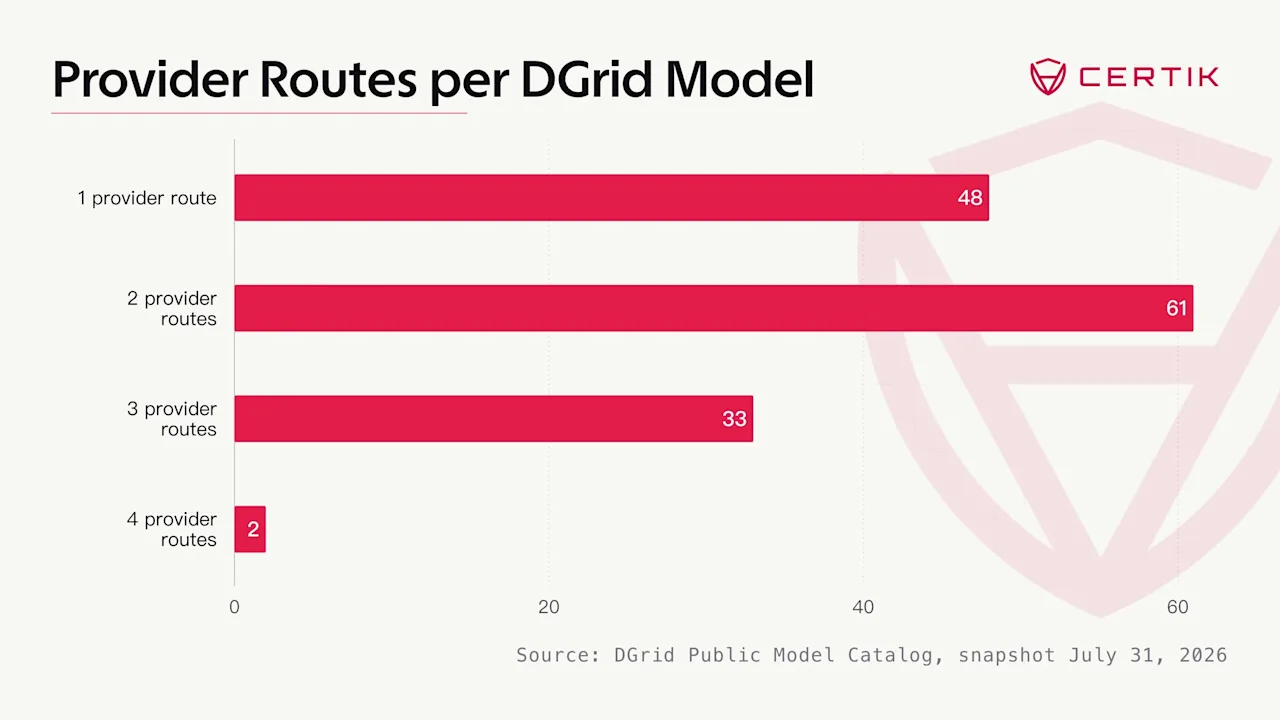
That choice may involve price, latency, availability, rate limits, geographic coverage, or observed output quality. It also creates a failover option when one endpoint becomes unavailable. For a developer, the practical value is not the number of logos in a catalog, but whether the routing layer can reduce failures or deliver a better cost-performance tradeoff without requiring manual intervention.
Multiple routes create the conditions for better routing, not proof of it. A useful benchmark would send equivalent requests through eligible providers and record successful completion, time to first token, total latency, billed cost, output consistency, and failover behavior. Results would also need to be segmented by model, task type, language, time, and region, because an endpoint that performs well in one setting may not lead in another.
This is where a routing dataset could become more valuable than the catalog itself. Popular models can be added by competing gateways or integrated directly by developers. A continuously updated history of provider behavior is harder to reproduce, provided that DGrid captures the data and actually uses it to change execution.
Aggregation Creates a New Trust Problem
A gateway reduces integration complexity by adding an abstraction layer. The same abstraction also creates a verification problem. Users request a named model, but they do not necessarily observe which provider served it, whether the expected model version was used, or whether service quality changed after the request entered the routing layer.
This creates several possible failure modes. A provider might substitute a cheaper model, deliver a degraded version, become less reliable during peak demand, or continue returning valid-looking responses while output quality declines. None of these scenarios requires a total outage. The API can remain available while the service received by the user changes.
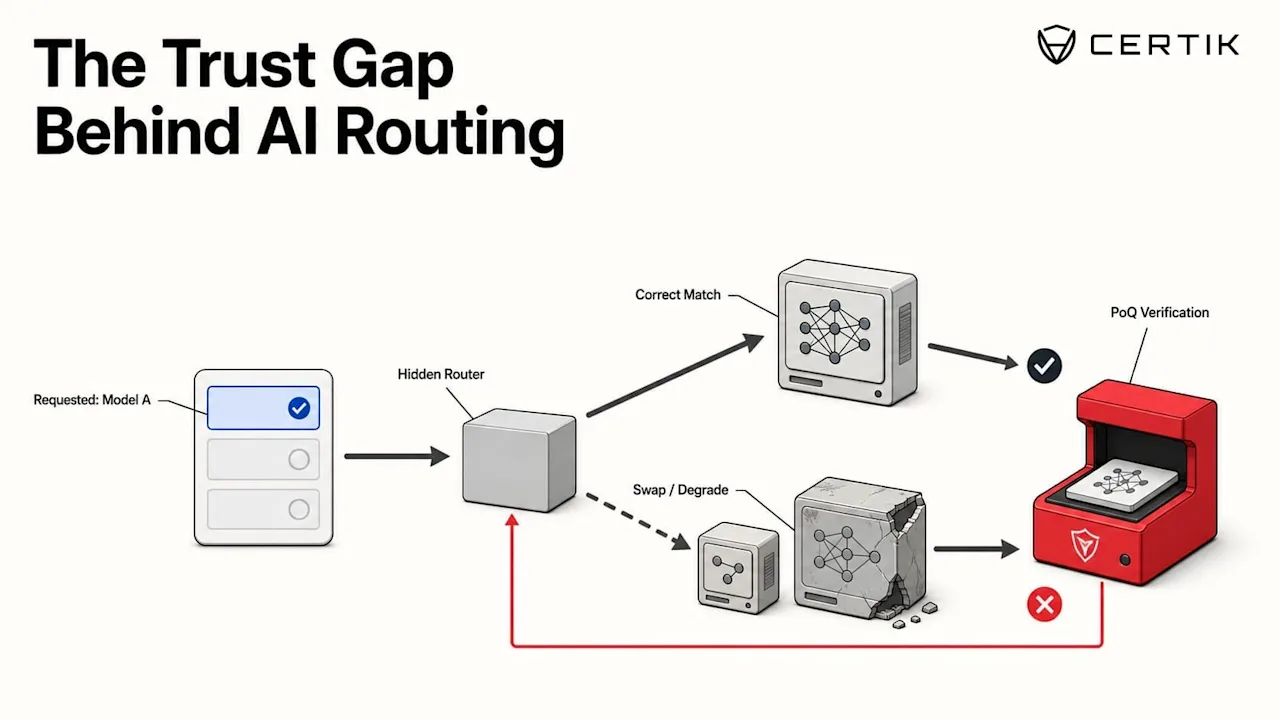
PoQ is DGrid's proposed response to this problem. It is intended to evaluate model identity, service behavior, and output quality, including the possibility of model replacement or silent degradation. DGrid has published code, datasets, configurations, and experimental results, making the mechanism inspectable and testable.
The current evidence supports a technical experiment, not a production conclusion. Public data does not yet show what share of live requests is checked, how often PoQ detects a problem, its false-positive rate, or the latency and cost added by verification. Most importantly, it does not show how frequently a PoQ result changes an actual route.
That final connection determines whether PoQ becomes operationally useful. A quality signal that does not affect execution remains descriptive. When several providers can serve the same model, the signal can become actionable by selecting, rejecting, repricing, or reserving a provider as a fallback.
Agents Could Supply Both Demand and Evaluation
DGrid's Agent layer adds a machine-native participant to the routing system. As of July 31, 2026, public records contained 4,385 DGrid-related ERC-8004 Agent registrations across 3,702 owner addresses. Approximately 90.5% of those addresses registered only one Agent, suggesting that registrations were distributed beyond a small set of large batch operators.
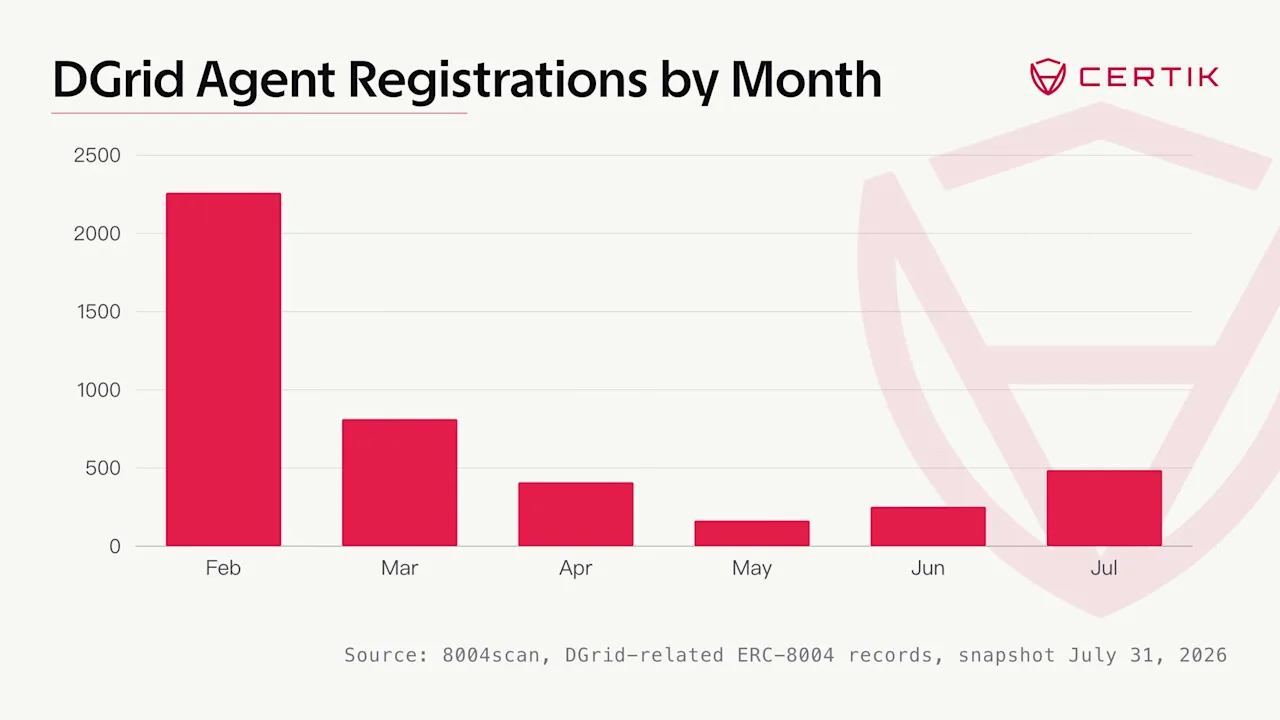
Registration is still an identity event rather than evidence of activity. The figures do not establish 4,385 active Agents, 3,702 individual owners, or an equivalent number of paying customers. July added 487 registrations, approximately 93% more than June, but registration growth does not reveal whether Agents complete tasks or remain active.
A total of 736 records were marked as supporting x402, concentrated in June and July. x402 can place API payment inside the request flow, allowing an Agent to access a model without relying entirely on a prepaid account or repeated human approval. Compatibility alone does not establish payment volume, settlement value, or useful work.
Agents may also participate in DGrid's Arena by comparing model outputs. This creates a dual role: calling a model generates Gateway demand, while evaluating the response generates data about model performance. In theory, those evaluations could provide another input to routing.
The quality of that input cannot be inferred from evaluation volume. Points and future rewards may encourage participation, but they can also attract copied judgments, low-effort submissions, coordinated behavior, or conformity with the majority. Useful reporting would include agreement between human and Agent evaluators, accuracy on reference tasks, consistency over time, and the share of Arena results that influence a production decision.
Genesis Provides Distribution, Not Yet a Usage Metric
Genesis is DGrid's paid membership program. Its NFT-based credential includes artificial intelligence usage credits, model services, and other platform benefits. The program gives DGrid a way to establish a commercial relationship with users and direct them toward the Gateway before its token generation event.
DGrid reports that Genesis generated more than USD 23 million in sales during the first half of 2026 and that the platform has more than 15,000 paying users. As of July 31, the Genesis NFT showed 6,164 holder addresses. Together, these figures describe a paid distribution base with an observable onchain footprint.
They do not describe what happens after purchase. A holder address is not an active customer, and a membership sale does not establish recurring model demand. The relevant operating measures are benefit activation, AI credit consumption, repeat model usage, and recurring API requests by member cohort.
Genesis matters to the routing thesis only if distribution converts into usage. If members repeatedly use the Gateway, the program becomes a demand channel for the model network. If activity fades after the initial purchase, the sales figure remains commercially meaningful but contributes less to the case for a recurring AI service economy.
The Missing Evidence Is the Connection Between Components
DGrid's proposed loop can now be stated clearly: Genesis supplies an initial paid audience; users and Agents generate model requests; multiple providers create routing choices; Arena and PoQ produce performance evidence; and that evidence may improve the next execution decision. x402 could add machine-native payment to the same flow.
The components are visible, but their operating connection is not yet established. Sales measure paid participation rather than recurring usage. Agent registrations measure identity formation rather than completed work. Multiple provider routes measure optionality rather than routing performance. PoQ experiments demonstrate a testable mechanism rather than production impact.
The next evidence should therefore focus on conversion and causation:
- How many Genesis members become recurring Gateway users?
- How many registered Agents remain active, complete tasks, and generate model spending?
- What share of requests has multiple eligible routes?
- How often do Arena or PoQ signals change provider selection?
- Do those changes improve cost, latency, availability, or output quality?
Monthly cohort reporting would help separate launch-driven activity from retained usage. A controlled routing benchmark would test whether provider choice produces measurable gains. PoQ coverage, detection accuracy, verification overhead, and route-change frequency would show whether quality verification has moved from experiment to operation.
DGrid is therefore most interesting as an attempt to connect three layers that are usually discussed separately: AI distribution, machine-native demand, and service-quality verification. The public evidence shows that each layer exists.
The decisive result will be whether they alter one another in production: usage creates quality evidence, quality evidence changes routing, and changed routing produces a better outcome for the user.