Crypto wallets are no longer used only to store assets. They increasingly bring more networks, tokens, decentralized applications, swap routes, yield products, and cross-chain services into the same interface. As a result, a wallet is becoming an execution environment for self-custody, not just a place where private keys are kept.
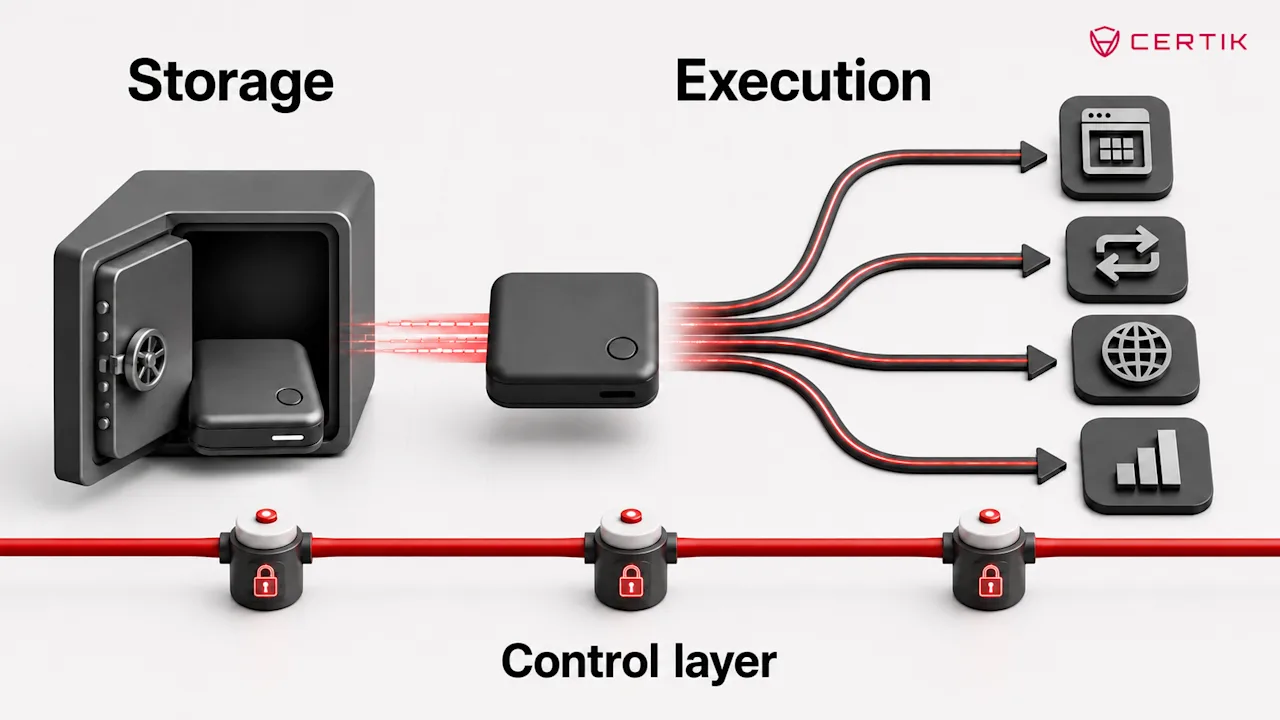
That expansion creates a product challenge. When users can do more through a wallet, the wallet must also help them control more of the risks involved. In this article, the control layer refers to the systems that help users generate, recover, understand, and safely use their wallet authority. Recovery, firmware integrity, and transaction review are core elements of that layer. Incident response is a cross-cutting operational element: when a vulnerability is discovered, users must be able to understand the risk, protect their assets, and take the necessary next step.
The recent Coldcard incident provides a useful starting point. In late July 2026, attackers began draining Bitcoin from wallets whose seeds had been generated on vulnerable Coldcard firmware. Security researchers linked the incident to a flaw in the seed-generation process that caused some devices to rely on weaker-than-intended randomness. Because the weakness affected the seed itself, attackers reportedly did not need physical access to the devices.
Updating the firmware could protect newly generated seeds, but it could not repair seeds that had already been created under the vulnerable process. Affected users needed to generate new wallets and move their funds. The Hacker News and CBC have reported on the technical issue and the required response.
The Coldcard incident was not caused by the wallet supporting too many assets or applications. It exposed a failure before a user ever signed a transaction. The expansion of wallet functionality creates a different set of risks later, when users connect to applications and authorize transactions. These are not the same failure, but they reveal the same strategic requirement: wallet security controls must scale across the full ownership lifecycle.
An Expanding Security Threat Landscape
The need for broader wallet controls is visible in the wider Web3 security environment. CertiK’s Hack3D H1 2026 report recorded 344 Web3 security incidents and total losses of USD 1,315,676,432 during the first half of 2026. Wallet compromise was the most costly attack category, accounting for USD 444,531,691 across 33 incidents. After funds that were frozen or returned were accounted for, adjusted losses stood at USD 1,200,364,925.
These figures establish the scale of the security problem, not the effectiveness of any individual wallet feature. They do show why the control question matters. As more value moves through wallets and more actions are completed through wallet interfaces, failures in key generation, recovery, transaction interpretation, or incident response can have consequences at scale.
The Coldcard incident illustrates an individual failure in key generation, but it sits within a broader environment of growing onchain threats and expanding wallet roles. The next question is whether users can safely control that broader access surface.
The Expanding Wallet Access Surface
Users increasingly access multiple networks, tokens, decentralized applications, swap routes, yield products, and cross-chain services from the same wallet interface.
DCENT’s current product pages provide one example of this shift from storage to execution, connecting wallet users with broader yield, cross-chain, and fiat-access services. The important point is not the partner list itself. It is that the wallet becomes an entry point to more financial actions rather than a passive place to hold assets. This direction is also reflected in DCENT’s participation in an XRP-focused alliance connecting hardware wallets with yield vaults.
Every new action path adds context that users must understand before signing. A transaction may involve token approvals, contract calls, bridge interactions, swap routing, or a connection to a decentralized application. The user is no longer evaluating only an address and an amount.
As the access surface grows, the control surface must grow with it. That does not mean adding warnings everywhere. It means providing the right controls at the right stages of the user journey.
Three Layers of Wallet Control
The broader argument can be organized around three control layers: key integrity, recoverability, and transaction understanding. Incident response is not a separate fourth layer so much as a cross-cutting operational element. Users must be able to recognize a vulnerability, migrate assets when necessary, and return to a safe state for each layer to provide meaningful protection.
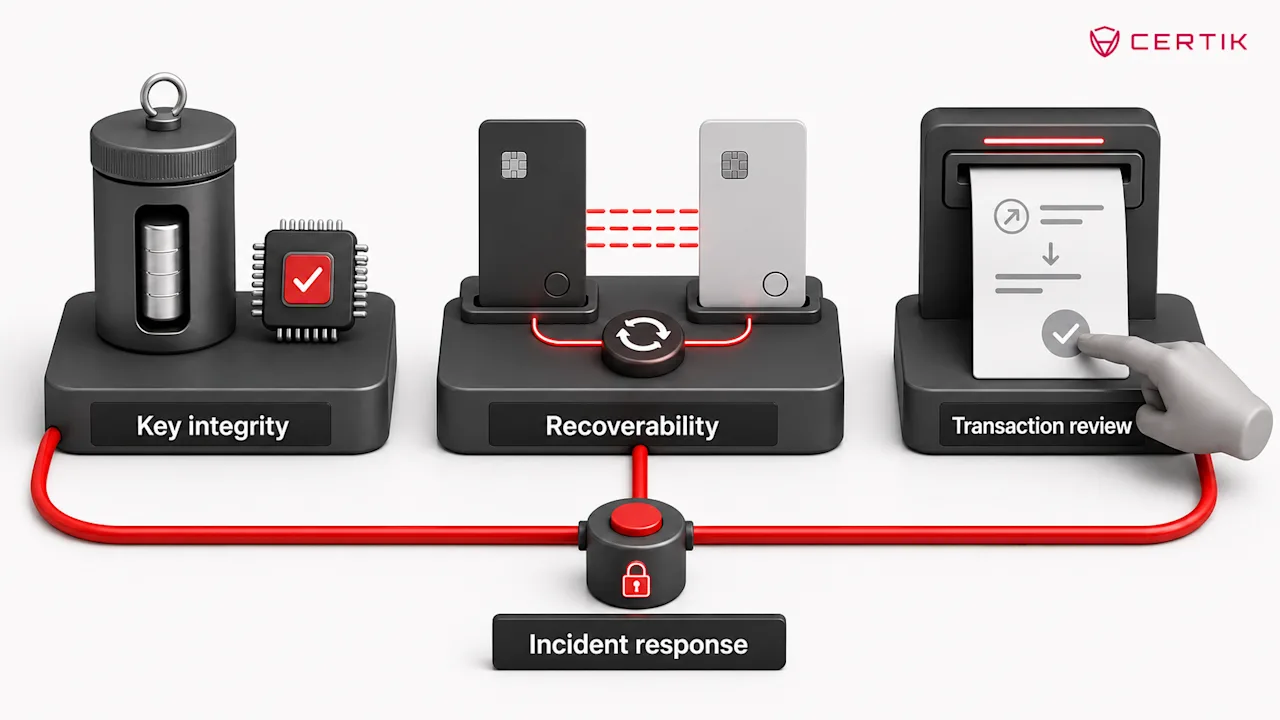
1. Key Integrity: Protection Before the Wallet Is Used
The Coldcard incident highlights the first layer. A wallet may be physically offline and still be compromised if the secret it generated was predictable from the beginning.
Security must therefore begin before storage and before signing. Seed-generation quality, entropy, firmware integrity, and release management are foundational controls. An air gap limits certain remote attack paths, but it cannot correct a weak seed. A secure element can protect the data stored inside it, but it cannot make an insufficiently random secret unpredictable.
The incident also shows why patching and incident response matter. Updating firmware may protect new wallets without repairing existing seeds. Users need clear guidance on whether they must migrate funds, and the product must make that response understandable.
2. Recoverability: Turning Ownership Into a Continuing Capability
Self-custody is often described as control over private keys. In practice, it also requires a reliable way for the legitimate owner to regain access after a device is lost, damaged, or replaced.
Traditional paper seed phrases place most of this responsibility on the user. The user must create the backup correctly, store it securely, find it when needed, and use it without exposing it. The system may be cryptographically sound while the recovery experience remains operationally fragile.
One product response is DCENT’s DCENT S, which separates everyday signing from recovery through a dedicated R3covery backup card. The main card is used for daily transactions, while the backup card is designed to restore the wallet if the main card is lost. The DCENT S product page also describes a setup that does not require users to write down a 24-word seed phrase on paper.
This design does not, by itself, prove a higher recovery success rate. It illustrates how recovery can be incorporated into the product interface rather than treated as an afterthought. The relevant performance questions are whether users complete the backup process, understand the separation between the main and recovery cards, and can successfully restore their assets when a replacement is required.
The Coldcard incident makes this distinction especially important. Recovery is not only about restoring access; it is also about knowing whether the wallet being restored is still trustworthy. If a seed was generated under a vulnerable process, restoring it faithfully is not a security success.
3. Transaction Understanding: Control Before the User Signs
The third layer concerns what happens immediately before a user authorizes an action.
DCENT is also one example of a wallet integrating pre-signing threat detection. In its description of the integration, Blockaid says the system scans token interactions, smart-contract activity, wallet addresses, and decentralized-application connections before approval. It also uses transaction simulation to identify unexpected transfers or contract calls and warn users before signing.
This kind of control addresses a different risk from the Coldcard vulnerability. Coldcard demonstrates that the integrity of key generation matters before a wallet is ever used. Transaction simulation and threat detection address the risk that a legitimate key may later be used to authorize a malicious or misunderstood action.
Both layers are necessary because modern wallet risk is not concentrated in one moment. It can arise when a key is generated, when a backup is created, when firmware is updated, when a user connects to an application, or when a transaction is approved.
Product Features Versus Measured Outcomes
The DCENT example illustrates how a wallet provider can address several control layers alongside a broad access surface: key and asset management, dedicated recovery design, and pre-signing risk detection.
It should not, however, be presented as proof of measured security outcomes. Public product information does not yet establish recovery success rates, transaction volume, warning override rates, false-positive rates, or the number of users who successfully migrated after a security alert.
Those measurements would be necessary to determine how effectively a wallet converts security architecture into operational protection. A wallet can have a strong feature set and still leave users exposed if the features are difficult to understand, rarely used, or unable to guide users through an incident.
Conversely, a well-designed control layer can reduce the operational burden of self-custody without removing the user’s authority over the assets.
Conclusion
The Coldcard incident did not show that expanding wallet access causes every security failure. It showed that wallet security can fail at a foundational layer before a transaction is ever signed. The growth of multi-chain and onchain functionality creates a different challenge: users need more help understanding and controlling the actions they initiate.
These issues converge on the same strategic requirement. As wallets expand from storage into execution, their control layers must cover the full ownership lifecycle: key integrity, recoverability, transaction understanding, and response to failure.
Multi-chain coverage is the starting point. Reliable key generation, recoverability, transaction interpretation, and incident response determine whether that access can be used safely.
The future of self-custody will not be defined only by how many assets a wallet supports. It will be defined by how much informed control it can provide before, during, and after every critical action.
Sources
- CertiK Hack3D: H1 2026 Report
- DCENT official website
- DCENT S Card Wallet
- Blockaid: No More Scam Transactions—DCENT Alerts You in Real Time
- The Hacker News: Coldcard Hardware Wallet Flaw Linked to Bitcoin Theft
- CBC: What We Know About the Ongoing Coldcard Hack
- The Block: XRP Alliance Debuts as Flare and DCENT Link Hardware Wallets to XRP Yield Vaults