

CertiK Blog
Security research, regulatory insights, and data-backed analyses for the institutional Web3 era. Turning real-world signals into actionable intelligence.
Research
View All Research
HOT Bridge / NEAR Intents
On 30 September 2026, HOT Omni Bridge on NEAR was exploited, resulting in five observed BSC treasury payouts totaling $3.86M USD. The attacker used a large pre-existing balance of a custom auxiliary token to request refunds far greater than the amounts in a new deposit. Recording the resulting large decimal amounts expanded the refund event beyond NEAR's 16384 bytes log limit and failed the Intents deposit resolver. HOT subsequently returned the original deposited backing, including USDT, while the Intents credit created by an earlier successful receipt survived.

MakerDAO Legacy Auction Keeper Incident Analysis
On October 6, 2026, at 06:13:11 UTC, an attacker drained 200 ETH ($542,982 at the time of the exploit) of ETH-A collateral from a legacy auction-keeper contract on Ethereum mainnet. The 200 ETH came from four 50 ETH lots that the keeper won with zero bids during MakerDAO's "Black Thursday" liquidations in March 2020 and never settled. An unauthenticated function on the keeper let the attacker give a contract it controlled full delegation over the keeper's MakerDAO Vat account. In a single transaction, the attacker settled the old auctions and withdrew the collateral.

Liquid Network Incident Analysis
On 6 September 2026, the Liquid Network was exploited through a vulnerability in the Elements codebase used to validate Confidential Transactions. The issue stemmed from an ambiguous cache-key encoding in the rangeproof verification cache, allowing two different validation inputs to produce the same cached entry.
Policy Pulse
View All Policy Pulse
U.S Legislation September Recap: Congress Blinked. The Regulators Didn’t.
We look at United States regulatory updates in September 2026, including the results of the CLARITY Act votes, updates on tokenized stocks, market structure guidance by the CFTC, and more.
How Central Banks Secure Digital Currency before Launch: Inside the CertiK and NBKR Deal
Kyrgyzstan’s central bank is developing a digital version of its national currency, the Digital Som. On 9 September 2026, it signed a Memorandum of Understanding with CertiK, the largest Web3 security services provider, on Digital Som security and broader digital asset oversight. The partnership spans security assessment, formal verification, operational resilience, and ongoing risk monitoring, connecting technical security with longer-term risk management and regulatory oversight.
Bridging the Atlantic: Why Security Is the Real Catalyst for Transatlantic Crypto Policy
As I wrap up a three-day DC roadshow coordinating Capitol Hill and agency roundtables for the US/UK Crypto Alliance, one conclusion stands out above the rest: the narrative surrounding digital asset policy in Washington has fundamentally shifted.
Technical Insights
View All Technical Insights
Preparing for a Web3 Penetration Test: What to Expect Before, During, and After
reparing for a Web3 penetration test? Here’s what happens before, during, and after an engagement, and how to get the most value from yours.

Red Team vs. Pentest vs. Bug Bounty: Building a Complete Web3 Security Program
Red team vs. pentest vs. bug bounty for Web3 projects: what each one actually tests, when to use which, and how to combine them into one program.

Tolk Security Explained: From FunC’s Engineering Pain Points to New Audit Considerations
This article compares FunC and Tolk through code, explains how typed schemas, automatic serialization, and lazy loading change TON contract security, and identifies the risks developers and auditors still need to review.
Company Updates
View All Company Updates
CertiK Formally Verifies zkWasm, Proving Mathematical Soundness of a Leading zkVM
CertiK’s formal verification of zkWasm provides mathematical proof that a leading zero-knowledge virtual machine executes programs correctly — a rigor level beyond traditional audits, now validated for ACM CCS 2026.
CertiK Joins LF Decentralized Trust to Advance Security Standards for Enterprise Blockchain
CertiK joins LF Decentralized Trust to bring formal verification and security expertise into the open-source infrastructure enterprises are building on amid intensifying global regulation.
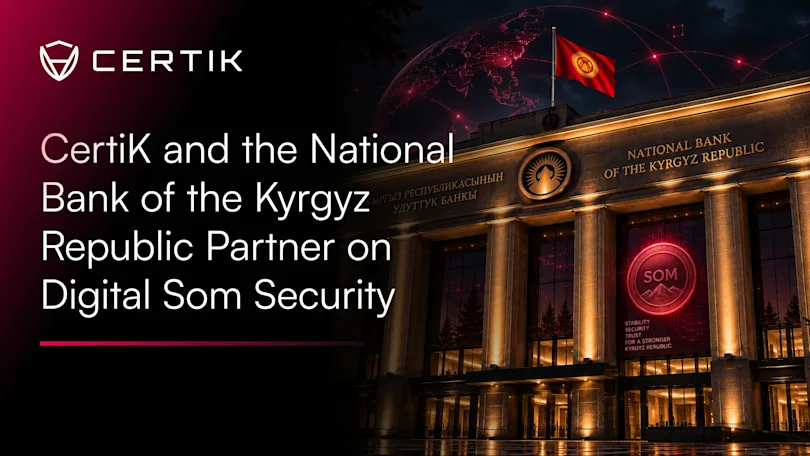
CertiK and the National Bank of the Kyrgyz Republic Partner on Digital Som Security
CertiK signs an MoU with the National Bank of the Kyrgyz Republic to advance Digital Som security, AML/CFT oversight, and digital asset supervision.
Ecosystem Analysis
View All Ecosystem Analysis
Circle’s Arc Mainnet: From a USD 74 Billion USDC Supply to Native Settlement
Circle’s Arc mainnet is scheduled for September 16, 2026, using USDC for gas and settlement while connecting stablecoin scale with institutional and programmable financial activity.

As Wallets Expand From Storage to Execution, Can Their Control Layer Keep Up?
This article examines how crypto wallets must extend security controls across key generation, recovery, transaction review, and incident response as they evolve into execution environments.

CEX H1 2026 Review: Volume Cools, Balance Sheets Decide
This H1 2026 review compares centralized exchanges by spot and futures volume, open interest, reserve depth, Bitcoin custody, and expansion into tokenized stocks and traditional financial products.