Arc’s public mainnet is scheduled to open on September 16, 2026, with USDC serving as both the gas and settlement asset. The chain combines Ethereum Virtual Machine (EVM) compatibility, a permissioned institutional validator set, and announced integrations across payments and tokenized assets. More than 100 ecosystem and institutional builders were already building on Arc during its private-mainnet phase.
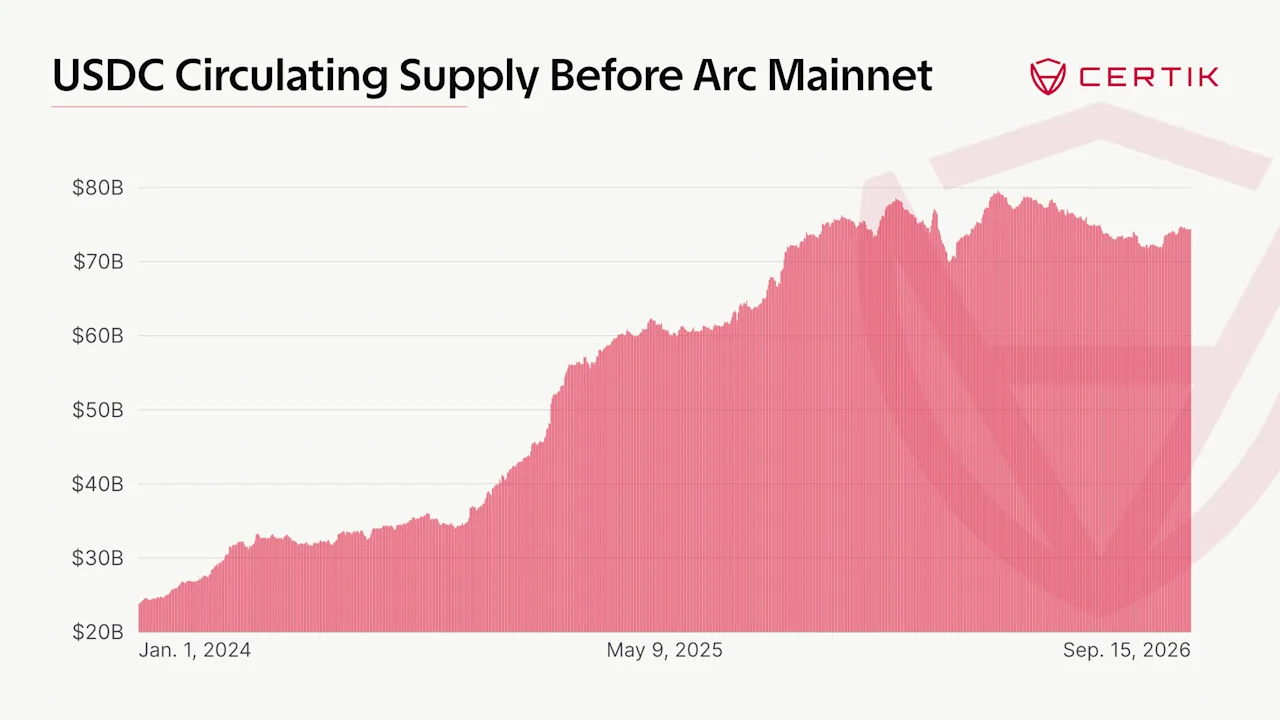
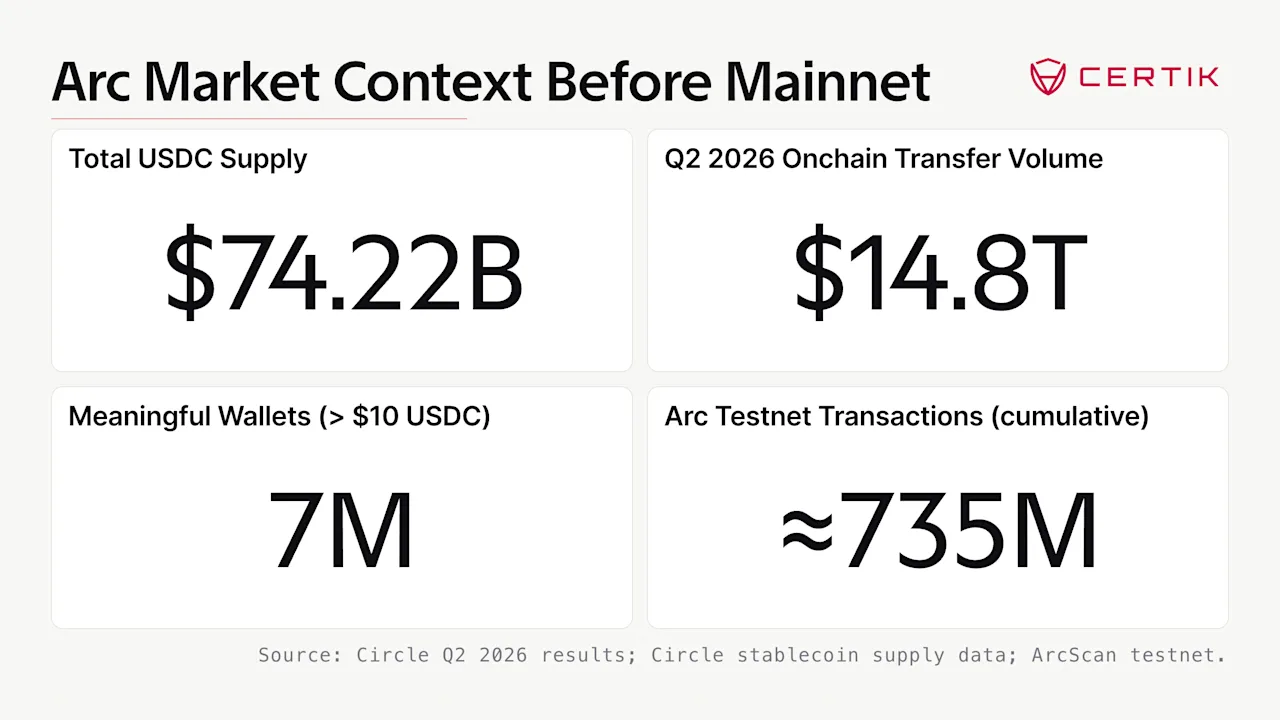
Circle’s total USDC supply was approximately USD 74.22 billion on September 14. Q2 2026 USDC onchain transaction volume reached USD 14.8 trillion, while Meaningful Wallets numbered 7.01 million. These figures give Arc substantial market context as it connects USDC distribution and institutional reach with programmable settlement.
Arc’s public-mainnet launch will show how a USDC-native network can turn stablecoin scale into recurring settlement activity.
USDC-Native Gas Connects Distribution and Settlement
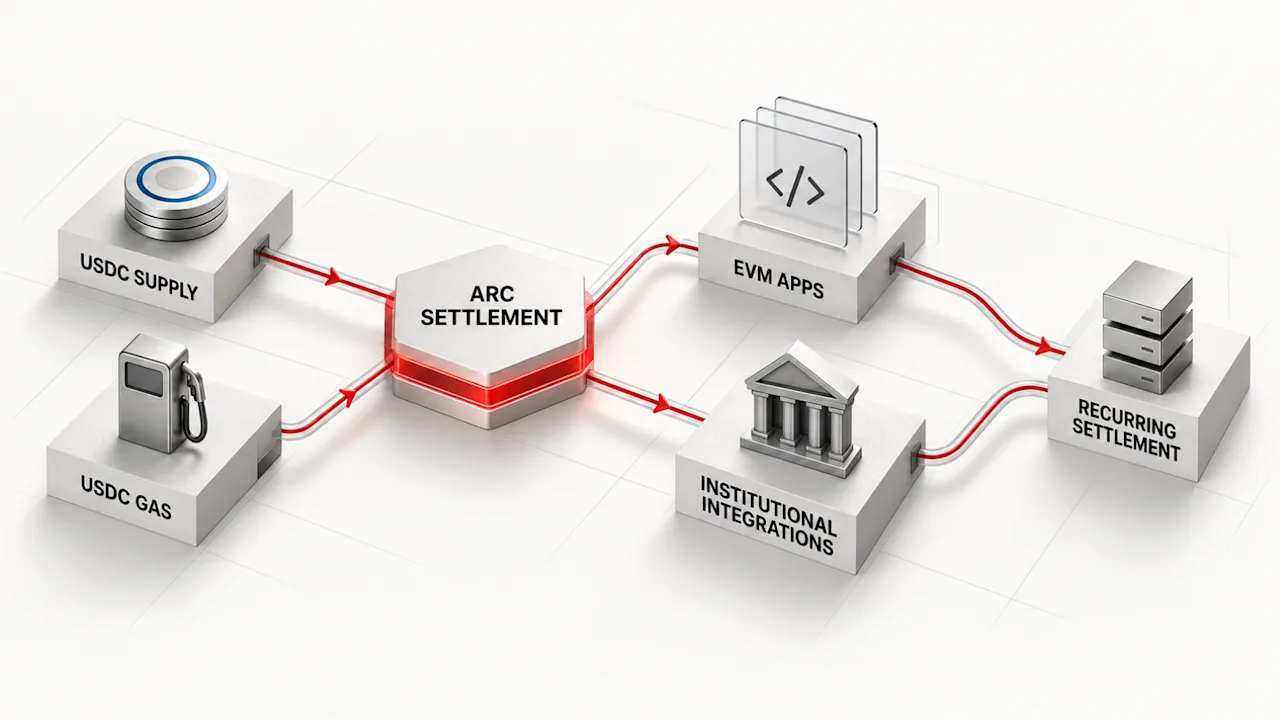
By using USDC for both gas and value transfer, Arc makes the same dollar-denominated asset part of both the transaction path and the settlement path. Users and institutions still need USDC on Arc, but they do not need a separate volatile gas token to pay fees; applications can keep fees and settlement value in USDC. EVM compatibility allows existing developers to bring familiar contracts and tooling.
That design connects network usage to USDC utility. Payments, foreign exchange, tokenized assets, treasury operations, and agentic applications can use one settlement asset for execution fees and value transfer. Arc’s proposition therefore extends beyond another application venue: it can reduce an integration step for financial workflows that already settle in stablecoins.
A USD 74 Billion USDC Supply Sets Arc’s Starting Context
USDC in circulation stood at USD 75.27 billion at the end of 2025 and rose to USD 77.05 billion at the end of Q1 2026. It then fell to USD 73.27 billion at the end of Q2, down 4.9% sequentially, before recovering to approximately USD 74.22 billion by September 14.
During Q2, Circle Mint customers minted USD 83.00 billion and redeemed USD 86.78 billion. Net redemptions of USD 3.78 billion equaled about 2.2% of more than USD 169 billion in combined gross minting and redemption activity; supply can contract while two-way activity remains large.
Meaningful Wallets stood at 7.01 million, up 23.9% year over year, versus 7.19 million at Q1 end. Under Circle’s stablecoin market-share measure, USDC’s share moved from 28% in Q1 to 27% in Q2. Annual wallet growth and quarterly market-share movement describe different parts of the market; together they provide a defined market context for Arc’s launch.
Q2 USDC onchain transaction volume reached USD 14.8 trillion, up 151% year over year and approximately 31% below Q1’s USD 21.5 trillion. The metric covers native and canonically bridged USDC processed on supported chains. It is a gross-transfer measure: it describes activity scale, not unique settlement count. For Arc, it is best read as context for the USDC transfer activity around its target use cases, not as a direct forecast of Arc volume.
Circle’s Q2 results provide the business context: reserve income represented 95.2% of total revenue. Arc could add network and developer-service revenue channels if its USDC utility develops into recurring public-network activity, while greater utility could extend the stablecoin’s role in financial workflows.
Open Application Access, Institutional Consensus
Arc uses USDC as the native asset for gas and value transfer. It pairs an Ethereum Virtual Machine-compatible execution layer with Malachite Byzantine Fault Tolerance (BFT) consensus. Application deployment and full-node operation are permissionless, while the public-mainnet design uses approved Proof-of-Authority validators for consensus. This separates open application access from a permissioned validator layer.
Under Arc’s documented BFT assumptions, safety requires fewer than one-third of validators to be faulty, while liveness requires at least two-thirds of validators to remain online and honest. The published 20-validator benchmark recorded more than 3,000 transactions per second with finality below 350 milliseconds. That profile is aligned with payment, trading, and capital-market workflows that require fast confirmation and predictable execution.
The announced founding cohort includes Circle and 11 named third-party institutions across finance and infrastructure. Arc’s published benchmark used approximately 20 validators, providing a disclosed performance condition alongside the cohort; public operation will add observed validator distribution, uptime, and proposer concentration over time.
A Staged Rollout Creates Arc’s Pre-Launch Integration Window
Arc’s progression from private mainnet in May toward public mainnet in September created time for validator onboarding, application work, and institutional integration work before broad access.
More than 100 ecosystem and institutional builders were already building on Arc during the private-mainnet phase. The sequence gives public mainnet an established group of builders and announced integrations to carry forward.
By September 14, the Arc testnet had recorded approximately 735 million transactions, including about 74.1 million over the 30 complete UTC days from August 15 through September 13. The cumulative count shows the scale of pre-launch activity, while the complete 30-day window shows continuity. Alongside the published 20-validator benchmark, these observations provide context on activity and documented performance before public mainnet.
Announced Integrations Create Potential Settlement Paths
The founding cohort and announced integrations span asset management, market infrastructure, card networks, banks, and payment companies. These participants map to Arc’s stated use cases: tokenized funds, capital-market assets, payments, treasury movement, and foreign exchange.
BlackRock is expected to deploy BUIDL, while the announced DTCC collaboration targets tokenization of DTC-custodied assets beginning in the second half of 2027. If implemented, these arrangements could connect Arc to tokenized-asset, payment, and market-infrastructure workflows, with institutional participants aligned to those use cases.
For each announced integration, the observable progression is announcement, live integration, funded activity, repeated usage, and material settlement. Public mainnet will make it possible to follow that progression. The speed and breadth of movement through these stages will show how announced relationships translate into recurring network activity.
Conclusion
Arc is scheduled to open public mainnet with three concrete starting conditions:
- A surrounding USDC market with approximately USD 74.22 billion in total supply on September 14
- Institutional participation spanning finance and payments
- Stablecoin-native architecture designed for fast settlement
The private-mainnet phase and more than 100 builders show that network and integration work began months before public access.
The measured 7 million Meaningful Wallets and USD 14.8 trillion of quarterly transfer activity provide the market context for Arc’s target use cases. Because USDC is the gas asset, applications have a direct path into payments, foreign exchange, tokenized assets, and programmable financial workflows.
The next phase is conversion: announced integrations moving into funded and repeated activity, USDC’s existing footprint supporting Arc-native liquidity, and benchmark performance translating into observed mainnet service levels. If those links develop, Arc can strengthen its role in settlement and extend USDC utility across financial workflows.
Arc’s public mainnet is a concrete attempt to turn USDC’s existing distribution scale into programmable settlement. It starts with a defined asset, institutional participants, and announced integrations; September 16 will move that conversion from design and preparation into observable operation.
Sources
- Circle Announces Founding Validator Cohort and Major Integrations for Arc, August 5, 2026
- Circle Q2 2026 Form 10-Q, filed August 5, 2026
- Circle Reports Second Quarter 2026 Results, August 5, 2026
- Circle Stablecoin Supply API
- Arc Network Overview and Consensus Layer
- ArcScan Testnet and Transaction Series