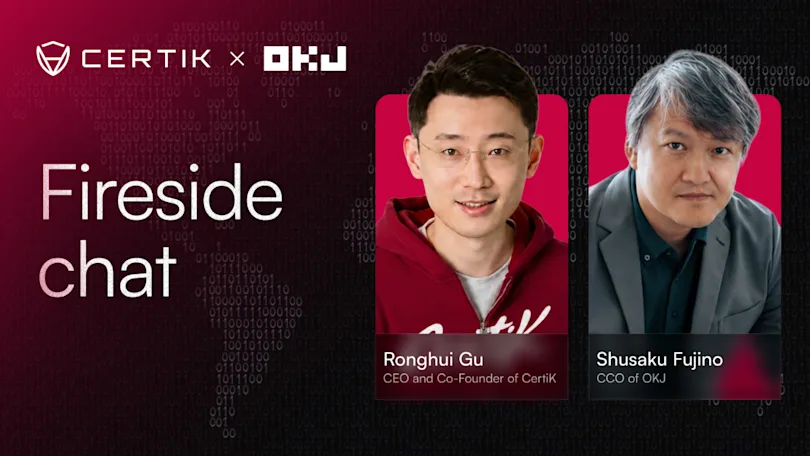
Trust remains one of the most important foundations of the crypto industry, especially for exchanges responsible for safeguarding user assets in an increasingly complex threat environment. During a recent fireside chat, Ronghui Gu, Founder and CEO of CertiK, joined Manfred Chew of CoinW alongside moderator Saul Hudson of Angle 42 to discuss the evolving cybersecurity landscape, the growing role of AI in crypto security, and what it takes to build long-term user confidence in digital asset trading.
The discussion highlighted a broader reality facing the industry today: security has become a core requirement for adoption. Keep reading to learn more about the key takeaways from the fireside chat.
Security as a Core Industry Requirement
For CoinW, security is fundamental to the exchange’s philosophy and long-term strategy. “Security itself is not a function; it’s a need,” Manfred said. “We cannot compromise in terms of security.” That mindset reflects the increasing pressure exchanges face as both institutional and retail users demand safer trading environments while cyber threats continue to evolve at a rapid pace.
From CertiK’s perspective, building that confidence requires more than simply securing smart contracts. Professor Gu explained that trust is built through a combination of infrastructure security, transparency, communication, and ongoing collaboration across the industry. “In terms of confidence, I would say it’s very, very hard to build,” Professor Gu said. “It took a lot of effort and it’s an endless war.”
The Cybersecurity Threat Landscape Is Expanding
Throughout the conversation, AI emerged as one of the most significant forces reshaping cybersecurity across the crypto industry.
Professor Gu shared data from CertiK’s Hack3D reports, noting that financial losses from crypto-related security incidents nearly doubled from 2024 to 2025. In April 2026 alone, there were reportedly only three days without a publicly disclosed hacking event.
At the same time, the nature of attacks is evolving. According to Professor Gu, vulnerabilities tied directly to smart contracts have declined as security practices across the industry have matured. However, attackers are increasingly shifting toward other vectors, including supply chain attacks, private key compromises, and social engineering campaigns.
“We firmly believe that AI definitely empowered many of these attacks,” Professor Gu said. As AI tools become more sophisticated and accessible, attackers are able to scale phishing campaigns, automate exploit discovery, and identify operational weaknesses more efficiently than before. This changing environment is forcing security firms and exchanges alike to rethink how they approach defense.
Moving Beyond Smart Contract Security
One of the key themes of the fireside chat was the growing need to expand Web3 security beyond traditional smart contract auditing. Professor Gu explained that, while smart contract security remains critical, the industry must now place far greater attention on operational security, monitoring systems, and real-time threat detection.
“We need to expand our defense solutions from smart contracts and so on to operational security and also try to strengthen the monitoring system,” Professor Gu said. To help address these emerging risks, CertiK recently introduced AI Auditor, designed to integrate security earlier into the development lifecycle. Rather than relying solely on milestone-based audits before deployment, the goal is to help developers identify vulnerabilities continuously throughout development.
Transparency and Communication Build User Trust
Beyond technical defenses, both speakers emphasized that transparency plays a major role in strengthening user confidence.
Professor Gu pointed to public audit reports, Proof of Reserve initiatives, and security rating systems as important tools for helping users better understand the security posture of the platforms they interact with. “That’s why we publish all of our audit reports,” Professor Gu explained. CertiK’s Skynet platform was also highlighted as part of this effort, providing users with accessible security insights and risk ratings across Web3 projects.
Communication, Professor Gu noted, is equally important. “Transparency, communication, and cybersecurity technology” together form the foundation for building trust, he said. Manfred echoed that sentiment from the exchange perspective, emphasizing the importance of user education alongside infrastructure security.
Preparing for the Next Era of Web3 Security
As the fireside chat concluded, the discussion shifted toward the future of institutional adoption and the broader maturation of the Web3 industry.
Professor Gu reflected on how much the ecosystem has evolved since CertiK was founded in 2017, when there were few established security standards, limited regulatory clarity, and little consensus around best practices. Today, the industry is entering a new phase shaped by clearer compliance frameworks, growing institutional participation, and rapidly evolving AI technologies.
For both CoinW and CertiK, that future will depend on continued collaboration between exchanges, infrastructure providers, security firms, and developers working together to strengthen trust across the ecosystem. As AI-driven threats continue accelerating, the conversation made one thing clear: building secure and transparent infrastructure will remain essential to the long-term growth of Web3.