
Services
Formal verification for Web3 security
Mathematically prove your smart contract and blockchain protocol works as intended. No more best effort reviews, leaving undiscovered vulnerabilities. CertiK's pioneering technique of using formal verification as part of its smart contract audits helps uncover all possible vulnerabilities in your code.
From startup launch to global enterprise
Security spotlights
CertiK received recognition from over 25 leading global companies for its significant contributions to security.

Delphinus Lab zkWasm
zkWasm developed by Delphinus Lab is the world’s first general-purpose zero-knowledge proof virtual machine that has been formally verified. CertiK discovered two critical bugs during the work.

TON
The Open Network (TON) has its Masterchain contract, the top layer of its chain consensus, formally verified by CertiK. Two subtle bugs were discovered during the work.

Ant Group HyperEnclave
HyperEnclave by Ant Group is a cross-platform trusted execution environment. Its core components have been formally verified by CertiK. The work has been accepted by ASPLOS'24 conference.

Cosmos SDK
Cosmos SDK is the world's most popular framework for building application-specific blockchains. CertiK formally verified its standard Bank module, a first for L1 modular frameworks.
Ethereum Foundation grant, Rocq tactics
Under an Ethereum Foundation grant, CertiK delivers "Better Rocq tactics" that streamline modular arithmetic and packed integer handling for zkVMs.
Scope
Better security for blockchains and smart contracts
Mathematically proven, effective auditing process for smart contracts and blockchain protocols, delivering more vulnerabilities than what the human eye can find.
Scale
Common Security Properties for popular smart contracts such as ERC-20 and ERC-721 have been automatically verified for hundreds of projects during their auditing.Precision
Advanced custom security and correctness properties, such as the increase-K property of AMM, have been specified and proved precisely for complex smart contracts in addition to their regular auditing.Coverage
In addition, CertiK also formally verifies other blockchain building blocks such as consensus protocol, etc. Basic systems infrastructure, such as Enclave Hypervisor, can also been formally verified.
Method
All audit processes are not created equal
Depending on the methodology, and experience, smart contract and blockchain protocol audits and process involved can yield different results. Having completed thousands of audits using highly accurate formal verification processes, it's no wonder CertiK is a leader in the industry.
- 90Most vendors and CertiK
Manual code review
A human review to try to spot errors. This is very flexible, but it’s best-effort, as you can never be sure you found all errors.
- 95Few vendors and CertiK
Automatic verification
Automatic verification of certain properties and issues e.g., reentrancy, or properties of ERC20 contracts.
- 100CertiK
Custom Formal Verification
Security specialists create machine-readable specification that are mathematically verified by CertiK's Custom Formal Verification system.
Why CertiK
Why CertiK?
Our in-depth evaluations of Web3 projects, exchanges, and wallets promote transparency and reliability in the industry. Discover how integrating CertiK's Skynet Score API can enhance the security and trustworthiness of your exchange or data services.
Benefits
Benefits of CertiK Custom Formal Verification
Tailored to the native languages running in your project
Highly customized for the features of your project, protocol, or virtual machine
Developed by a world-class team of academics, researchers, and engineers
FAQ
Questions, answered
Formal verification is a mathematical process used to prove that a smart contract or blockchain protocol behaves exactly as intended. Instead of relying solely on manual review, formal verification uses machine-readable specifications and theorem proving to check all possible execution paths, helping eliminate entire classes of vulnerabilities.
Traditional audits often rely on manual code review, which is flexible but inherently “best effort.” Formal verification goes further by mathematically proving that defined security and correctness properties always hold, ensuring that no undiscovered logical flaws remain within the specified scope.
Smart contracts are immutable once deployed, meaning that vulnerabilities can lead to irreversible losses. Formal verification provides mathematical guarantees about contract behavior, reducing risks and strengthening trust among users, investors, and ecosystem partners.
Formal verification can identify complex logical errors, subtle consensus flaws, incorrect arithmetic handling, reentrancy risks, token standard inconsistencies, and protocol-level edge cases that may not be detectable through manual inspection alone.
CertiK’s Custom Formal Verification involves security specialists creating precise, machine-readable specifications tailored to a project’s unique logic. These specifications are mathematically verified using CertiK’s proprietary systems, delivering the highest level of assurance beyond automated checks.
CertiK automatically verifies common properties for widely used smart contract standards such as ERC-20 and ERC-721. This includes checks for token behavior consistency, access control constraints, and common exploit patterns.
Yes. CertiK formally verifies blockchain building blocks, including consensus protocols, masterchain contracts, modular frameworks, zkVM components, and even foundational infrastructure such as enclave hypervisors.
By mathematically analyzing all possible execution paths, formal verification increases coverage beyond what human reviewers can realistically achieve. It ensures that specified properties hold across every scenario, not just sampled test cases.
CertiK has completed thousands of audits using formal verification techniques and has contributed to the formal verification of major blockchain frameworks, zkVMs, and infrastructure components. Its pioneering approach enables projects to move from startup launch to enterprise-grade security with mathematically proven assurance.
Resources
Learn more from our resources
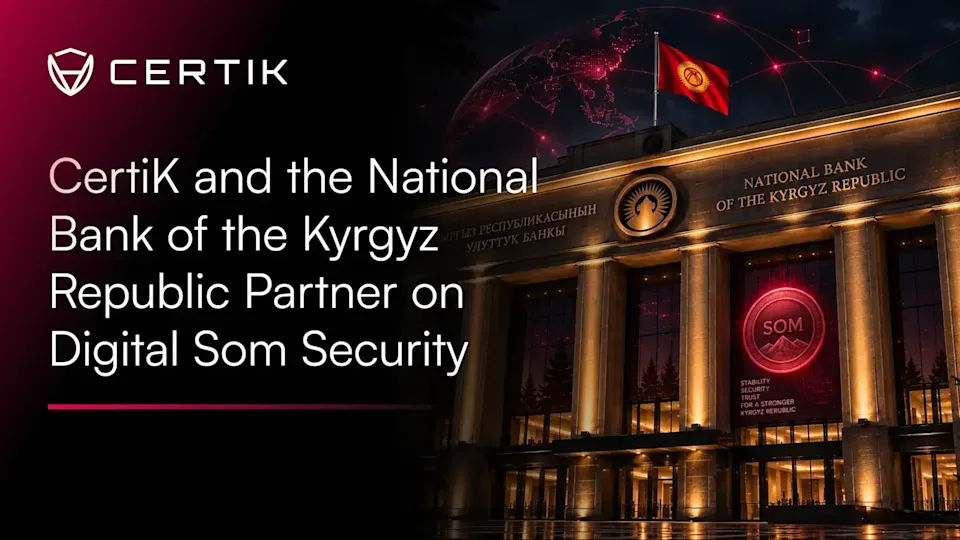 Policy pulseHow Central Banks Secure Digital Currency before Launch: Inside the CertiK and NBKR DealKyrgyzstan’s central bank is developing a digital version of its national currency, the Digital Som. On 9 September 2026, it signed a Memorandum of Understanding with CertiK, the largest Web3 security services provider, on Digital Som security and broader digital asset oversight. The partnership spans security assessment, formal verification, operational resilience, and ongoing risk monitoring, connecting technical security with longer-term risk management and regulatory oversight.
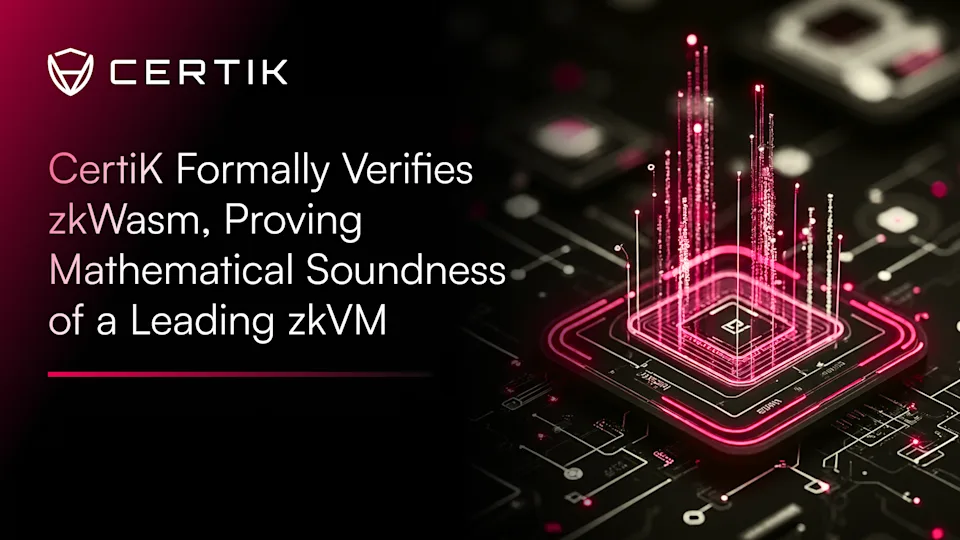 Company updatesCertiK Formally Verifies zkWasm, Proving Mathematical Soundness of a Leading zkVMCertiK’s formal verification of zkWasm provides mathematical proof that a leading zero-knowledge virtual machine executes programs correctly — a rigor level beyond traditional audits, now validated for ACM CCS 2026.
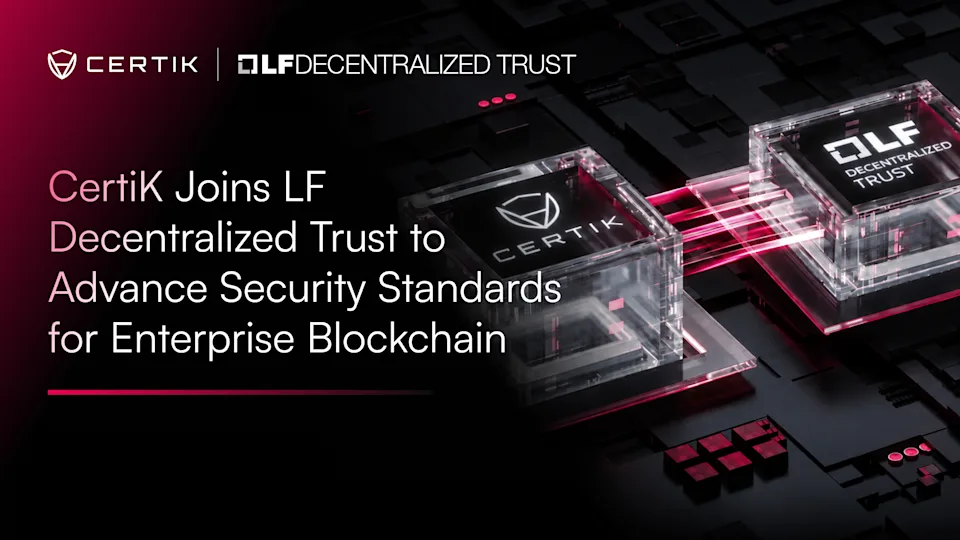 Company updatesCertiK Joins LF Decentralized Trust to Advance Security Standards for Enterprise BlockchainCertiK joins LF Decentralized Trust to bring formal verification and security expertise into the open-source infrastructure enterprises are building on amid intensifying global regulation.
 Company updatesCertiK Sponsors the First Theorem Proving Competition, Supported by OpenMathThe first Theorem Proving Competition, hosted by the China Computer Federation (CCF) officially launched. The competition is supported by OpenMath, the world’s first decentralized mathematical platform, with backing from Shentu Chain and CertiK.
 Policy pulseStablecoin Regulation and the GENIUS Act: A Case for Formal VerificationAs Web3 adoption continues to accelerate, many central banks and institutions are developing digital asset products, such as stablecoins, to support the stability of existing blockchain ecosystems while offering transparency, speed, and flexibility. However, such stablecoin innovations must win user trust, meet regulatory requirements, and integrate with existing Web3 systems in order to acquire mainstream adoption. In the context of rigorous compliance frameworks, formal verification is a promising methodology to help build reliable stablecoin contracts by verifying essential compliance requirements.
 Technical insightsAdvanced Formal Verification of ZKP: How ZK Memory Was ProvenIn this post, we will discuss some interesting technical points that arise along our journey of verifying the zkWasm memory subsystem. The memory is the most distinctive part of a zkVM, so handling this well is a crucial point relevant for all other zkVM verification projects as well.