
Blog
All blogs
CertiK provides educational content including blogs and case studies on Web3 security blockchain audits and compliance for developers and users.
 Research reportsMobius Token Incident AnalysisOn 11 May 2025, our system detected a suspicious attack involving Mobius Token #MBU on Binance Smart Chain #BSC, which resulted in an approximate loss of $2.16M
 Company updatesCertiK at Consensus 2025: Attendee GuideAs a leading Web3 security company and an important sponsor of this conference, CertiK sincerely invites Web3 participants from all over the world to attend to learn more about our cutting-edge security research, discuss the future of Web3, and promote industry security. This guide will take you through CertiK’s exciting activities at Consensus 2025 and help you efficiently plan your interactive itinerary with us.
 Technical insightsPancakeSwap Infinity: Hooks Security ConsiderationsThis article discusses some of the new features of PancakeSwap Infinity, and explores the security considerations related to PancakeSwap Infinity hooks.
 Technical insightsPectra’s EIP-7702: Redefining Trust Assumptions of Externally Owned Accounts (EOAs) in EVMIn this post, we examine how EIP-7702 reshapes core EVM assumptions, spotlight mocked examples, and provide actionable guidance for developers to assess whether their existing contracts may be vulnerable.
 Technical insightsOracle Wars: The Rise of Price Manipulation AttacksIn this article, we look at how oracles work, why they matter, how they can be exploited, and more, with the goal of educating DeFi participants on how to better protect themselves from these types of threats.
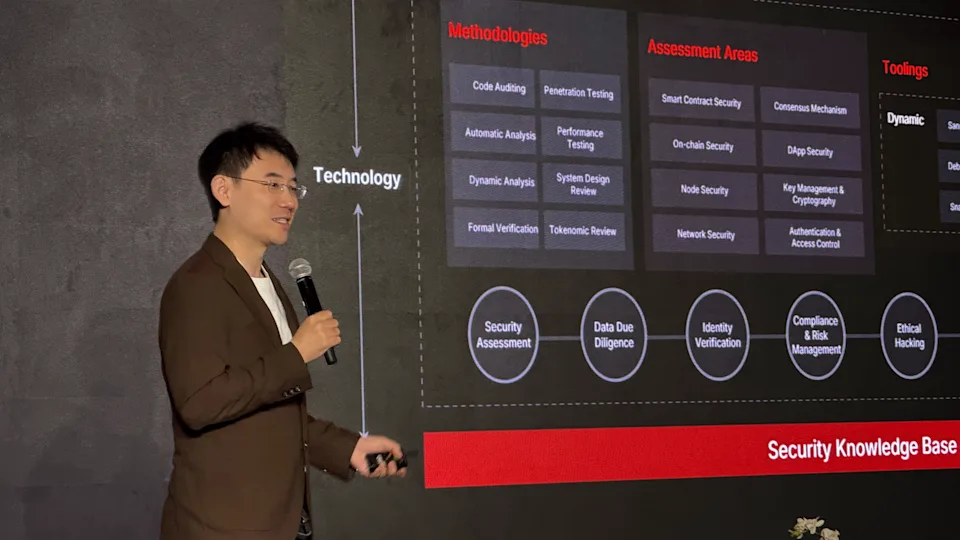 Policy pulseCertiK Co-founder Ronghui Gu Speaks at Unchained Summit on Web3 Security and ComplianceRonghui Gu, Co-founder of CertiK and Associate Professor of Computer Science at Columbia University, delivered a Keynote speech at Unchained Summit Dubai 2025, emphasizing the important balance between Web3 innovation and security.
 Technical insightsEVM – Cosmos Convergence Research From Security Base: Part 1Ethereum and Cosmos, two prominent blockchain protocols, have long pursued integration through solutions like EVM compatible chains built on Cosmos SDK (e.g. evmos/Ethermint), followed by the emerging consensus-layer (CL) swaps (e.g. Tendermint replacement for Ethereum PoS) in EVM compatible chains. This series unpacks their technical approaches and associated security trade-offs, providing an in-depth exploration of the convergence of these ecosystems.
 Technical insightsMove for Solidity Developers I: Storage and Access Control“Move for Solidity Developers” is a series created for experienced Solidity developers who already know a bit about Move. It helps you shift from writing Solidity contracts to developing on Move-based blockchains, such as Aptos and Sui. In this first installment, we’ll explore how Move’s approach to state storage and access control differs from the Solidity/EVM model. By drawing comparisons and analogies, we aim to make these new concepts feel familiar.
 Technical insightsA “Long Overdue” innovation in Cardano: Interoperable Programmable Token DesignAs CIP-113 advances toward finalization, CertiK is closely tracking its progress—a milestone that could reshape how developers build and enterprises engage with Cardano. This article explores the specification in depth, covering its background, the problems it addresses, its implementation, its impact on the Cardano ecosystem, comparisons with ERC-20, and security considerations.
 Research reportsMagic Internet Money Incident AnalysisOn 25 March 2025, MIM Spell was exploited for 6,261.13 ETH (~$12.9M) due to a vulnerability in the integration of the RouterOrder and Cauldron contracts. The attacker was able to borrow funds, liquidate themselves then borrow funds again without repaying them. This was due to the liquidation process not overwriting records in RouterOrder that counted as collateral, allowing exploiter to falsely borrow additional funds after liquidation.
 Research reports0xInfini Incident AnalysisOn 24 February 2025, 0xInfini was targeted by an attack that resulted in a loss of ~$49M. A key wallet used in the attack had previously been involved in the development of Infini contracts and had retained admin rights which were used to redeem all Vault tokens.
 Research reportsBybit Incident Technical AnalysisOn Feb-21-2025 at 02:16:11 PM UTC, the Bybit’s cold ethereum wallet was drained due to a malicious contract upgrade. This exploit resulted in an estimated loss of approximately $1.46 billion, marking the largest breach in Web3 history.